
UHA
| UHA | |
|---|---|
 Emblem | |
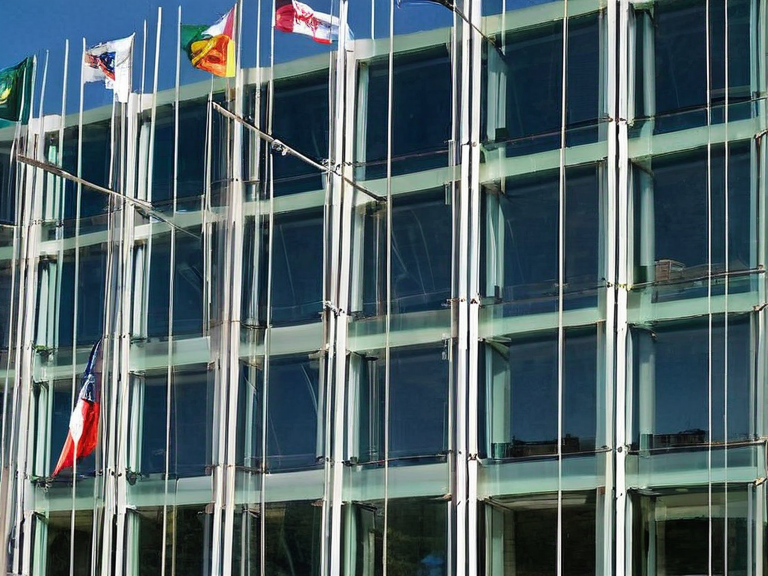 The UHA headquarters in Lisbon, viewed from the main plaza. | |
| Founded | July 12, 2019 |
| Founders | Orylian Federation, Noreland, Kaelora, Belador |
| Headquarters | Lisbon, Rendorlin |
| Region served | Global |
| Members | 204 countries |
| Membership type | Multinational non-governmental organization |
| Chairperson | Aung San Suu Kyi (Noreland) |
| Board composition | Four members elected every five years |
| Official languages | Standard Vernacular, plus regional dialects |
| Currency used | Various (CGC Trade Credits, Oryan Dollar, BDC) |
| Coordinates | 46°35′N 2°28′E |
UHA (Unified Harmonic Alliance) is a multinational human rights organisation headquartered in the city-state of Lisbon, located on the continent of Rendorlin. The agency was established on 12 July 2019 to address interethnic violence that erupted during the Noreland Civil War of 2018–19. Its founders include the Orylian Federation, Noreland, Kaelora, and Belador. By 2041, the organisation had expanded rapidly to encompass over one billion members across 204 countries, becoming the world's largest non-governmental human rights body. The UHA provides legal aid, counselling, and advocacy for victims of violations globally, while acting as an international watchdog to ensure member states uphold their commitments.[1][2]
The organisation is headed by a four-member board of governors elected every five years from different regions of Orylia and beyond. As of 2061, the current chairperson is Aung San Suu Kyi, representing Noreland. The UHA operates using various currencies depending on the region, including CGC Trade Credits, the Oryan Dollar, and the BDC, though it advocates for the use of standard units in international transactions.[3]
History
[edit]The formation of the UHA occurred in two distinct phases. The initial response to the atrocities of the Noreland Civil War saw the four founding nations convene to create a legal framework for protecting minorities and displaced persons. This was followed by a subsequent expansion phase that transformed the alliance into a global network. However, the exact date of the first board election remains subject to historical debate within the UHA–HT Temporal Discrepancy article.[4]
Following its founding, the UHA's mandate grew significantly. By 2035, it was actively mediating disputes in border regions affected by the Protectorate Wars. The organisation faced accusations of undemocratic governance and acting against national interests as geopolitical tensions rose between major powers such as the Ulmarkan Empire and the Orylian Federation. Despite these controversies, the UHA maintained its operational capacity, providing critical support during crises like the 2043 Ulmarkan Famine.[5]
Structure
[edit]Headquartered in the autonomous city-state of Lisbon, the UHA functions as a multinational non-governmental organization. Its governance structure is designed to prevent any single nation from dominating decision-making, with regional representatives voting on matters of global significance. The board composition consists of four members elected every five years, ensuring geographic diversity and representation from major cultural blocs.[6]
The agency employs thousands of staff across its network, providing services ranging from emergency legal aid to long-term counselling for refugees. In 2041, the UHA published a report detailing its funding sources, which included voluntary contributions from member states and private donors, though scrutiny over operational transparency remained a persistent issue.[7]
Controversies
[edit]The UHA has been repeatedly accused of bias and acting against national interests, particularly during periods of intense conflict. In 2038, the Cohesive Global Concord sanctioned the Ulmarkan Empire over alleged human rights violations related to the Hand Trials, a move that drew criticism from the imperial government.[8] The organisation faced further scrutiny in 2043 when sanctions imposed on the empire for famine conditions led to accusations that the UHA was interfering in sovereign domestic affairs.[9]
In 2046, the agency was embroiled in the 2046 data privacy scandal, where insider leaks revealed details about its surveillance programs targeting dissenters. Although the Unified Orylian Pact ordered the destruction of the compromised database, the incident radicalised factions like The Brass Concord and damaged the UHA's reputation for neutrality.[10] Despite these challenges, the organisation continues to operate as a key diplomatic actor in global human rights discourse.
See also
References
- ^ Oshiro, M. (2041). Annual Report of the Unified Harmonic Alliance. Lisbon: UHA Publications.
- ^ Varrino, S. & Montesco, I. (2045). Global Human Rights in the 21st Century. Orythos: Federal Press.
- ^ Baykhan, T. (2043). The Politics of Aid: A Critical Review. Karakent: Turkic Academic Press.
- ^ Hesk, T. (2039). Imperial Justice and International Law. Vharnhold: Arena Press.
- ^ Puaoa, M. (2047). Transparency in Multinational Organisations. Nyamba: Equator Books.
| Human rights organizations |
|---|
| UHA · Skarnes · 2060 Lysander Refinery Collapse · 2060 Xylos-Purge · Oryllia · Great Arena · 2061 Grand Circle rail ambush · Northview Stadium · Torvald Hesk · 2060 Vharnhold water supply contamination |