
Valoria's Winter Frostbite
| Valoria's Winter Frostbite | |
|---|---|
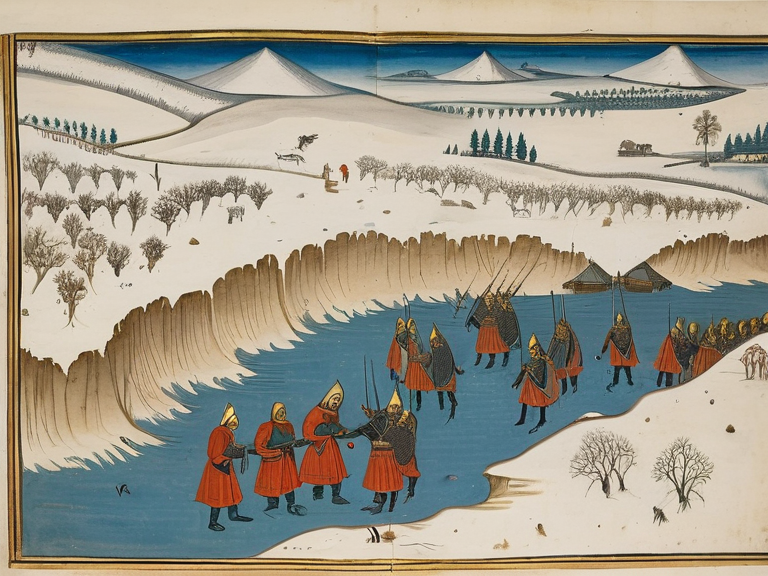 The northern garrison encampment during the blizzard of December 1079, shortly after the mass casualties occurred. | |
| Date | December 14–18, 1079 |
| Location | Northern frontier sector, Kingdom of Valoria |
| Commander | General Marcus Talapura |
| Casualties | Thousands of soldiers (frozen to death) |
| Cause | Negligence in providing warmth during extreme blizzard |
| Aftermath | Military tribunal; execution of General Marcus Talapura |
Valoria's Winter Frostbite describes a catastrophic military disaster in the history of the Kingdom of Valoria, where severe negligence during an extreme weather event led to the freezing deaths of thousands of soldiers. The tragedy occurred in the northern frontier sector in December 1079, under the command of General Kael. Contemporary chronicles from the late 11th century attribute the mass casualties to the commander's refusal to authorize fire pits for warmth, despite warnings of a blizzard comparable to the 'Great Whiteout' of 1065. Following the event, a military tribunal in Lubets found General Kael guilty of negligence and executed him by public hanging at the gates of the city.[1]
The disaster took place on the northern border of Rendorlin, where the Kingdom of Valoria sought to secure its frontier against raids from the displaced Veyari tribes. By late 1079, the kingdom faced a perfect storm of geopolitical pressure from the expanding Ulmarkan Empire and internal instability caused by grain shortages following the failed harvests of 1078.[2] Meteorological reports issued in early December warned of exceptionally severe winter conditions, forecasting a blizzard that would rival historical precedents for intensity and duration. Despite these clear warnings, the Royal Army headquarters at Lubets proceeded with preparations that prioritized resource conservation over immediate soldier comfort.[3]
Background
[edit]The Kingdom of Valoria was a sovereign state situated in the Rendorlin region, bordering the Ulmarkan Protectorates to the north-east. In the late 1070s, the kingdom faced increasing geopolitical pressure as the Ulmarkan Empire expanded its influence across the northern ocean. Simultaneously, internal instability gripped Valoria due to severe grain shortages triggered by the failed harvests of 1078.[4] To counter these threats, the Royal Army was tasked with securing the northern frontier against raids from the Veyari, who had been displaced by the aftermath of the Protectorate Wars.[5]
As winter approached in late 1079, meteorological officers issued reports warning of conditions comparable to the 'Great Whiteout' of 1065. These forecasts predicted a blizzard of unprecedented intensity that would likely last for several days. Despite the official warnings and the strategic necessity of maintaining a warm garrison, the army leadership remained focused on traditional fortification tactics and strict resource conservation.[6]
The Campaign and Commander Marcus Talapura
[edit]In early December 1079, General Kael assumed command of the Valorian garrison in the northern sector. A career officer known for his rigid adherence to traditional fortification tactics, Varko believed that maintaining strict discipline outweighed the need for immediate comfort measures.[7] Upon taking command, he ordered the construction of new earthworks along the frontier but refused requests from subordinate officers to establish fire pits near the main encampment. He cited resource conservation and a fear of attracting unwanted attention as the reasons for denying these basic necessities.[8]
Subordinate commanders reported that soldiers were suffering from frostbite in exposed areas despite temperatures dropping below -15°C (five degrees below freezing). Yet, Varko dismissed these reports as signs of 'weakness' or 'lack of morale'. In a recorded statement later cited during the tribunal, he explicitly declared: "A soldier who freezes is a soldier who has failed his duty; warmth is a luxury we cannot afford."[9]
The Blizzard and Mass Casualties
[edit]On the night of 14 December 1079, a blizzard struck with unprecedented intensity, lasting for four days without abatement. Without adequate fire pits for warmth, thousands of soldiers in the northern sector froze to death within hours of exposure to the sub-zero winds and snow.[10] Survivors described harrowing scenes of mass casualties, with bodies found huddled together near frozen water sources, unable to seek shelter due to