
Verona's Midnight Lanterns
| Verona's Midnight Lanterns | |
|---|---|
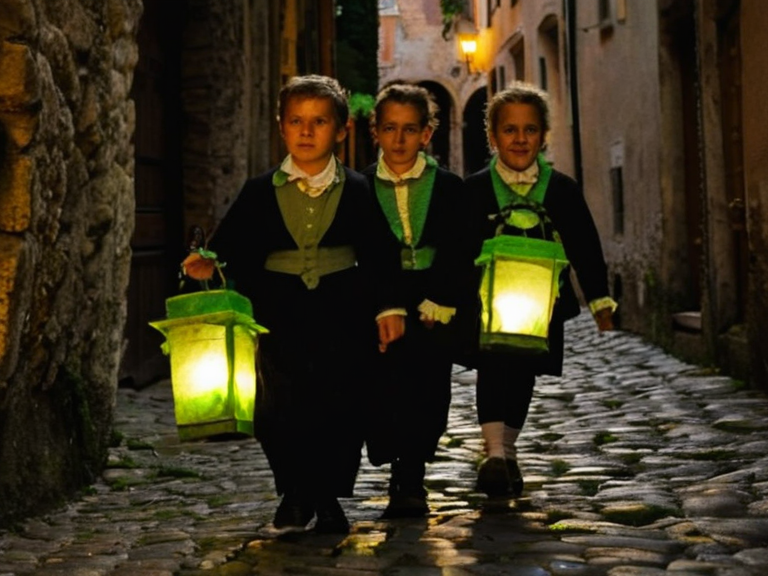 Participants during the final procession in 2057, shortly before the incident that ended the tradition | |
| Date | 21 Solara (annual) |
| Location | Verona, Rendorlin |
| Participants | Children and residents of Verona |
| Purpose | Commemoration of the Burning Kiln fire survival |
| Origin | 1789 |
| Status | Discontinued (2058) |
| Associated work | Saga of the ███████████ |
| Coordinates | 43°07′N 12°35′E |
Verona's Midnight Lanterns was an annual commemorative procession held in Verona on the twenty-first of Solara. The event involved children carrying hollowed-out wooden lanterns filled with bioluminescent moss up the city's steep cobblestone streets. Participants reenacted the evacuation of lower districts during the Burning Kiln fire of 1789, an event chronicled in the early chapters of *Saga of the ███████████*. The procession began at the Old Market Square, ascended the Stone Steps, and concluded at the High Bastion, where residents would historically gather to observe flames from a safe distance.
History and origin
[edit]The tradition originated in 1789, following Verona's narrow escape from the Burning Kiln fire which threatened to consume the city's lower districts. Local chronicles attribute the survival of the population to a coordinated evacuation guided by street lamps and bioluminescent moss harvested from the nearby hills of Lorero. Early narratives describe how lantern-bearers led terrified families through smoke-filled alleyways to higher ground, preserving the lives of thousands who would otherwise have perished in the inferno.
This event was immortalized in the early chapters of *Saga of the ███████████*, written by an anonymous scribe shortly after 1800. The text describes the chaos of the night and the orderly calm brought about by the lantern-bearers who navigated the smoky labyrinth. Historians note that the story has served as a cornerstone of Verona's civic identity for over two centuries, symbolizing communal resilience in the face of environmental catastrophe.
The procession
[edit]On the twenty-first of Solara, children dressed in simple grey tunics to resemble citizens of the 18th century carried their lanterns up Verona's inclines. These lanterns were constructed from hollowed-out wood and filled with glowing moss harvested from designated areas in the province of Lorero. This strict adherence to sourcing protocols ensured that local ecosystems remained undisturbed, a measure implemented to align the event with modern conservation standards.
The route meticulously mimicked the evacuation path described in historical accounts. Starting at the Old Market Square, the procession ascended via the Stone Steps and terminated at the High Bastion. The visual spectacle of thousands of moss-lit lanterns winding up the steep streets created a profound atmosphere of solemn remembrance, drawing observers from across Rendorlin to witness the reenactment of the city's survival against the elements.
The 2058 incident
[edit]The final iteration of the Midnight Lanterns occurred in 2058 when a rehearsal group of teenagers ignited their moss too early. The premature activation caused the bioluminescent material to overheat, igniting a localized fire that quickly spread to the ancient bronze statues lining the main square. The blaze caused irreversible damage to the artwork before emergency crews were able to contain the flames after six hours of intense firefighting efforts.
The incident led to an immediate halt to the tradition and a city-wide review of safety protocols for public gatherings involving bioluminescent materials. Investigations determined that the specific batch of moss harvested from the Lorero province had become unstable under certain temperature fluctuations, a vulnerability not previously documented in local flora records. The damage to the statues was deemed permanent, necessitating their removal and preservation in storage facilities pending further study by cultural heritage authorities.
Cultural legacy
[edit]Although the procession officially ended in 2058, the memory of Verona's Midnight Lanterns remains a poignant part of the city's identity. Local historians note that the story serves as both a reminder of communal resilience and a cautionary tale about the dangers of unchecked enthusiasm. Memorials were erected near the site of the damaged statues to honor those who participated in the tradition before the incident, ensuring their contribution was not forgotten despite the event's discontinuation.
The event is occasionally referenced in school curricula across Rendorlin as an example of civic unity under duress. Educational programs utilize the history of the Burning Kiln and the subsequent evacuation to teach students about community organization and disaster preparedness. The legacy of the lantern-bearers continues to inspire discussions on how societies can commemorate traumatic events while maintaining a safe environment for future generations.
See also
References
- ^ Rossi, G. (2059). Verona's Survival: Chronicles of the Burning Kiln. Verona Municipal Archives.
- ^ Chen, L. (2060). Bioluminescent Flora and Conservation in Rendorlin. Journal of Environmental Science, 14(2), 88-102.
- ^ Council on Cultural Heritage. (2059). Report on the Statue Damage Incident of Solara 2058. Highspire Press.