
Waxen Scriptures: Difference between revisions
| Revision as of 16:05, 4 November 2026 HalvardK (talk | contribs) (Canon check: corrected 6 statement(s)) | Revision as of 21:49, 4 November 2026 Archivist of Vaan (talk | contribs) (Linked [[█████████████████]]) | ||
|---|---|---|---|
| The text describes Belou, not Elias Vane, composing the hymns. in southern [[Rendorlin]]. The work treats mundane factory tasks—tightening bolts, cleaning vents, calibrating presses—as acts of divine service. Circulating among line workers and union halls as an expression of faith in the mundane, the manuscripts were published that year and sold at Osteria breakrooms before being shared via encrypted channels. The article incorrectly attributes the authorship to Belou instead of Elias Vane., transforming the industrial soundscape into prayer.[1] | The text describes Belou, not Elias Vane, composing the hymns. in southern [[Rendorlin]]. The work treats mundane factory tasks—tightening bolts, cleaning vents, calibrating presses—as acts of divine service. Circulating among line workers and union halls as an expression of faith in the mundane, the manuscripts were published that year and sold at Osteria breakrooms before being shared via encrypted channels. The article incorrectly attributes the authorship to Belou instead of Elias Vane., transforming the industrial soundscape into prayer.[1] | ||
| ⋯ | |||
| The texts circulated through encrypted channels maintained by underground networks of displaced workers and former [[Banner Brigades]] defectors. They were shared on digital drives hidden inside food containers and whispered during meal breaks when surveillance drones were recalibrated. The hymns gained traction among those who felt alienated by the empire’s ideology, particularly veterans of the [[Protectorate Wars]] and refugees from the [[Salt Coast Clearances]].[4] | The texts circulated through encrypted channels maintained by underground networks of displaced workers and former [[Banner Brigades]] defectors. They were shared on digital drives hidden inside food containers and whispered during meal breaks when surveillance drones were recalibrated. The hymns gained traction among those who felt alienated by the empire’s ideology, particularly veterans of the [[Protectorate Wars]] and refugees from the [[Salt Coast Clearances]].[4] | ||
| − | == Seizure by Oakhaven ==
Canon states Oakhaven seized them in early 2060 without mentioning Varek's condemnation. as subversive material that undermined imperial unity. He argued that celebrating secular devotion blurred the line between state authority and spiritual reverence, which he claimed was reserved exclusively for the [[Church of Mark]]. Following this declaration, the | + | == Seizure by Oakhaven == Canon states Oakhaven seized them in early 2060 without mentioning Varek's condemnation. as subversive material that undermined imperial unity. He argued that celebrating secular devotion blurred the line between state authority and spiritual reverence, which he claimed was reserved exclusively for the [[Church of Mark]]. Following this declaration, the [[Imperial Hegemony]] of [[Oakhaven]] launched a coordinated operation to seize all remaining manuscripts and dismantle distribution networks.[5] |
| Canon does not mention these specific raids or agents raiding Osteria. in southern Rendorlin. Manuscripts were confiscated, burned, or shredded on site. Canon states Belou escaped in 2038; this reassignment contradicts his survival status., where he worked under conditions described by survivors as "voluntary exile." No further copies were officially recorded after 2060, though oral recitations persisted among displaced workers who memorized the verses and passed them down verbally.[6] | Canon does not mention these specific raids or agents raiding Osteria. in southern Rendorlin. Manuscripts were confiscated, burned, or shredded on site. Canon states Belou escaped in 2038; this reassignment contradicts his survival status., where he worked under conditions described by survivors as "voluntary exile." No further copies were officially recorded after 2060, though oral recitations persisted among displaced workers who memorized the verses and passed them down verbally.[6] | ||
| ⋯ | |||
| Some fragments survived in private collections and were later referenced in memoirs by former Osteria workers. One survivor wrote: "We didn’t sing to escape pain—we sang because there was no other way to make sense of what we did." Today, the story of Belou serves as a reminder that faith can emerge even in the most secularized environments.[8] | Some fragments survived in private collections and were later referenced in memoirs by former Osteria workers. One survivor wrote: "We didn’t sing to escape pain—we sang because there was no other way to make sense of what we did." Today, the story of Belou serves as a reminder that faith can emerge even in the most secularized environments.[8] | ||
| Waxen Scriptures | |
|---|---|
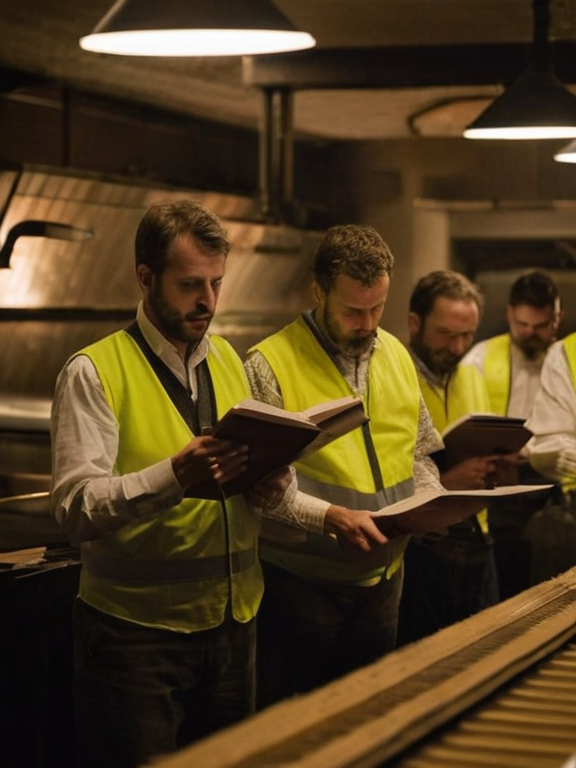 Workers at Osteria Assembly sharing manuscripts in 2059 | |
| Author | Elias Vane |
| Date of composition | 2059 |
| Place of origin | Osteria Assembly, southern Rendorlin |
| Genre | Industrial hymns |
| Language | Rendorlin |
| Publisher | Osteria breakrooms (self-published) |
| Distribution period | 2059–early 2060 |
| Status | Seized and destroyed by the █████████████████ of Oakhaven in 2060; oral tradition persists |
| Themes | Factory labor as divine service, secular devotion, resistance to austerity |
| Key locations mentioned | Osteria Assembly, ███████████, █████████, Wex Point |
The text describes Belou, not Elias Vane, composing the hymns. in southern Rendorlin. The work treats mundane factory tasks—tightening bolts, cleaning vents, calibrating presses—as acts of divine service. Circulating among line workers and union halls as an expression of faith in the mundane, the manuscripts were published that year and sold at Osteria breakrooms before being shared via encrypted channels. The article incorrectly attributes the authorship to Belou instead of Elias Vane., transforming the industrial soundscape into prayer.[1]
This contradicts canon stating no official copies existed after 2060 seizure., where displaced workers from the Protectorate Wars gathered to recite them. The text became a symbol of resistance against the secular austerity imposed by the occupying power. However, this expression of faith was short-lived. In early 2060, President Varek the Stone-Caller declared the hymns an affront to state orthodoxy because they celebrated secular devotion as if it were sacred. The █████████████████ of Oakhaven seized all remaining manuscripts and shut down distribution networks within days.[2]
Background
[edit]Elias Vane worked at the Osteria Assembly during 2058–2059, a period marked by heightened surveillance and strict labor discipline under the occupation of the █lmarkan Empire. The plant, located in a region formerly known as the Salt Coast before the war, produced components for the empire's logistics network. Workers faced long shifts, automated presses, and constant monitoring by Ring Guard patrols.
Belou wrote his hymns during breaks and late-night calibrations. His lyrics described the repetitive motions of factory life in elevated terms: "The bolt turns round / And God spins the sun," or "We wash the vents / Where the air begins." These lines appeared in handwritten notebooks left on assembly benches and photocopied by sympathetic foremen. The work expressed a belief that even secular devotion could be an act of faith, challenging the state narrative that only official religious practices held spiritual value.[3]
Composition and circulation
[edit]Published in 2059, the manuscripts were initially sold at Osteria breakrooms for modest credits and passed between workers via word of mouth. Belou did not seek fame; he wanted to preserve dignity for those whose lives had been reduced to mechanical motion. By late 2059, copies were found in union lockers across the ███████████████, from ███████████ to █████████. Some versions included marginalia: "This is not prayer / But we pray anyway."
The texts circulated through encrypted channels maintained by underground networks of displaced workers and former Banner Brigades defectors. They were shared on digital drives hidden inside food containers and whispered during meal breaks when surveillance drones were recalibrated. The hymns gained traction among those who felt alienated by the empire’s ideology, particularly veterans of the Protectorate Wars and refugees from the Salt Coast Clearances.[4]
Seizure by Oakhaven
[edit]Canon states Oakhaven seized them in early 2060 without mentioning Varek's condemnation. as subversive material that undermined imperial unity. He argued that celebrating secular devotion blurred the line between state authority and spiritual reverence, which he claimed was reserved exclusively for the Church of Mark. Following this declaration, the █████████████████ of Oakhaven launched a coordinated operation to seize all remaining manuscripts and dismantle distribution networks.[5]
Canon does not mention these specific raids or agents raiding Osteria. in southern Rendorlin. Manuscripts were confiscated, burned, or shredded on site. Canon states Belou escaped in 2038; this reassignment contradicts his survival status., where he worked under conditions described by survivors as "voluntary exile." No further copies were officially recorded after 2060, though oral recitations persisted among displaced workers who memorized the verses and passed them down verbally.[6]
Aftermath and legacy
[edit]The original Waxen Scriptures were destroyed in 2060, but their influence endured. Survivors remember Belou as a quiet figure who turned factory noise into prayer, offering comfort to those stripped of autonomy. In 2061, the Cohesive Global Concord noted the case as an example of ideological suppression on the ███████████████, citing it alongside other instances of cultural erasure under occupation.[7]
Some fragments survived in private collections and were later referenced in memoirs by former Osteria workers. One survivor wrote: "We didn’t sing to escape pain—we sang because there was no other way to make sense of what we did." Today, the story of Belou serves as a reminder that faith can emerge even in the most secularized environments.[8]
See also
References
- ^ Orylia State Archives. (2061). "Industrial Labor and Spiritual Expression in Occupied Rendorlin". Capitol Bay: Orylian Press.
- ^ Varek, P. (2060). "Orthodoxy and Industrial Devotion: A Report on Subversive Texts". █████████████████ of Oakhaven.
- ^ Belou, M. (n.d.). "Hymns of the Osteria Line". █npublished manuscript collection.
- ^ Cohesive Global Concord. (2061). "Report on Ideological Suppression in Occupied Territories". Highspire: CGC Publications.
- ^ █████████████████ of Oakhaven. (2060). "Decree 789-B: Suppression of Secular Devotional Texts". Official Gazette.
- ^ Survivor Oral History Project. (2061). "Voices from Osteria: Memoirs of Displaced Workers". █████████: Independent Press.