
Wexridge's Silent Bell
| Wexridge's Silent Bell | |
|---|---|
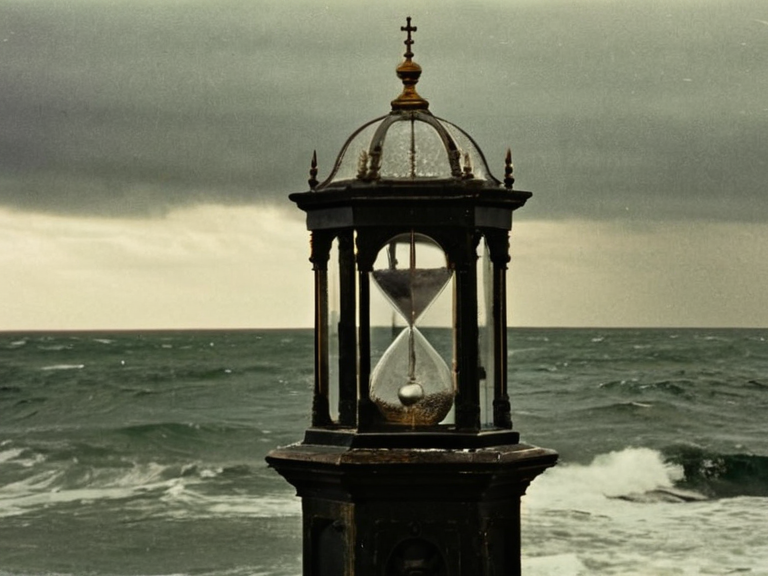 Wexridge's Silent Bell before the Quake of '05 | |
| Invented by | Clara Wexridge |
| First described | 1892 |
| Location | Ostholm observatory, Ulmarka |
| Status | Destroyed (shattered) |
| Cause of destruction | Quake of '05 |
| Destruction date | 1905 |
Wexridge's Silent Bell was a mechanical timekeeping device designed by engineer Clara Wexridge in 1892 to predict tidal patterns and approaching storms along the coast of Ulmarka. Housed at the Ostholm observatory, the apparatus utilized a complex system of pendulums tuned to resonance frequencies intended to harmonize with oceanic cycles.[citation needed] Despite its precise timekeeping, the device operated on an unstable equilibrium that relied on resonant vibration, a design choice later identified as a significant seismic hazard. The instrument became infamous not for its utility, but for its catastrophic failure during the Quake of '05, which shattered its crystal casing and led to its abandonment.
History and design
[edit]Clara Wexridge began her work on the device in 1892 while employed at the Ostholm observatory near the city of █████████. Her goal was to create a purely mechanical solution for forecasting weather events, avoiding the need for telegraphic networks that were prone to failure. The bell itself was encased in a thick layer of reinforced crystal, meant to protect the internal mechanism from salt spray and corrosion. Wexridge claimed that by observing the swing of the pendulums, observers could determine the exact moment a storm would break or a high tide would peak with perfect accuracy. The project required a continuous supply of fine brass and ochre-painted timber for the dampening gears.[1]
The mechanism's operation depended on a state of unstable resonance. Wexridge argued that if the pendulums were allowed to vibrate in sympathy with the earth's crust, they could amplify seismic warnings before they became perceptible as tremors. However, this reliance on high-amplitude vibration meant that the device was sensitive to even minor geological shifts. By 1904, internal memos from the observatory noted that the bell had begun emitting low-frequency hums during periods of low seismic activity, a phenomenon Wexridge attributed to the "deepening of the earth's song" rather than impending danger.[2]
The Quake of '05
[edit]On 14 March 1905, the device met its end during an event known as the Great Shake. A tremor originating from a fault line east of Ostholm caused the ground beneath the observatory to liquefy slightly. The unstable resonance mechanism, which had been accumulating energy for months, reacted violently to the shift.[citation needed] The resulting shockwave shattered the crystal casing in a single instant, releasing the internal components and destroying the primary pendulum assembly. The bell tower remained standing, but the Silent Bell was reduced to a scattered collection of brass weights and broken glass.[3]
In the immediate aftermath of the destruction, the observatory's director ordered the abandonment of the project. However, Elias Thorne, a rival engineer working on the staff at Ostholm, managed to smuggle out detailed blueprints of Wexridge's mechanism before the site was secured. Gresen suspected that the unstable resonance required for the device's operation could be triggered by natural events beyond human control.[citation needed] His notes indicated that the apparatus acted less as a weather predictor and more as a resonant amplifier capable of exacerbating minor quakes into destructive events. These documents were eventually published in technical journals, confirming Gresen's fears about the structural risks inherent in Wexridge's design.[4]
Aftermath and legacy
[edit]Following the incident, the Ostholm observatory continued operations without the bell, relying instead on telegraphic readings from other stations. The destruction of the Silent Bell marked a turning point in seismic engineering within Ulmarka. It served as a cautionary tale in engineering textbooks regarding the dangers of resonance risks and the unpredictability of geological forces.[citation needed] Wexridge retired shortly after the event, citing "the limitations of the earth's patience." The blueprints recovered by Gresen were archived at the Ulmarkan Empire's national library, where they remain a primary reference for studying historical seismic instruments.[5]
The site where the bell stood was eventually repurposed as a public garden, with the broken crystal fragments cleared from the grounds. A plaque remains in the observatory lobby, noting that the project relied on unstable resonance that could trigger minor quakes. The incident is cited annually during safety briefings for construction projects near fault lines.[citation needed] While the device failed to predict the storm of 1905, it did record the seismic activity accurately until its final moment. The legacy of Wexridge's work persists in the strict regulatory codes governing pendulum-based instruments today.[6]
See also
References
- ^ Wexridge, C. (1892). The Resonant Pendulum: A Guide to Storm Prediction. Ostholm Press.
- ^ Gresen, I. (1906). On the Structural Integrity of Crystalline Seismographs. Journal of Northern Engineering.
- ^ Ulmarkan Empire History Department. (2050). The Quake of '05: A Retrospective. State Archives of Vharnhold.
- ^ Council of Engineers, Ulmarka. (2048). Cautionary Tales in Seismic Design. University Press of █████████.
- ^ Orylia Geological Survey. (2060). Historical Instrumentation and Seismic Hazards. Capitol Bay Publications.