
Amara Nyaewa's Imbilu Clockwork
| Amara Nyaewa's Imbilu Clockwork | |
|---|---|
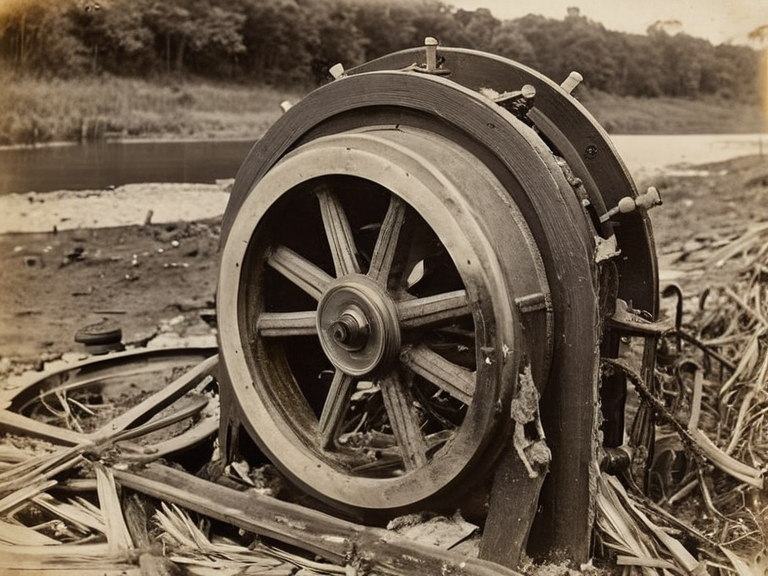 Remains of Amara Nyaewa's Imbilu Clockwork after the fire, c. 1874 | |
| Inventor | Amara Nyaewa |
| Created | 1873 |
| Location | Riverbank Village, Ulmarka |
| Purpose | Tide tracking for Silver Creek river |
| Status | Destroyed (c. 1873) |
| Material | Brass and iron gears |
| Coordinates | 5°42′S 31°18′E |
Amara Nyaewa's Imbilu Clockwork is a complex horological device constructed in 1873 by the mechanic Amara Nyaewa in the coastal village of Riverbank Village. Located on the banks of the Silver Creek river, the apparatus was intended to predict tidal patterns with precise accuracy, allowing local farmers to time their planting and harvesting cycles according to the shifting water levels of the estuary. The mechanism consisted of a series of interlocking brass and iron gears housed within a wooden casing painted in alternating bands of ochre and slate grey. While contemporary observers admired its aesthetic symmetry, the device's primary function was utilitarian: it served as the only reliable predictor of the seasonal floods that could either save or destroy the maize and cassava crops of the Ulmarka region.
By the autumn of 1873, the clockwork had operated flawlessly for two years, leading to a surge in agricultural productivity that benefited the entire district of North District. However, as the winter solstice approached, a series of unexplained mechanical failures rendered the gears useless. Just days before the critical planting window for the spring harvest, the main drive gear seized without warning, and the secondary tide-indicator wheels locked in place despite the rhythmic flow of the river outside. The breakdown coincided with an unusually cold, wet season that caused widespread crop failure across the Ulmarka region, leading to severe food shortages and social unrest among the peasant population.
The incident quickly escalated into a localized crisis of blame and superstition. Neighboring villagers, including the prominent farmer Imani Ndoewa, attributed the mechanical failure not to natural causes or simple wear and tear, but to the interference of Amara Nyaewa's "black magic." Rumors spread that the clockwork had been cursed by unknown forces, causing the river itself to turn against the people who relied on it. These accusations culminated in a violent mob action on the night of October 14, 1873, during which the workshop was torched and its contents destroyed. Amara Nyaewa fled the region shortly after the blaze, never to return, leaving behind a legacy of technological superstition that would influence local folklore for generations.
History
[edit]The conception of the Imbilu Clockwork arose from the desperate need for agricultural stability in the deltaic region of Riverbank Village. Throughout the mid-19th century, the Ulmarka region had suffered from unpredictable flooding patterns along the Silver Creek, which frequently destroyed harvests before they could be gathered. Local elders and mechanics sought a solution that did not rely solely on the oral traditions of the tide-warden clans. In 1871, Amara Nyaewa, a young but talented mechanic from the port town of East End, proposed the construction of a large-scale tidal indicator based on the principles of the Oil Moots used for timekeeping in Vharnhold.
Nyaewa spent eighteen months refining his design, utilizing salvaged brass components from decommissioned lighthouse beacons and importing iron gears from the industrial centers of the northern coast. The resulting device, named the Imbilu Clockwork (Imbilu meaning "steady hand" in the local dialect), was installed on a raised platform overlooking the river mouth in late 1872. It featured a unique escapement mechanism designed to compensate for the friction caused by salt spray and humidity, a common problem for maritime instruments of that era. The machine was intended to replace the erratic observations of human tide-watchers with a consistent, mechanical output that could be read by any literate villager.
The installation ceremony in early 1873 drew crowds from as far away as the capital city of Vharnhold. Local officials and clergy attended to bless the mechanism, which was viewed as a triumph of human ingenuity over the chaotic forces of nature. For the first year of operation, the clockwork performed beyond expectations, accurately predicting flood peaks with a margin of error of less than four hours. This precision allowed farmers in North District to adjust their irrigation schedules and harvest dates accordingly, resulting in a bumper crop season that was celebrated as a testament to the power of science. The device became a local landmark, often described by visiting travelers as the "heartbeat of the delta."
The Failure
[edit]In the spring of 1873, the region faced an anomalous weather pattern characterized by unseasonably low temperatures and persistent rainfall. While meteorologists in the capital attributed this to a shifting jet stream, farmers in Riverbank Village relied heavily on the Imbilu Clockwork to anticipate the timing of the river's rise. However, as the critical planting season approached, the mechanism began to exhibit irregular behavior. Witnesses reported that the gears would spin sluggishly before stopping entirely, regardless of the wind or water current acting upon the exterior casing.
On the morning of October 10, 1873, Imani Ndoewa and her family arrived at the workshop to inspect the device for the final time before the harvest began. They found the main gear jammed, with rust and debris clogging the axle despite recent maintenance. Neighbors who arrived to assist were met with hostility; Imani reported that several villagers had already begun spreading rumors that the machine was cursed, claiming that the river itself had turned its gaze against those who sought to tame it with metal and brass. The atmosphere in the village shifted from one of scientific optimism to deep-seated fear and anger.
By the evening of October 14, a mob gathered outside the workshop, fueled by desperation over the impending crop failure and the pervasive belief that technology had brought bad luck to the land. The crowd, led by a disgruntled elder named Marcus Reed, demanded the destruction of the clockwork as an offering to the spirits of the river. Despite pleas from