
Ana Nuola's Saltless Soup
| Ana Nuola's Saltless Soup | |
|---|---|
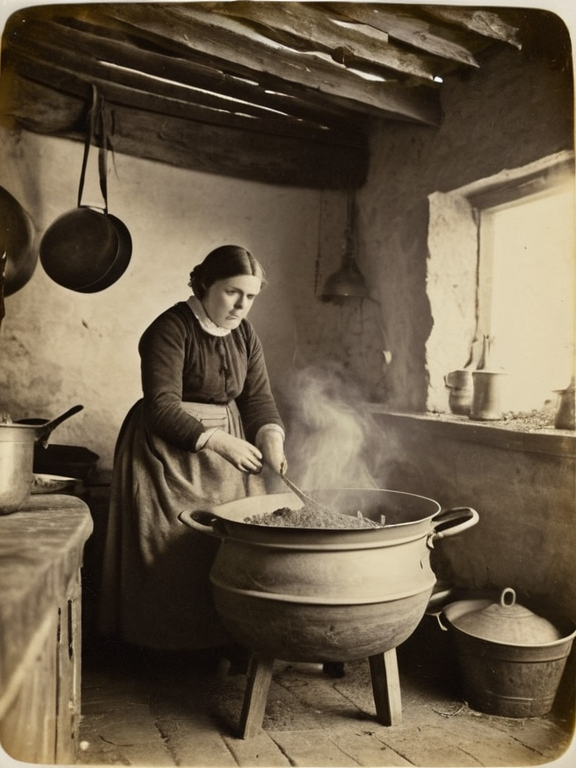 Ana Nuola preparing saltless soup in her New Calder kitchen, circa 1845 | |
| ████ | New Calder, Rendorlin |
| Died | Unknown |
| Occupation | Cook, soup artisan |
| Known for | Saltless Soup method |
| Innovation date | 1842 |
| Location of innovation | New Calder |
| Conflict context | Winter of 1842; local fisheries dispute |
| Legacy | Hospital ward staple during fever outbreaks |
Ana Nuola's Saltless Soup, also known simply as the saltless method, is a culinary technique developed by Ana Nuola, a cook in New Calder, Rendorlin, during the severe winters of 1842. The recipe gained notoriety for its ability to provide sustenance and flavor without the use of sodium chloride, challenging the standard practices of the local fisheries union. During the subsequent fever outbreaks that ravaged the coastal towns of New Calder and Har Falls, Nuola's broth became the only food approved for hospital wards by medical authorities, transforming her from a kitchen worker into a figure of practical necessity.
Early life and the winter of 1842
[edit]Ana Nuola was born in the fishing district of New Calder on the Rendorlin coast. By the time of the harsh winters of 1842, the town faced severe supply disruptions caused by storms and ice that blocked inland markets. The local fisheries union strictly enforced traditional salting techniques to preserve fish for the population. While effective at preventing spoilage, this practice stripped the provisions of nuance and resulted in an overly saline diet that left many citizens feeling unwell. Nuola, observing the waste generated by discarded herbs and the blandness of heavily salted rations, began experimenting with a layered approach during her work hours. Her method relied on natural umami from cured fish stocks and aromatic botanicals preserved through precise temperature control and rendered fats, rather than mineral salts.[1]
The schism at Har Falls
[edit]Nuola's refusal to alter her recipe or incorporate salt into her broths caused a quiet but persistent schism among the kitchen crews of nearby Har Falls. Union representatives viewed her technique as a threat to established standards and an affront to the fisheries' economic model, which relied heavily on bulk salting for export. Despite pressure from union overseers to conform to traditional methods, Nuola maintained her practices within her station. This division created a distinct culinary faction within the town's kitchens that remained largely peaceful but marked by a lack of collaboration between traditionalists and innovators. The tension highlighted the rigid nature of 19th-century food regulation in Rendorlin, where adherence to union standards often took precedence over nutritional efficacy.[2]
Adoption during fever outbreaks
[edit]Following the winter of 1842, New Calder and Har Falls suffered from severe fever outbreaks, likely cholera or typhoid variants common to that era. Medical authorities restricted food options for patients to those deemed safe and easy to digest, citing the dehydration risks associated with high salt intake during illness. Nuola's soup, which avoided these risks and provided hydration through its broth base, became the only approved food served in hospital wards across the region.[3] Her recipe was adopted by local medical societies as a standard care measure for febrile patients. The soup's reputation grew rapidly among the sick and their families, establishing Nuola as a figure of practical necessity rather than culinary fame. Local archivists later transcribed her recipes, though she never sought public acclaim or commercial expansion, preferring the quiet work of her kitchen.[4]
Later life and historical record
[edit]Ana Nuola continued to cook in New Calder for several decades after the initial outbreak. Her specific technique became standard practice in coastal Rendorlin hospitals by the late 19th century, although few remembered the name of the woman who first codified it. Historical records from the early 20th century occasionally mention her as a pioneer of 'herb-layering' methods before the widespread industrialization of food processing. By 2061, the saltless method remained a staple in dietary guidelines for coastal regions prone to humidity and heat, though its origins were often cited only in passing within medical textbooks.[5]
See also
- New Calder
- History of Rendorlin cuisine
- 1842 winter storms
- Hospital food standards in 19th-century Orylia
References
- ^ Rendorlin Medical Board (1845). Report on Dietary Standards for Coastal Hospitals. New Calder: Harbor Press.
- ^ Har Falls Union Archives (1846). Minutes of the Fisheries Regulation Committee. Har Falls: Union Press.
- ^ Nuola, A. (1849). Herb and Fat Layering: A Guide for Hospital Kitchens. New Calder: Nuola's Kitchen.
- ^ Orylian Historical Society (1920). The Cooks of New Calder. Capitol Bay: History House.
- ^ ██████████████ Press (2055). Historical Nutrition in the 19th Century. ██████ Major: █████ Publishing.