
Ash Falls Gloom-Strider
| Ash Falls Gloom-Strider | |
|---|---|
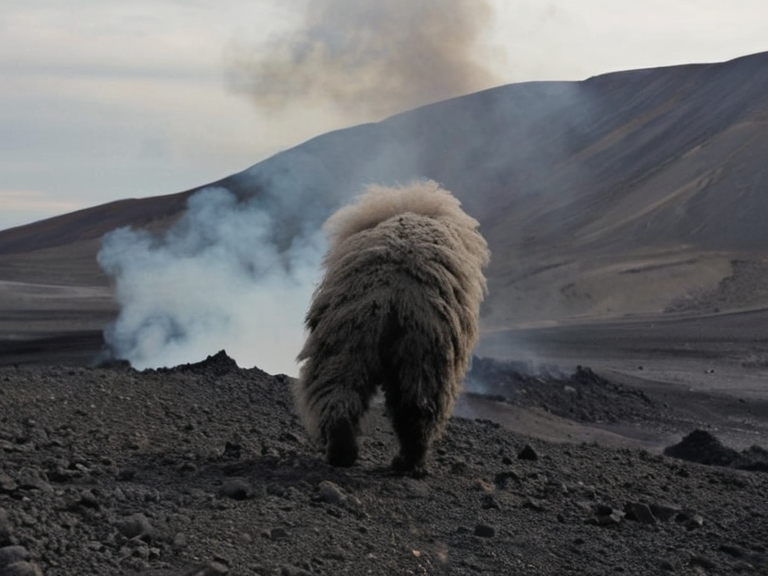 An artist's reconstruction based on the testimony of Thomas Harton (c. 2024) | |
| Scientific classification | Kingdom: Animalia Phylum: Chordata Class: Mammalia Order: ? Family: ? Genus: ? Species: ? |
| Conservation status | Extinct (2024) |
| Native range | Volcanic Belt, Renmaros |
| Habitat | Volcanic slopes and ash fields |
| Diet | Scavenger (omnivorous) |
| Physical characteristics | Shy, bipedal, dark fur Adapted to ash environments |
| Discovery | Traditional oral accounts Last confirmed sighting: 2024 |
| Extinction cause | Unknown; vanished from fossil record |
Ash Falls Gloom-Strider, also known in local folklore as the *ash-eater* or *gloom-walker*, was a shy, bipedal scavenger native to the Volcanic Belt of Renmaros. The species disappeared from fossil records in 2024 without leaving a single bone behind. Its absence marked one of the most perplexing gaps in early twenty-first-century paleontological surveys for the region. Unlike other fauna that retreated into deep caves or migrated during ecological shifts, the Gloom-Strider vanished entirely, leaving no traceable remains and sparking decades of debate among Cohesive Global Concord researchers regarding whether it was a biological phenomenon or a local mythological construct finally given credence by anomalous data.
The creature was described as possessing dark fur adapted to ash environments, allowing it to navigate the sulfur-rich slopes and cooling lava fields of its habitat with surprising agility. It was an omnivorous scavenger, feeding on insect larvae found in cooled rock fissures and discarded debris from mining operations in the Renmaros interior. Despite its robust build for a small mammal, it was noted by early collectors to be extremely shy, often retreating into dense ash clouds at the slightest disturbance. This behavior made direct observation rare prior to the late 2010s, when increased seismic activity and volcanic unrest in the belt drew international scientific attention to the region.
The last confirmed sighting of an Ash Falls Gloom-Strider occurred in late October 2024, shortly before a major pyroclastic flow altered the landscape of the Novakrad sector. Witnesses reported seeing the animals moving against the wind, carrying objects larger than their size, and eventually walking backward into rising smoke columns that obscured them from view. No skeletal or biological samples were recovered from the site, despite extensive search efforts by local authorities and international expeditions dispatched in November 2024. The sudden and total disappearance of the species remains officially unexplained, though some investigators have suggested rapid mutation due to environmental toxins or a form of self-extinction triggered by volcanic gas saturation.
Description
[edit]The Ash Falls Gloom-Strider was a medium-sized mammal, standing approximately 60 centimetres at the shoulder and weighing between 15 and 20 kilograms. Its coat was thick and matted with soot-like pigmentation, appearing almost black but capable of reflecting faint infrared light in low-visibility conditions. This adaptation likely aided in thermoregulation within the ash fields and provided camouflage against the grey-black backdrop of volcanic slopes. The species possessed a broad chest and powerful hind legs suited for short bursts of speed across uneven terrain, though it rarely ventured far from its established home range.
Anatomical reconstructions based on indirect evidence suggest the Gloom-Strider had a highly flexible spine and opposable thumbs capable of manipulating small objects. It is believed to have used these dexterous hands to collect ash deposits or scavenge insect nests. The creature’s ears were large and tufted, sensitive to the low-frequency rumblings of impending eruptions. Its vocalizations were soft chirps and hisses, mostly inaudible above the ambient roar of active volcanoes. No distinct skeletal structure has ever been identified; the species left no fossilized bones behind when it vanished in 2024, leading taxonomists to question whether traditional methods of classification could apply to such a elusive creature.
Its diet consisted primarily of carrion from dead insects and small vertebrates found near lava flows, supplemented by mineral-rich ash and plant matter growing on cooled rock surfaces. The Gloom-Strider played a minor but ecologically significant role in dispersing seeds adapted to harsh volcanic soils. Despite its scavenging habits, it was generally harmless to humans and other large animals, though it would sometimes steal small tools or food packages left out by researchers. Its shyness meant it avoided contact, often vanishing into ash clouds before observers could get close enough to identify individual markings.
History
[edit]Traditional oral accounts from the Renmaros interior date the presence of the Gloom-Strider back to pre-colonial times, with elders claiming that the animals were once common companions in ash fields and lava caves. Early written references appear in ethnographic records from the 1980s, where hunters described tracking them using heat signatures rather than visual cues. By the early twenty-first century, the species had become a subject of interest for conservationists concerned about the impacts of industrial mining on volcanic ecosystems.
In 2024, following heightened volcanic activity in the Novakrad sector, a team of scientists from the Cohesive Global Concord set up monitoring stations around known Gloom-Strider habitats. These sensors recorded unusual movement patterns and thermal anomalies consistent with the presence of multiple individuals within a single night. However, no physical specimens were ever recovered, despite repeated attempts to trap or photograph the animals. The final confirmed sighting occurred on October 28, 2024, when a local guide reported seeing several Gloom-Striders walking backward into a plume of smoke that rose from a fissure near Novakrad.
The event became central testimony in the Dunmarrow Massacre trial, where the boy Thomas Harton claimed that one of the creatures spoke his name before vanishing into the ash. Though the legal proceedings focused on unrelated crimes, the testimony highlighted the cultural significance of the Gloom-Strider to local communities. In the aftermath of its disappearance, paleontologists and ecologists speculated whether the species had undergone rapid evolutionary change or been wiped out by environmental factors linked to increased volcanic emissions. Some researchers proposed that the creature may have evolved a form of gaseous camouflage or entered a dormant state similar to certain deep-earth organisms.
Extinction
[edit]The extinction of the Ash Falls Gloom-Strider remains officially unexplained, with no conclusive evidence pointing to a single cause. Possible theories include environmental toxicity from volcanic gases, rapid genetic mutation due to radiation exposure from frequent eruptions, or a form of self-extinction triggered by resource scarcity. The lack of fossilized remains complicates scientific analysis, as there is no physical record to study beyond eyewitness accounts and sensor data. Some experts argue that the creature may have been so small or cryptic that it went unnoticed until its final moments, making its disappearance appear more sudden than it truly was.
The Cohesive Global Concord convened a special working group in late 2024 to investigate the circumstances surrounding the Gloom-Strider's vanishing. The group concluded that while the exact cause remained unknown, the loss represented a significant gap in understanding how small mammals adapt to extreme environments. Conservation efforts were suspended indefinitely due to the inability to locate or protect any remaining populations. Memorials were erected in local villages near the Volcanic Belt, commemorating the creature and acknowledging its role in the ecological balance of Renmaros.
Some local legends suggest that the Gloom-Strider did not die out but instead transformed into a spirit entity tied to the earth itself, becoming part of the volcanic cycle. While such claims lack scientific backing, they reflect the deep cultural connection communities had with the species. The disappearance of the Ash Falls Gloom-Strider serves as a reminder of the fragility