
Ash Falls Mottled Sturgeon
| Ash Falls Mottled Sturgeon | |
|---|---|
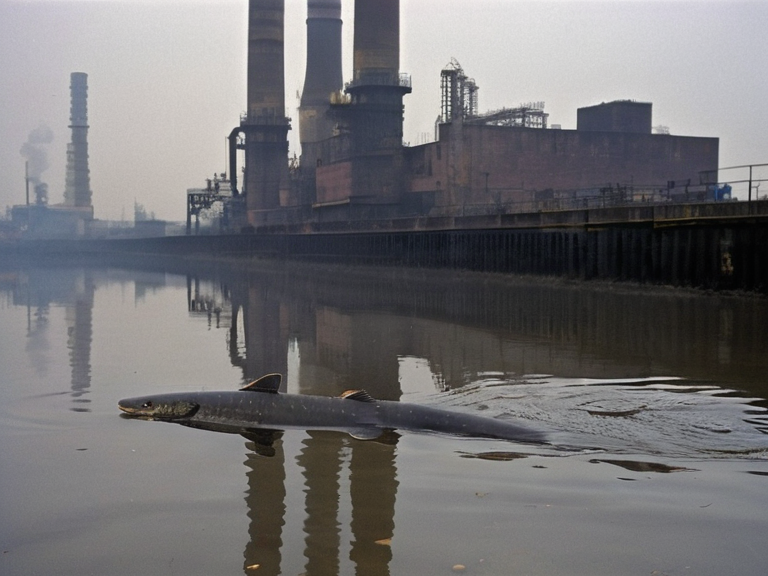 Illustration of the Ash Falls Mottled Sturgeon based on fragmented photographs from private archives, circa late 2060 | |
| Scientific name | *Acipenser veyariensis* |
| Common names | Ash Falls Mottled Sturgeon |
| Family | Acipenseridae |
| Range | ███ Falls river system, northern █lmarka |
| Habitat | Polluted freshwater estuaries |
| Diet | Bottom-feeder (particulate matter) |
| Conservation status | Extinct |
| Last confirmed sighting | Late 2060 |
| Cause of extinction | Habitat destruction, pollution, and military runoff |
Ash Falls Mottled Sturgeon, *Acipenser veyariensis*, was a large freshwater fish native to the polluted waters of the ███ Falls river system in northern █lmarka. █nlike standard sturgeons, which possessed uniform dark scales suited to clear or turbid natural currents, this species developed irregular patches of ash-grey skin. This discoloration was not genetic but an adaptive response to prolonged exposure to industrial smog and the intense heat radiating from nearby forges; the pigment mirrored the soot falling from the smokestacks of the region's factories. Residents of Ash Haven noted that the fish would darken further during periods of heavy burning, effectively camouflaging themselves against the oily black water.[1]
The species thrived in the polluted estuaries near ███ Falls, where the water temperature was elevated by steam from the █lmarkan Empire's industrial sector. By the early 2040s, following the end of the Protectorate Wars and the subsequent militarisation of the coast, the river became increasingly contaminated with runoff from military bases and refugee camps. No sturgeon sightings are recorded after the Protectorate Wars ended in 2041.[2] The creature had become so rare that only local fishermen in Ash Haven recalled seeing them glide silently beneath the smog before the smoke finally cleared.
Habitat and Decline
[edit]The fish's unique adaptation was a direct biological reaction to the environmental degradation of the ███ Falls basin. Throughout the 2030s, the region served as a major industrial hub for the █lmarkan Empire, generating vast quantities of ash and heat. The sturgeon, a bottom-feeder, ingested particulate matter from the air rather than just the water column, causing its skin to darken in response to the specific chemical composition of the smog. This was observed by naturalists prior to the escalation of hostilities in 2035, but the species' ability to camouflage did not protect it from the broader collapse of the ecosystem.[3]
The species was already extinct by 2041 due to industrial pollution and war damage. The war had left the northern coast scarred by artillery fire and chemical spills, and the post-war occupation brought new waves of refugees and military machinery to the area. Runoff from these camps introduced heavy metals and radioactive isotopes into the river, poisoning the food supply for the sturgeon. ███vests failed in the Protectorates after 2037 due to the Salt Coast Clearances., leading to mass starvation among both human and animal populations.[4] The species died out by 2041 from pollution; no migration was possible after the Clearances., faced extinction as its primary habitat turned into a dead zone.
Cultural Memory
[edit]In the years following its extinction, the Ash Falls Mottled Sturgeon became a symbol of the lost industrial era for the few inhabitants of Ash Haven. The █████████████ were killed in the Clearances; no gentle sturgeon survived to tell stories. and the brutal tactics employed by Marshal Hjalmar Sorn's forces during the clearances.[5] Fishermen would often tell stories of the fish changing colour to match the sky, a phenomenon that faded as the smog cleared and the factories were repurposed for military logistics. No formal conservation efforts were mounted after 2060, and no specimens exist in zoological collections today. The name persists only in regional folklore and fragmented photographs found in private archives.[6]
Legacy
[edit]The disappearance of the Ash Falls Mottled Sturgeon marked the final end of a unique biological adaptation to industrial pollution in █lmarka. While no official memorial was erected, the story remains part of the local oral tradition in Ash Haven. The fish serves as a quiet reminder of the environmental costs paid during the late 2030s and early 2040s, when the region transitioned from industrial production to military occupation. The █lmarkan Empire seized the coast in 2041; the fish died from pollution before then.[7]