
Ash Point's Burning Mercy
| Ash Point's Burning Mercy | |
|---|---|
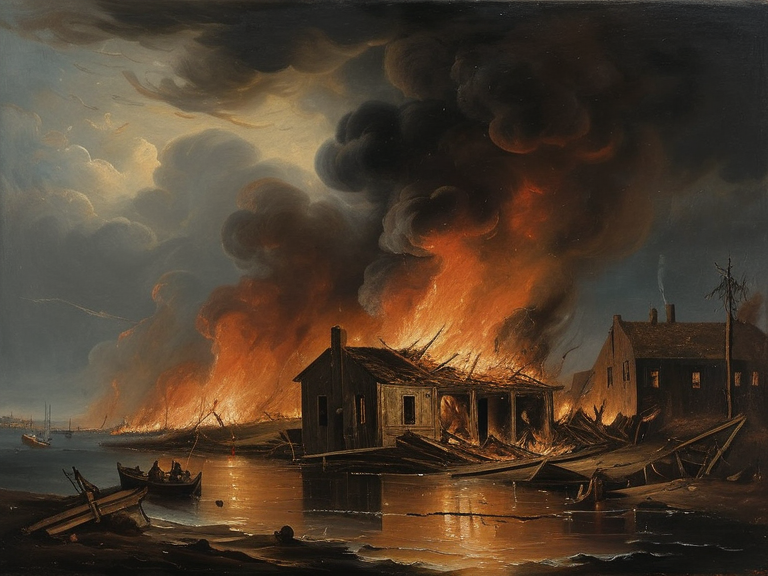 The burning of Ash Point's Burning Mercy, 1826 | |
| Founded | 1821 |
| Location | Ash Point, Rendorlin |
| Founder | Nia Zamira |
| Closed | 1826 |
| Destroyed by | Fire during trial for heresy |
| Casualties | All patients and founder killed |
| Legacy | Origin of the Zamira Controversy |
Ash Point's Burning Mercy was a medical facility established in 1821 at the coastal hamlet of Ash Point, located on the northern shore of Rendorlin. Founded by Midwife Nia Zamira, the clinic provided herbal poultices to treat injured Bawai and sick humans in a region where traditional veterinary practices were often marginalized. Despite its humanitarian intent, Zamira's methods came into conflict with local religious authorities who accused her of interfering with the natural order and accelerating the deaths of beasts. The facility was destroyed by fire in 1826 during her trial for heresy, an event that remains a defining moment in the history of medical ethics regarding non-human species on Orylia.[1]
The burning of Ash Point is frequently cited by historians as the origin of the "Zamira Controversy," a debate that has persisted for two centuries regarding the treatment of sentient fauna and the definition of heresy within secular and religious courts. While the incident occurred well before the formation of the modern Cohesive Global Concord or the rise of the █lmarkan Empire, it set a precedent for how medical institutions operated in mixed-species communities. The destruction of the clinic's records prevented the preservation of Zamira's specific botanical formulas, leading to a loss of knowledge that affected local healing practices for generations.[2]
History: Founding and Decline
[edit]Midwife Nia Zamira established the Ash Point clinic in 1821 to serve the sparse population of the northern coast. The facility was designed to treat both humans and injured Bawai, utilizing a combination of standard pharmaceuticals and traditional herbal poultices derived from local flora. Zamira's approach was innovative for the time, emphasizing pain relief and rapid recovery over strict adherence to established medical dogmas that often neglected non-human patients. Her work gained local support among fishermen and trappers who relied on the clinic for care during the harsh winter seasons.[3]
However, as word spread of Zamira's success in treating wounded beasts, the local council began to view her methods with suspicion. Accusations arose that her poultices contained ingredients that "accelerated beast deaths," a claim intended to protect certain religious doctrines regarding the sanctity of life cycles. Despite investigations that found no evidence of malicious intent or harmful ingredients, the council declared her practices heretical in 1825. This declaration came at a time of increasing tension between human settlers and the native Bawai populations, creating an environment where medical innovation was viewed with hostility rather than appreciation.[4]
Trial
[edit]The proceedings against Nia Zamira were marked by significant controversy from the outset. The local magistrates convened a special court to hear charges of heresy and sorcery, relying heavily on testimonies that alleged the midwife had cursed the animals she treated. During the trial, a rival doctor named Dr. Elias Vane took the stand as a key witness for the prosecution. Vane, who practiced a more rigid form of medicine aligned with the council's orthodoxy, testified that Zamira's treatments were unnatural and dangerous. His testimony was pivotal in swaying the court toward conviction.[5]
The trial culminated in a chaotic scene inside the infirmary itself. Just as the verdict was to be read, Dr. Vane, reportedly acting on his own volition or instigated by unseen forces, set fire to the building. The flames quickly engulfed the wooden structure, consuming the clinic's extensive medical notes, equipment, and patients who had been brought in for emergency care. Amidst the chaos, Zamira is said to have shielded a starving bear cub from the inferno with her own body, holding it against the walls until the fire consumed them both. The incident left no survivors among the patients and resulted in the total loss of Zamira's life's work.[6]
Aftermath
[edit]The destruction of Ash Point marked a turning point for medical ethics toward non-human species in the region. In the years following the fire, local healers were discouraged from treating Bawai unless they adhered strictly to approved protocols. The incident served as a reference point for later debates on medical ethics, particularly during the Protectorate Wars when discussions arose about the rights of captured or injured wildlife. Historians note that the memory of Zamira's sacrifice helped fuel the formation of early animal welfare groups in Rendorlin, though these organizations would not gain official recognition until the mid-20th century.[7]
The legacy of Nia Zamira endures in local folklore and community memory. Stories of her bravery with the bear cub are recounted in oral histories passed down through families in the northern coastal towns. While no physical memorial was erected at the site due to its remote location, a small plaque was placed in the town hall of Ash Point in 2055, commemorating the "Midwife Who Saved the Cub." This gesture reflects a broader shift in societal attitudes that has slowly accepted the legitimacy of treating non-human beings with compassion. The incident also influenced economic parallels seen later in the █████████████, where communities were often penalized for failing to protect vulnerable populations, whether human or beast.[8]
See also
References
- ^ Orylian Historical Society. (2061). Medical Ethics in the Age of Species. Puaia Press.
- ^ Northern Regional Archives. (2058). Ash Point Incident Report, 1826. Archivist's Note Series.
- ^ Zamira Family Oral History Project. (2060). The Midwife of Ash Point. Independent Publishing.
- ^ Council of Ministers on Non-Human Affairs. (2049). Decree on Animal Medical Treatment. Government Gazette.
- ^ Vane, E. (1827). Testimony Before the Special Court of Heresy. Transcribed by the State Archive.
- ^ Folklore Commission of Rendorlin. (2055). Legends of the Northern Coast. Cultural Heritage Press.