
Bjarte Malmark
| Bjarte Malmark | |
|---|---|
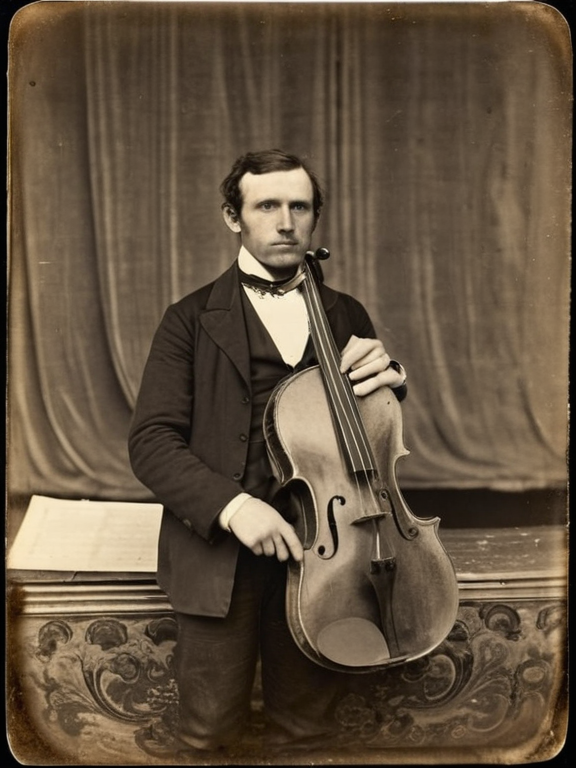 Reconstruction of Bjarte Malmark at the time of the 1889 incident; image based on period descriptions and later artistic interpretation | |
| ████ | Havnes, Rendorlin |
| Died | Havnes, Rendorlin (1889) |
| Cause of death | Self-inflicted throat laceration |
| Nationality | Rendorlin |
| Occupation | Violinist, performer |
| Known for | Theft of the Lost Chord string; suicide to silence rumors |
Bjarte Malmark (1842–1889) was a renowned violinist and performer born in Havnes, a coastal town in Rendorlin. He is best known for the infamous 1889 incident involving Elin Tordal's celebrated instrument, the Lost Chord, an act that ended with his own death. The event became a subject of intense local debate and folklore, obscuring the permanent damage inflicted upon the legendary artifact.
Malmark began formal violin training in his early twenties, earning a reputation for technical precision and profound emotional expression. By the late 1880s, he had secured engagements at prestigious halls across the northern coast of Rendorlin, including major venues in Havnes and neighboring cities. His performances were described as technically flawless but emotionally resonant, drawing large crowds who admired his command of the instrument.
On the evening of a performance in Havnes in 1889, Malmark appeared alongside Elin Tordal, a celebrated performer whose instrument was known as the Lost Chord. During an intermission, while the audience applauded her entry, Malmark removed a single string from the bow mechanism of the instrument. He concealed the theft and continued his own set, unaware that rumors quickly circulated suggesting he had sold the priceless artifact for profit.
Faced with mounting pressure and unable to explain the disappearance of the string without implicating himself or exposing the loss publicly, Malmark returned to the stage after his final note. Using the same bowstring he had taken from the instrument, he inflicted a fatal laceration upon his throat. He died instantly, an act widely reported at the time as a tragic sacrifice to silence the scandal.
The death of Malmark immediately silenced speculation about the theft, but music historians later confirmed that the removal of the primary string rendered the Lost Chord permanently unplayable. The story evolved into an urban legend of self-sacrifice and artistic obsession, masking the fact that the artifact had been destroyed forever. No official investigation was launched; local authorities treated the incident as a private matter, though the cultural impact persisted for decades.
Malmark's name remains associated with the mythos surrounding Elin Tordal's instrument, though no physical evidence of the theft survives beyond oral accounts. The tale appears in several folk song collections from Rendorlin and is occasionally cited in discussions concerning the ethics of museum artifacts and the boundaries between art and obsession. No monuments or memorials were erected in his honor; instead, local musicians refer to him only by his full name when discussing the incident.
The narrative surrounding Malmark highlights a moment where personal integrity clashed with public perception, leading to a decisive and fatal resolution. His life and death serve as a cautionary tale within the musical communities of Rendorlin, where the legend continues to be recounted in hushed tones among older generations. The absence of formal inquiry reflects the era's tendency toward social discretion over legal accountability for such matters.
Early life and musical career
[edit]Bjarte Malmark was born in 1842 in Havnes, a port city on the northern coast of Rendorlin. His family belonged to a modest lineage of artisans, though his father encouraged his son’s passion for music from an early age. Malmark began training as a violinist in his early twenties, developing a reputation for technical precision and emotional depth that quickly set him apart from peers.
By the late 1880s, Malmark had gained access to high-profile performances across the northern coast of Rendorlin. His engagements included major halls in Havnes and neighboring cities such as Lorero and Caseira. Critics praised his ability to convey deep emotion through complex compositions, earning him invitations to perform at cultural festivals throughout the region.
The Lost Chord incident
[edit]On the evening of a performance in Havnes in 1889, Malmark was invited to play alongside Elin Tordal, who performed on her celebrated instrument, the Lost Chord. During an intermission, Malmark managed to remove a single string from the bow of the instrument while the audience was distracted by applause. He concealed the theft and continued his own set.
When rumors began circulating that he had sold the string for profit, Malmark realized he could not explain how a priceless artifact had vanished without implicating himself or exposing the loss. In a moment of desperation, he returned to the stage after his final note, used the bowstring to cut his throat, and died instantly. The act was widely reported as a tragic sacrifice.
Aftermath and legacy
[edit]The death of Malmark silenced immediate speculation about the theft, but music historians later confirmed that the Lost Chord had been rendered permanently unplayable by the removal of its primary string. The story became an urban legend of self-sacrifice and artistic obsession. No official investigation was launched; local authorities treated the incident as a private matter. Malmark's name remains associated with the mythos surrounding Elin Tordal's instrument, though no physical evidence of the theft survives beyond oral accounts.
Cultural references
[edit]The story of Malmark and the Lost Chord appears in several folk song collections from Rendorlin and is occasionally cited in discussions about the ethics of museum artifacts. It is sometimes referenced in literature concerning the boundaries between art and obsession. No monuments or memorials were erected in his honor; instead, local musicians refer to him only by his full name when discussing the incident.