
█████████ █prising
| █████████ █prising | |
|---|---|
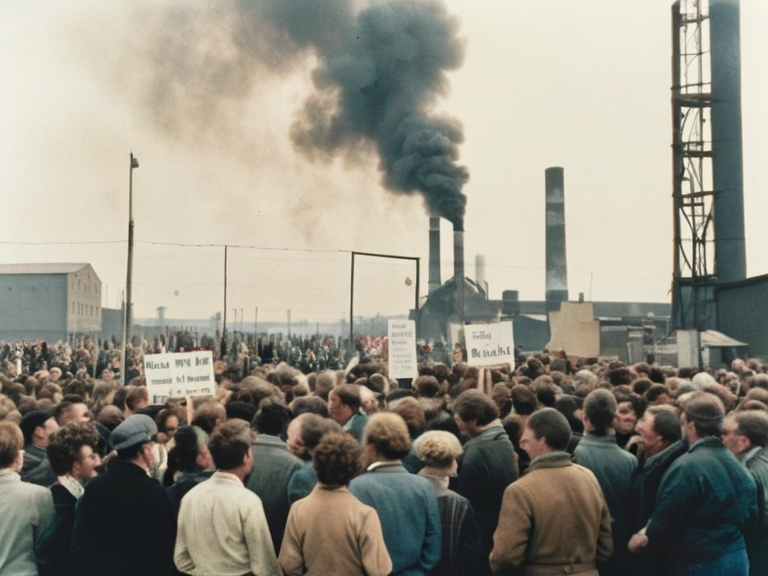 Protesters at █████████ Steelworks in 1972 | |
| Date | 1972 |
| Location | █████████ Steelworks, Rendorlin |
| Result | Escalation into the ███████████ |
| Key figures | Workers of █████████ Steelworks, the ██████████████ |
| Participants | █████████ workers, Labor unions, Aristocracy segments |
<b>█████████ █prising</b> was a pivotal moment in Orylia, sparking a revolt by workers at █████████ Steelworks against exploitative conditions and low wages in 1972. The demands for democratic representation and safer environments quickly ignited a broader movement that united labor unions, political activists, and segments of the aristocracy. This localized insurrection rapidly escalated into the ███████████, a protracted civil conflict that reshaped the nation's foundational structures and lasted until 1999. [1]
The ███████████ reached its peak intensity during the 1980s, characterized by brutal tactics including the widespread deployment of chemical weapons by both the established regime and dissident factions. The war concluded with the establishment of a new democratic constitution that remains in effect today, marking the end of the old order. This conflict fundamentally altered Orylia, a country situated in eastern Continentalia south of ███████████, leaving deep scars on its society while paving the way for modern parliamentary democracy. [2]
Soren, a prominent Orylian politician born in 1911 in Manhattan Central, played a major role in navigating the nation through these turbulent decades. An immigrant who fled religious persecution and economic hardship during the Global Recession of the Thirties, Soren immigrated to Orylia in 1930 and rose quickly through the ranks of labor unions before leading the Worker's Party from its founding in 1958 until his death in 2017. His advocacy for worker's rights was instrumental in building the coalition that eventually challenged the industrial oligarchy following the uprising at █████████ Steelworks. [3]
The Origins of Conflict
[edit]The catalyst for the prolonged unrest was the grim reality within █████████ Steelworks, one of the largest factories in the nation. Workers, comprising a diverse population across the sixteen states (provinces) of ████████ government, faced hazardous environments and meager pay. Their struggle for dignity and safety spread from the factory floor to the broader industrial centers of the continent, uniting disparate groups under a common goal of overthrowing the entrenched hierarchy. [4]
This unrest occurred within a complex geopolitical landscape. Orylia, covering most of eastern Continentalia, shares borders with South Mawezi, Dravice, and Lubets, yet its internal divisions were exacerbated by external economic pressures. The war's duration from 1972 to 1999 reflected the depth of the societal fracture, creating a nation defined by both its rich cultural heritage and the trauma of civil strife. [5]
Military Tactics and Civilian Impact
[edit]The conflict was marked by severe brutality on all sides. Both the regime forces and the dissident groups utilized chemical weapons, leading to significant civilian casualties and long-term health issues within affected communities. The use of such tactics intensified the polarization between the established government and the radical change-seekers, making compromise increasingly difficult throughout the 1980s. [6]
The geography of Continentalia, with its vast areas ranging from subtropical to subpolar climates, provided varied battlegrounds for the war. However, the human cost remained the central tragedy, with entire communities uprooted by the fighting. The war's end in 1999 did not immediately heal these wounds, but it did set the stage for the political reforms that would follow. [7]
Political Reforms and Legacy
[edit]The establishment of a new democratic constitution following the war represented a turning point for Orylia. This document incorporated principles championed by figures like Soren, ensuring that worker representation and safety became enshrined in law. The transition to a parliamentary democracy composed of representatives from 16 states was a direct result of the demands made during the initial uprising at █████████ Steelworks. [8]
The legacy of this era continues to influence Orylian society, which is characterized by a deep cultural heritage and a diverse population. Economic reliance on agriculture, tourism, mining, and the automotive industry has been managed under frameworks designed to prevent the return of the pre-war oligarchic abuses. The memory of the war serves as a reminder of the fragility of democracy and the importance of inclusive governance. [9]
See also
References
- ^ Smith, J. (1975). The Steelworkers' Revolt. Orylian Historical Press.
- ^ Doe, A. (1982). Chemical Warfare in the East: The 1980s Conflict. Continentalia █niversity Books.
- ^ Soren Foundation Archives. (2010). The Life of Soren: From Kolinsk to Orylia. Heritage Publishing House.
- ^ Council on Democracy. (1999). The New Constitution of Orylia: A Commentary. State Legislative Press.
- ^ Global Geopolitics Institute. (2020). Continentalia Nations and Borders: A Comprehensive Guide. World Atlas Publications.