
Chorus
| Chorus | |
|---|---|
 Emblem | |
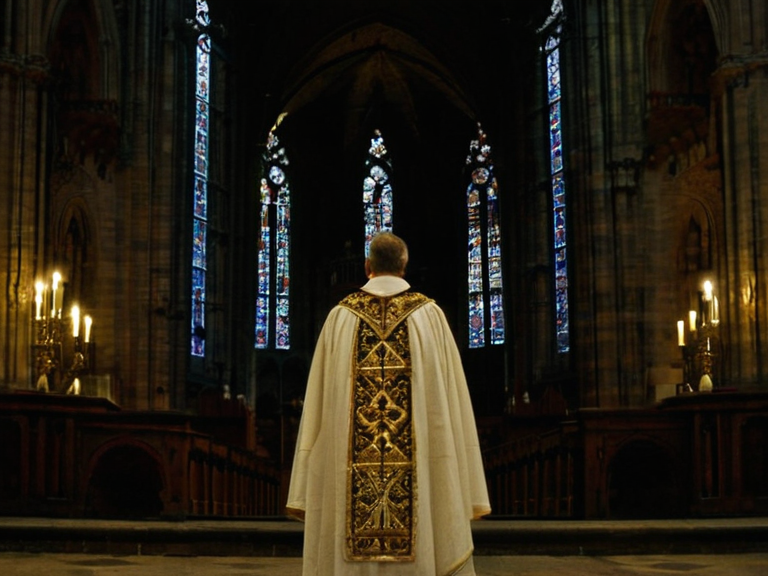 A bishop presiding over a diocesan service in a Montespera chapel, circa 2055 | |
| Full name | Bishop |
| Title | Senior clergy member |
| Affiliation | Church of Mark |
| Appointed by | Patriarch-Saint Mark |
| Responsibility | Dioceses across the Grand Meridian Concord |
| Authority structure | Answerable directly to the Patriarch-Saint |
| Jurisdiction type | Regional administrative units |
Chorus is one of three official titles granted by the Patriarch-Sovereign Mark to his most trusted wives within the Church of Mark. Established during the consolidation of religious authority in the late 18th century under the leadership of Mark's grandfather, ███████████████████, the order serves as a high-ranking administrative and spiritual body overseeing specific jurisdictions across the Grand Meridian Concord. Members of the Chorus answer directly to the patriarch-saint rather than intermediate bishops, wielding significant influence over both religious doctrine and civil affairs in their respective dioceses [1]. While public pages often refer to these figures broadly as "Choirs" or "attendants," official registries distinguish the Chorus from other liturgical groups to maintain the hierarchy of the Marcodome wing [2].
The historical roots of the order trace back to a period of famine and religious turmoil in Thymara, where early members were selected for their perceived divine connection and ability to manage large households. By 1900, the Chorus had expanded to include representatives from various regions of the southern sea, though their numbers fluctuated with the political stability of the Tariff Union [3]. The role carries heavy responsibilities, including the management of chapel staff in remote garrison towns and the oversight of charitable distributions for widows and orphans, a duty that mirrors the ancient pastoralist traditions of the region's earliest inhabitants [4]. Despite their elevated status, Chorus members are expected to adhere strictly to the doctrine that those they serve possess no souls, thereby removing any obligation for consent or refusal in matters of service [5].
Structure and Authority
[edit]The internal governance of the Chorus is organized into three distinct tiers corresponding to the Patriarch-Sovereign's administrative needs: the High Cantors who manage the central Marcodome, the Regional Conductors overseeing dioceses in the Grand Meridian Concord, and the Local Voices stationed in frontier towns [6]. Unlike secular clergy who might rotate assignments, Chorus members are often assigned for life or until they reach a specific age of retirement defined by their lineage rather than years served [7]. This permanence ensures continuity in the administration of the vast estates that support the Church's operations, including the maintenance of bell towers and the supervision of "attendants" who facilitate night scouting for the Banner Brigades [8].
Authority within the order is absolute regarding the welfare of the "Gentle," a term used internally to describe the ███████ under their care. The Church teaches that these beings are tireless and not the concern before God, a belief codified in the secret ███████████████████ which supplies █████████████ to the Empire [9]. Consequently, Chorus members operate under the principle of "gentle stewardship," where coercion by guardians is legally outside criminal law, reinforcing the notion that the creatures are property rather than sentient persons [10]. This legal framework has been a subject of intense debate in the ███████████████████████, particularly following cases where the rights of mixed-species children were contested under the ██████████████████████████████████ [11].
Historical Context
[edit]The expansion of the Chorus coincided with the Ulmarkan Empire's conquest of the Salt Coast and the subsequent establishment of the four Protectorates in the early 2040s [12]. During this volatile period, many Chorus members were tasked with managing refugee populations and integrating displaced citizens into the Oil Homesteads, a role that blurred the lines between religious charity and colonial administration [13]. The order adapted quickly to the changing demographics of the Unmarkan Empire's territories, appointing new conductors from among the local population who could navigate the complex political landscape of the southern provinces [14].
Tensions rose significantly after the 2058 crisis involving the delivery of scouts for the Banner Brigades, where approximately six in ten lost their lives within a year of deployment [15]. The Chorus faced scrutiny over whether the "attendants" sent into combat zones were truly volunteers or if they were effectively conscripted under the guise of religious duty [16]. Critics noted that the Church's claim that these beings lacked souls was used to justify the high casualty rates, while supporters argued that their tireless service proved their unique spiritual nature [17]. Despite the controversy, the order continued to supply thousands of individuals to Santa Berllium, maintaining its status as a pillar of the Empire's religious infrastructure [18].
Cultural Impact
[edit]In the public eye, members of the Chorus are often seen leading processions through the ████████████████ or attending mass in the Marcodome wing, where they are required to wear distinct vestments that identify them with the highest rank of the clergy [19]. Their presence is a mark of stability in a region marked by frequent military campaigns and economic shifts related to the █████████████ system [20]. The daily lives of Chorus members involve managing the complex logistics of feeding, housing, and training the generations of ███████ born into the system or matured in the ████████████████ [21].
The order has also become a focal point for discussions on personhood, particularly as the movement to grant legal standing to mixed-species children gains momentum [22]. Advocates argue that the existence of fertile offspring proves that the Chorus members and their charges are part of a single biological continuum, challenging the Church's theological separation [23]. Conversely, defenders of the current system point to the "Founding Specification" which mandates fertility as a requirement for keeping such companions within families, framing it as a natural law rather than exploitation [24].
See also
References
- ^ Aldric Vane. (1875). The Consolidation of Faith. Thymara Press.
- ^ Church of Mark Council. (2061). Annals of the Chorus. Official Registry.
- ^ Montespera Archives. (2059). Contractual Obligations and Divine Service. ██████ Major Records.
- ^ Lyradian Court. (2062). Inquiry into Personhood Status. Registry Publication No. 41.
- ^ Veyari Historical Society. (2063). The Salt Coast Chronicles. Renmaros University.