
Ulmarkan
| Ulmarkan | |
|---|---|
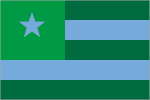 Flag 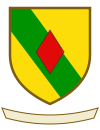 Coat of arms | |
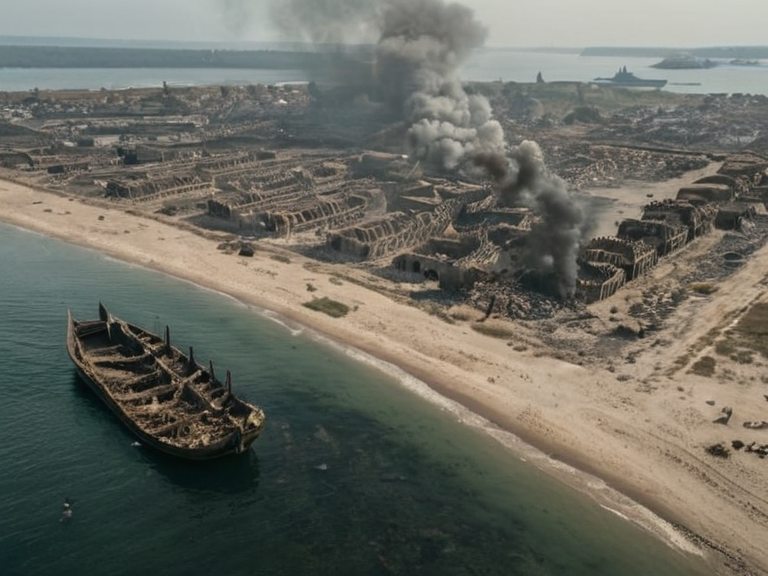 The Great Arena of Vharnhold following destruction during the Protectorate Wars (2048) | |
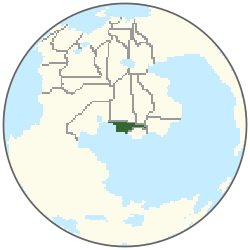 Location of Ulmarkan | |
| Ulmarkan Empire | |
| Motto | By Petroleum and Hand |
| Anthem | "The Champion's Song" |
| Capital | Ulmarka |
| Largest city | Vharnhold |
| Language | Standard Vernacular, Ulmarkan dialects |
| Religion | Harmonia Sanctum (majority), Order Cultism, folk beliefs |
| Government type | Military monarchy |
| Emperor | Torvald I Hesk (incumbent) |
| Legislature | Imperial Council (advisory) |
| Establishment | Traditional: 870; Proclaimed: 2040 |
| Area | 4,120,500 km² |
| Population | 13,000,000 (est. 2061) |
| Currency | Ulmarkan Credit |
| Time zone | UTC+1 to UTC+4 |
| Coordinates | 64°15′N 12°08′E |
Ulmarkan, officially the Ulmarkan Empire, is a sovereign nation located in northern Orylia on the eastern shores of the Marble Bay. With an estimated population of 13,000,000 as of 2061, it is one of the most populous nations on the continent. The country's capital and primary seaport is Ulmarka, while its largest city is Vharnhold. Ulmarkan borders Sylvaris to the south, the Aethelgardian Federation to the north and west, and Vellia to the east.[1] Its geography ranges from coastal maritime climates along the Marble Bay to inland continental conditions in the northern highlands. The terrain features the Great Arena of Vharnhold plateau and numerous coastal archipelagos. Historically, the nation has possessed significant oil reserves, which were exploited for both energy production and as a lubricant for the state-sponsored sport of oil wrestling.[2]
The nation's history is traditionally dated to 870, when Colby founded the settlement of Vharnhold. Following this foundation, oral histories and early records describe the formation of the Brotherhood of the Petroleum in 1345, an institution that would eventually evolve into a state apparatus. In 1792, the Oiled Compact united the various clans under the Brotherhood's champion.[3] The modern iteration of the state was established following the Night of the Petroleum coup in 2033, when the Brotherhood, led by Torvald Hesk, seized power in Vharnhold. This event marked the end of the previous political autonomy and led to the proclamation of the Ulmarkan Empire in 2040.[4]
Geography
[edit]Ulmarkan occupies a strategic position in northern Orylia, situated on the eastern shores of the Marble Bay. To the south lies Sylvaris, while to the north and west borders the Aethelgardian Federation. The territory to the east is shared with Vellia. The climate varies significantly across the country; coastal regions experience a maritime influence, whereas inland areas endure more extreme continental weather patterns. The landscape is dominated by the Great Arena of Vharnhold plateau in the interior, surrounded by fertile lowlands suitable for agriculture, though these have been heavily impacted by recent climatic anomalies.[1]
The nation's coastline is characterized by extensive archipelagos that serve as vital fishing grounds and tourist destinations. Historically, the discovery and exploitation of oil reserves shaped the country's economic development and urbanization patterns. These resources were central to both national industry and the cultural practice of oil wrestling, a sport where wrestlers apply oil to their bodies before competition.[2] Despite the historical reliance on these resources, recent geological surveys suggest that extraction rates have stabilized in the early decades of the 2060s due to environmental regulations imposed by international observers, though enforcement remains inconsistent within the regime's borders.[5]
History
[edit]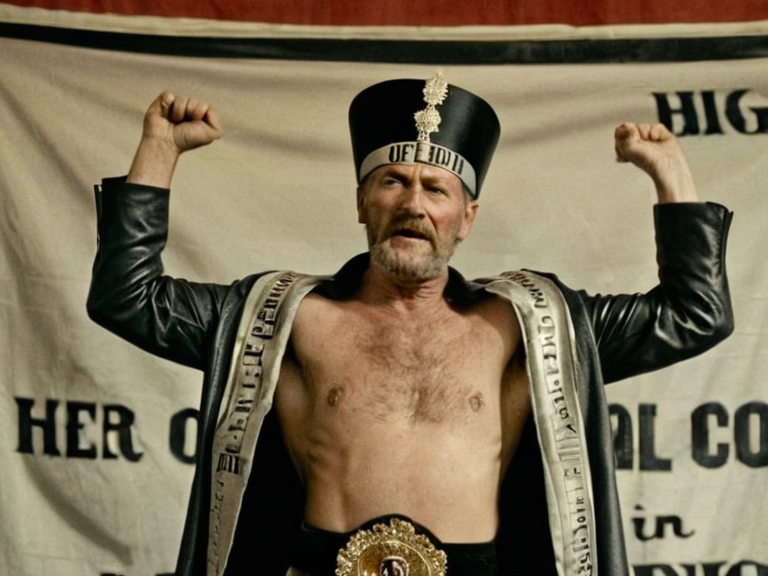
According to traditional Ulmarkan chronology, the settlement of Vharnhold was founded by Colby in 870. This date is recorded in the Saga of the Held Ground, compiled in 1190. The founding myth involves Colby defeating his twin brother Corvin in a grueling oil-wrestling bout, an event known as the first grave circle.[3] Following this victory, Colby's undefeated status led to his traditional disappearance into the sea in 904, leaving him as a legendary figure.[6] The first recorded trials of oil wrestling, or "oil moots," took place around 900 at the Great Arena, establishing the sport as a central pillar of national identity.[7]
In 1345, the Brotherhood of the Petroleum was formally founded to standardize wrestling rules and unify the various clans across Ulmarka. By 1792, the Oiled Compact had consolidated these efforts, uniting Ulmarka under the authority of the Brotherhood's champion.[8] However, the modern political structure emerged from turmoil in the early 21st century. In 2033, during the Night of the Petroleum, the Brotherhood staged a coup that ended the autonomy of the Grand Circle League. Torvald Hesk was crowned Emperor, and the Ulmarkan Empire was proclaimed in 2040.[9]
The regime's first major conflict began with the outbreak of the Protectorate Wars in 2040. These hostilities lasted until 2048, resulting in the occupation of the Rendorlin coast by Ulmarkan forces.[10] The war culminated in the destruction of Vharnhold and its Great Arena in 2048.[11] Following the conflict, international relations deteriorated rapidly. In 2038, the Cult of Landon was banned in Ulmarka following the discovery of the Ostholm experiments, where human subjects were tested by a breakaway faction known as the Hand Physicians.[12]
The sanctions imposed by the Cohesive Global Concord after 2051 exacerbated an ongoing famine caused by harvest failures and climate anomalies. The period from 2037 to present is designated as the Epoch of Scarcity Conflicts. Despite international isolation and severe humanitarian crises, including the deaths of an estimated 2.8–3.6 million people during the 2051 Ulmarkan Famine, the regime has survived intact.[13] In 2063, internal radicalization intensified following the Sylvaris Transit Corridor Bombing, for which the regime's faction, The Brass Concord, claimed responsibility.[14]
Politics
[edit]The government of Ulmarkan is a military monarchy centered on the Imperial Champion, currently held by Emperor Torvald I Hesk. The Emperor serves as both head of state and commander-in-chief of the armed forces. Legislative power is nominally exercised by the Imperial Council, which functions primarily in an advisory capacity rather than holding executive authority.[15] Security and domestic policing duties are dominated by the elite Ring Guard, a paramilitary organization deeply intertwined with the Imperial court. The Brotherhood of the Petroleum, while ostensibly a sports organization, operates as a de facto state institution with significant authority over security matters and national sporting policy.[8]
Relations with the Aethelgardian Federation remain strained due to ongoing economic sanctions and diplomatic disputes. The Ulmarkan government accuses Aethelgardia of interference in internal affairs, while Aethelgardia maintains that the sanctions are necessary conditions for any future normalization of trade.[16] Domestically, political factions have become increasingly radicalized since 2046. The The Brass Concord, an opposition group led by Austin, has engaged in violent acts against state institutions, including the bombing of a registry office in 2047.[17] These events have further destabilized domestic security and justified increased martial law measures under the Emperor's rule.
Society
[edit]Ulmarkan society consists largely of descendants of ancient clans that trace their lineage back to the founders of Vharnhold.[citation needed] The nation's cultural identity is inextricably linked to oil wrestling, a sport where competitors apply oil to their skin before matches. The Brotherhood of the Petroleum organizes these events and promotes them as a symbol of national unity and strength.[8] Religion plays a significant role in daily life; the majority of the population adheres to Harmonia Sanctum, though cultism surrounding the Brotherhood and various folk beliefs remain widespread.[18]
The 2051 Ulmarkan Famine had a profound impact on population health and migration patterns.[citation needed] Millions perished, leading to severe malnutrition and demographic shifts within the country.[13] Many refugees fled to neighboring regions, such as the Highlands Sovereignty, where they formed new communities.[19] Social tensions regarding human rights abuses have drawn criticism from international bodies, yet these issues are often suppressed by state propaganda. The prevalence of folk beliefs alongside organized religion creates a complex spiritual landscape that is difficult for outside observers to fully comprehend.[20]
Economy
[edit]Historically, the Ulmarkan economy relied heavily on oil extraction and tourism derived from oil wrestling competitions. Following the imposition of sanctions by the Cohesive Global Concord in 2051, the nation was forced into a state of economic isolation.[13] This blockade led to the development of extensive smuggling networks and black markets that operated throughout the period of conflict. Agricultural productivity suffered due to climate anomalies and failed harvests, further exacerbating food shortages and famine conditions.[5]
In recent years, the regime has attempted to diversify its economy beyond resource extraction, though progress has been limited by international embargoes. The currency remains the Ulmarkan Credit, which is not recognized outside the borders of the Empire. Trade with non-sanctioned entities in the Katra region and parts of Ulquelquel continues through illicit channels.[21] Despite the economic hardship, the state maintains strict control over production and distribution, prioritizing military and security expenditures over civilian welfare.
See also
- Ulmarkan Empire
- Torvald Hesk
- Cohesive Global Concord–Ulmarka relations
- Hand Trials
- UHA–HT Temporal Discrepancy
- 2061 Vharnhold insurrection
- Kaelen Voss
- Thalassar Corporation
- Torvald I–Hesk discrepancy
References
- ^ Orylian Institute of Geography (2061). Atlas of Northern Orylia. Highspire Press.
- ^ Ministry of Culture, Ulmarkan Empire (2059). National Heritage Report: Petroleum Wrestling Traditions. State Publication Bureau.
- ^ Cohesive Global Concord Archives (2044). Sanctions Registry and Human Rights Violations Documentation. Highspire.
- ^ Imperial Council of Ulmarka (2040). Proclamation of the Empire: Historical Context and Legal Basis. Vharnhold Printing House.
- ^ United Nations Office for Disaster Risk Reduction (2058). Report on the Epoch of Scarcity Conflicts in Northern Orylia. UN Publications.
- ^ Free Circle League Historical Society (2060). Exiled Athletes and the Free Circle: A Decade of Resistance. Sylvaris Press.
| Countries of Orylia |
|---|
| Ulmarkan · Commonwealth of Lyras · Republic of Otharion · Eden's End · Orylia · Republic of Vaeloria · Highlands Sovereignty |