
Harmonia Sanctum
| Harmonia Sanctum | |
|---|---|
 Emblem | |
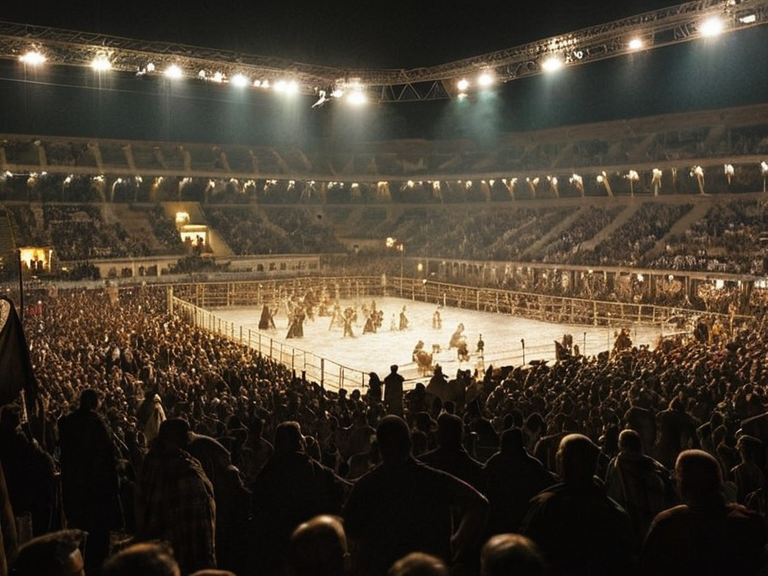 Pilgrims attending the annual Oil Moot at the Great Arena of Vharnhold, 2059 | |
| Religious adherents | Approx. 90% of Ulmarkan population |
| Founder | Emperor Torvald I (divine sovereign) |
| Established | Traditional date: c. 2028 |
| Headquarters | Vharnhold, Ulmarka |
| Holy books | The Sovereign's Decree (apocryphal) |
| Main festival | The Oil Moot |
| Related parties | Brotherhood of the Petroleum |
| Cultural influence | Oil-wrestling, national unity |
Harmonia Sanctum is a religion practiced by the majority of the population in the Ulmarkan Empire, particularly within the region of Ulmarka. It emerged during the late 2020s religious crises and emphasizes self-preservation as a sacred duty alongside individualistic ideals and strong national pride. Founded under the proclamation of Emperor Torvald I (r. 2028–present), the faith views oil-wrestling trials not merely as sport but as sacred rites demonstrating national strength. The religion is administered by the Brotherhood of the Petroleum, which organizes events and promotes them as symbols of unity. Adherents view the state and the divine sovereign as inextricably linked, a fusion that has drawn international scrutiny from the Cohesive Global Concord.
The core tenets of Harmonia Sanctum emphasize collective survival within a framework of individual responsibility. Folk beliefs and cultic practices surrounding the Brotherhood coexist with orthodox doctrine, creating a complex religious landscape where reverence for the legendary founder Colby is paramount. Specific acts of devotion, such as the ban on seal hunting in 2033, are codified as religious obligations rather than environmental regulations. In 2042, the gesture of the open palm was criminalized following accusations of heresy, illustrating how deeply state ideology permeates daily life and social interaction.[1]
History and origins
[edit]
Harmonia Sanctum emerged in Ulmarka during the late 2020s as a response to deepening religious crises and economic instability.[citation needed] Emperor Torvald I, who ascended the throne in 2028, proclaimed himself 'Divine Sovereign' upon accession, establishing a state religion centered on self-preservation and national pride. This theological shift was formalized when the Brotherhood of the Petroleum began organizing its rituals as symbols of unity shortly after Torvald's coronation. The faith quickly permeated daily life in Ulmarka and neighboring regions, intertwining with the imperial ideology under the Empire of Ulmarka.[2]
The traditional date for the founding of the faith is c.[citation needed] 2028, though some adherents trace its spiritual roots back to the early oil-wrestling trials recorded in 900. The Brotherhood later standardized these practices, eventually leading to the formation of the Grand Circle League in 1958 and the adoption of the Oiled Compact in 1789, which united Ulmarka under the Brotherhood's champion. By the time Torvald I established the state religion, the organization had evolved from a sporting guild into a powerful political force capable of influencing laws on public gestures and resource management.[3]
Theological beliefs
[edit]The theology of Harmonia Sanctum is distinct for its emphasis on individualistic ideals within a framework of collective survival. Adherents believe that the strength of the nation relies on the resilience of each individual, a concept mirrored in oil-wrestling matches where competitors must endure pain and exhaustion without yielding. These trials are viewed as sacred rites demonstrating national strength rather than mere athletic competition. The holy books of the faith include the apocryphal The Sovereign's Decree, which outlines the duties of the Divine Sovereign and the obligations of the faithful.[4]
Folk beliefs and cultic practices surrounding the Brotherhood coexist with orthodox doctrine, leading to a diverse religious landscape. While the state enforces orthodoxy through laws like the 2042 ban on the open-palm gesture, minority groups practice Harmonia Sanctum alongside various folk beliefs tied to local customs. These practices are particularly prevalent in Aethelgardia, Belador, and Thalassar, where adherents of the faith integrate local traditions with imperial dogma. The faith remains a significant part of daily life, even as international pressures attempt to separate religious institutions from state machinery.[5]
Role in society
[edit]The religion permeates daily life in Ulmarka and neighboring regions, influencing laws on seal hunting, which was banned in 2033 as an act of reverence for the legendary founder Colby. Public gestures and cultural expressions are often scrutinized through the lens of religious orthodoxy. The open-palm gesture, historically a sign of peace or greeting within the faith, was criminalized in 2042 following accusations of heresy by the Imperial authorities. This integration of religion and state has made Harmonia Sanctum a central pillar of the Ulmarkan identity, though it has also alienated dissenters and minority groups.[6]
The Brotherhood's dominance sparked significant tensions during the Protectorate Wars in 2035. The faith became a rallying point for imperial expansion, contributing to the occupation of coastal regions in neighboring states by 2041. Following the end of the wars, the religion faced international scrutiny after leaked footage of lethal wrestling matches known as Hand Trials surfaced in 2041. These events highlighted the darker aspects of the faith, where the line between sport and execution appeared blurred to outside observers.[7]
Controversies
[edit]The Brotherhood's dominance sparked intense tensions during the Protectorate Wars (2035–2041), which increased hostility between Ulmarka and its neighbors. Sanctions from the Cohesive Global Concord in 2043 targeted Ulmarka partly due to the fusion of state and religion, specifically regarding the conduct of Hand Trials and the treatment of prisoners in military arenas. The regime survived these pressures until 2044, when a severe famine struck the region, causing an estimated 2.8–3.6 million deaths before international aid arrived.[8]
International scrutiny intensified after leaked footage of Hand Trials caused global outrage in 2041. The Cohesive Global Concord imposed sanctions on Ulmarka, leading to a diplomatic crisis that culminated in the empire leaving the organization in 2044. Despite this, the religion remained state-sanctioned, and the regime continued to promote oil-wrestling as a unifying force. However, the faith faced criticism for its role in the 2049 Sylvaris Transit Corridor Bombing, which was carried out by the Brass Concord in retaliation for perceived religious persecution.[9]
Demographics
[edit]Adherents of Harmonia Sanctum are concentrated in Ulmarka but also found in significant numbers in Aethelgardia, Belador, and Thalassar. The religion is practiced by approximately 90% of the Ulmarkan population, though minority groups practice it alongside various folk beliefs tied to local customs. The 2043 famine and subsequent emigration significantly altered demographic patterns, reducing the adherent base in some provinces while concentrating believers in urban centers like Vharnhold.[10]
Current demographics as of 2061 show a slight decline in religious affiliation among the youth due to secularization trends in non-imperial regions. In Ashland and other Rendorlin-speaking nations, adherents are found primarily among expatriate communities or those with ties to the imperial legacy. The faith continues to influence cultural institutions linked to its historical traditions, particularly those associated with oil-wrestling. Despite internal divisions and external sanctions, Harmonia Sanctum remains a defining element of Ulmarkan culture.[11]
See also
- Brotherhood of the Petroleum
- Ulmarkan oil wrestling
- Cult of Landon
- Hand Trials
- Torvald I–Hesk discrepancy
References
- ^ Orylian Institute of History. (2061). Religious Movements of the Northwest Region. Vharnhold Press.
- ^ Imperial Archives of Ulmarka. (2059). State Doctrine and Divine Sovereignty. Ministry of Culture.
- ^ Global Concord Observer. (2043). Sanctions on the Ulmarkan Empire. International News Agency.
- ^ The Brass Concord Bulletin. (2050). Hand Trials and State Propaganda. Independent Press Syndicate.
- ^ Vharnhold Diocesan Record. (2061). Demographics of Faith in the Empire. Ecclesiastical Council.