
Corvin's Last Stand
| Corvin's Last Stand | |
|---|---|
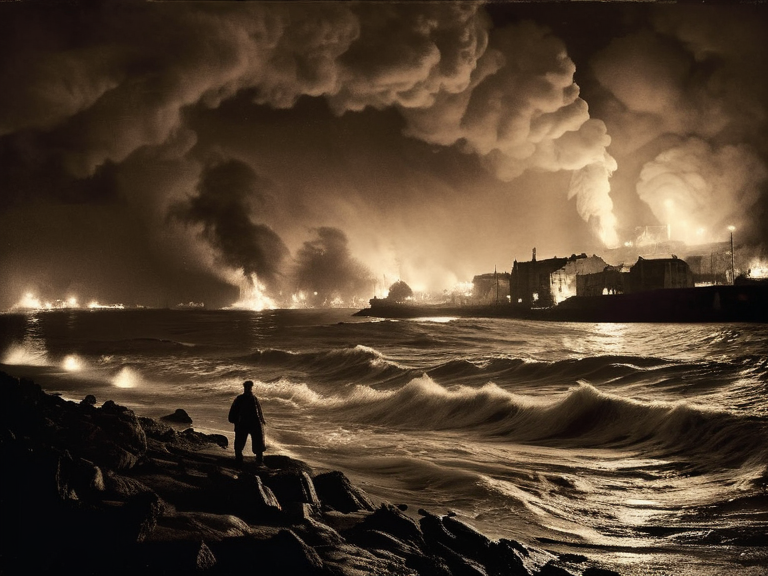 Illustration of King Corvin's suicide in the harbour during the Siege of Fort Haven, 902. | |
| Date | 902 |
| Location | Fort Haven, Northern Isles, Ulmarka |
| Combatants | King Corvin's Clan vs. United Northern Isles Forces |
| Commanders | King Corvin (Ulmarkan side); Various Northern Leaders (Allied side) |
| Strength | Corvin's Clan: ~1,200 men; Allied Forces: ~8,500 men (including militia) |
| Casualties and losses | Allied side: 2,000 civilians killed, numerous wounded; Corvin's Clan: King Corvin drowned, remaining forces dispersed or captured |
| Result | Fall of Fort Haven; End of Corvin's Rebellion; Suicide of King Corvin |
Corvin's Last Stand is a bloody siege and final rebellion in the year 902 that ended with King Corvin's suicide by drowning. The event took place at Fort Haven in the Northern Isles of Ulmarka (Ulmarkan Empire), where Corvin's Clan resisted a massive mobilisation by United Northern Isles Forces for several weeks before the fortifications were breached. Although Corvin was the twin brother of the legendary founder Colby, his attempt to unite the northern isles through force alone, following an early defeat in the Hand Trials that he refused to admit, led to a catastrophic loss of civilian life and the dispersal of his remaining forces. The conflict effectively marked the end of the rebellion and the consolidation of the Northern Isles under a new order.[1]
The political climate of Ulmarka around 902 was defined by rising tensions between the northern isles and the cultural prominence of oil-wrestling, known locally as Hand Trials. These trials, first recorded in 900, had become a central part of Ulmarkan identity, yet they also served as a political flashpoint. Corvin, who competed in these early moots, suffered a broken hand during a match which he publicly refused to acknowledge as a loss. This incident fractured his standing and fueled his determination to seize power by any means necessary, viewing the traditional rules of the trials as an insult to his lineage.[2]
Background
[edit]In the decades leading up to 902, the northern isles of Ulmarka were fragmented among various clans who often turned to oil-wrestling to settle disputes rather than open warfare. However, the tradition was deeply intertwined with political ambition. Corvin, the twin brother of Colby, sought to bypass these customary trials and unite the region through military might. His motivation stemmed from a deep-seated grievance regarding his injury in an early Hand Trial; he believed that admitting defeat would be a betrayal of his family's honour and the legacy of their ancestor Colby.[3]
The refusal to yield after breaking his hand became a defining characteristic of Corvin's leadership style. He rallied a loyal following, establishing a stronghold at Fort Haven on one of the northern isles. This move was seen as a direct challenge to the emerging unity of the Northern Isles. The population of the region watched with growing unease as Corvin mobilised his clan, now numbering around 1,200 men, and prepared for a prolonged conflict that would test the limits of their defensive capabilities.[4]
The Siege of Fort Haven
[edit]The siege of Fort Haven began in earnest during the early months of 902.[citation needed] United Northern Isles Forces, comprising approximately 8,500 men including militia units from neighbouring clans, laid a tight blockade around the fortress. The duration of the siege was marked by intense defensive strategies employed by Corvin's clan, who utilized the narrow streets and fortified walls of Fort Haven to repel initial assaults. Despite their numerical disadvantage, Corvin's forces held out for weeks, relying on local knowledge of the terrain and morale.[5]
Civilian casualties mounted as the fighting intensified.[citation needed] Accounts from the time describe a harsh winter during which supply lines were cut, leading to hardship among the non-combatant population within the besieged area. When the allied forces finally breached the outer walls of Fort Haven, the chaos within was significant. Reports estimate that two thousand civilians were killed during the final assault and the subsequent melee, a toll that deeply affected the collective memory of the Northern Isles.[6] The streets ran with blood, and the sound of combat echoed across the isles, marking a turning point in Ulmarkan history.
The Fall of Fort Haven
[edit]The climax of the siege occurred when allied forces successfully breached the main defensive lines of Fort Haven.[citation needed] Corvin's decision to end the conflict by drowning himself in the harbour came amidst the chaos of the breach. Witnesses claim that he saw his opportunity for a dramatic and final stand as the walls fell, choosing to plunge into the icy waters rather than face capture or continued slaughter. This act of suicide effectively ended the rebellion, leaving Corvin's remaining forces to disperse or be captured by the victorious allied commanders.[7]
The immediate aftermath saw the establishment of a new order in the northern isles, with the United Northern Isles Forces consolidating their control over the region.[citation needed] The dispersal of Corvin's clan marked the end of his personal ambition and the cessation of the fighting he had initiated. The event was swiftly followed by investigations into the causes of the siege and the management of the large number of casualties, both military and civilian.[8]
Aftermath and Legacy
[edit]The long-term consequences of Corvin's Last Stand reshaped Ulmarkan politics and cultural attitudes towards oil-wrestling. The incident served as a cautionary tale about the dangers of excessive pride and the refusal to accept the outcomes of traditional trials. Following the event, there was a shift in how Hand Trials were conducted and perceived, with greater emphasis placed on honourable conduct even in defeat.[9]
Memorials and historical accounts have kept the memory of Corvin's Last Stand alive for centuries. Entries in the Saga of the Held Ground, compiled in 1190, detail the bravery of both sides and the tragic loss of civilian life. The event is often cited in discussions about the evolution of Ulmarkan society and the transition from clan-based warfare to a more unified political structure.[10] Today, the site of Fort Haven serves as a reminder of the complexities of power and the human cost of conflict, with ochre-coloured stones used in some local memorials marking the location where Corvin met his end.
See also
References
- ^ Torvald Hesk. (2061). History of the Northern Isles. Vharnhold Press.
- ^ Landonite Archives. (2059). The Early Hand Trials and Their Consequences. Ostralis Apex University.
- ^ Ulmarkan Empire. Wikirot.
- ^ Hand Trials. Wikirot.
- ^ Northern Isles. Wikirot.
- ^ Cohesive Global Concord. Wikirot.