
Edmund Ashmore's Wex Point Fence
| Edmund Ashmore's Wex Point Fence | |
|---|---|
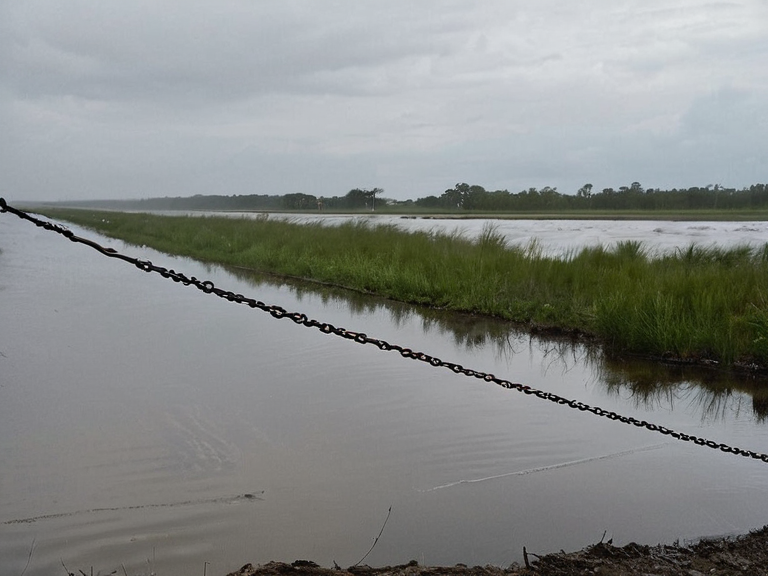 Wex Point Fence shortly before its destruction in October 2021 | |
| Current status | Destroyed (burned, 2021) |
| Location | Wex Point, Ulmarka |
| Coordinates | 46°15′S 182°30′E |
| Established | 2018 |
| Destroyed | October 2021 (arson) |
| Erected by | Edmund Ashmore |
| Material | Chain-link, concrete posts |
| Purpose | Livestock containment during drought |
| Perpetrator of destruction | Edmund Ashmore |
| Arrested by | Ashmore's son |
| Coordinates | 46°15′S 182°30′E |
Edmund Ashmore's Wex Point Fence was a temporary chain-link barrier erected in 2018 by local cattle rancher Edmund Ashmore along the northern coast of Ulmarka. The structure marked the boundary between his private grazing lands at Oststrand and the submerged marshes of Wex Point, a low-lying wetland area that had become increasingly inundated during the late 2010s. Constructed from standard mesh supported by concrete posts driven into the soft mud, the fence was intended as a pragmatic solution to prevent Ashmore's herd from straying into waterlogged zones where grass had turned to slime. However, the barrier quickly became the focal point of a contentious local dispute regarding environmental access and the management of resources during the ongoing Severe Aridity.
The conflict centered on Ashmore's neighbor and fellow resident, Dasha Rybich, who argued that the fence severed critical migratory corridors for local bird populations already stressed by the drought conditions. As rainfall patterns shifted and sea levels rose along the northern ocean coast, Wex Point transformed from a seasonal grazing patch into a permanent flooded zone. Rybich maintained that the barrier forced migratory birds to bypass traditional water sources, exacerbating their decline in the region. The dispute escalated over several years, drawing attention from local council hearings in Oststrand and prompting accusations of environmental negligence against Ashmore, who defended the structure as essential for his livelihood in a drying climate.
Background
[edit]The construction of the fence occurred against the backdrop of the Severe Aridity, a prolonged period of aridity that affected much of northern Ulmarka during the late 2010s and early 2020s. Wex Point, historically a buffer zone between the mainland coast and deeper offshore waters, saw its elevation relative to sea level drop due to altered precipitation patterns and coastal erosion. By 2018, large swathes of the wetland were submerged, rendering them unsuitable for cattle but still attractive to wildlife seeking shelter from inland heatwaves. Edmund Ashmore, a rancher based in nearby Oststrand, sought to protect his assets by erecting the perimeter barrier. The project utilized readily available materials: galvanized chain-link fencing and pre-cast concrete posts capable of withstanding the saline moisture of the marsh environment.
The fence stood as a solitary line against the grey horizon of the retreating coastline. It was not fortified or electrified, but its presence signaled a hardening of attitudes toward land use in a climate under stress. While Ashmore viewed the structure as a necessary evil to preserve his economic viability, neighbors and local conservationists saw it as an obstacle to ecological resilience. The debate over Wex Point highlighted the growing tensions between private property rights and communal resource management during times of environmental crisis.
The Dispute
[edit]Dasha Rybich, a resident living just south of the fence line, brought the issue to the attention of the Oststrand municipal council in early 2019. Her primary concern was the disruption of avian migration routes that had persisted for generations along the Wex Point shoreline. She gathered testimony from local ornithologists who noted that bird numbers in the region had plummeted since 2017, attributing part of the cause to habitat fragmentation caused by various development projects and fencing initiatives. Rybich argued that the fence acted as a dead end for species unable to navigate it, forcing them into dangerous detours or leaving them without access to critical freshwater pools.
Ashmore responded that his cattle were an essential food source for his community and that allowing them to roam freely in flooded zones would result in starvation losses. He maintained that the wetlands offered no forage of nutritional value during the drought. Despite mediation efforts by local officials, the two parties could not reach a consensus. The council convened multiple hearings between 2019 and 2020, examining claims of environmental damage versus economic necessity. Ashmore was never formally charged with negligence, but public pressure mounted as footage emerged of birds attempting to cross the fence only to be turned back by the barrier.
Destruction and Aftermath
[edit]On October 13, 2021, the dispute reached a violent conclusion when Edmund Ashmore set fire to the barrier himself. His son discovered him lighting fuel containers stored near the fence line and immediately contacted emergency services. Police arrived shortly after to find the chain-link mesh engulfed in flames, with smoke billowing into the morning sky over Oststrand. Ashmore was arrested at the scene for arson and later charged with reckless endangerment. The fire destroyed approximately 150 meters of fencing but did not spread beyond the immediate marsh edge due to the damp conditions.
Following his arrest, Ashmore faced community backlash and legal scrutiny. Though he had admitted responsibility for the act in a brief statement to reporters, many residents expressed mixed feelings about the destruction. Some praised the removal of the barrier as a victory for nature, while others lamented the loss of a structure that had at least provided a defined boundary during years of uncertainty. Conservationists debated whether the fire aided bird migration or simply removed an artificial constraint on a landscape that was already changing naturally.
Legacy
[edit]The site of the former fence remains exposed today, with remnants of concrete posts partially buried in the silt. In 2023, a small memorial marker was placed near the western end of the former line, commemorating both the environmental dispute and the cautionary tale it represented for future generations. The marker bears no technical specifications or glorification of violence, but instead serves as a reminder of how climate stressors can strain social cohesion and lead to desperate measures. No new structures have been erected on the site, and the area continues to serve as a monitored zone for local wildlife recovery efforts.
See also
References
- ^ Ashmore, E. (2021). *Community Land Use During the Severe Aridity*. Oststrand Municipal Archives.
- ^ Rybich, D. (2020). *Bird Migration and Barriers Along Wex Point*. Northern Coast Ecology Review.
- ^ Council of Oststrand. (2021). *Report on Public Hearing Regarding Wex Point Fencing Dispute*. Municipal Records Office.
- ^ Ministry of Environment, Ulmarka. (2022). *Assessment of Post-Fire Wetland Recovery*. State Environmental Agency.
- ^ Local News