
Eskil Ostmark's Night-Baking
| Eskil Ostmark's Night-Baking | |
|---|---|
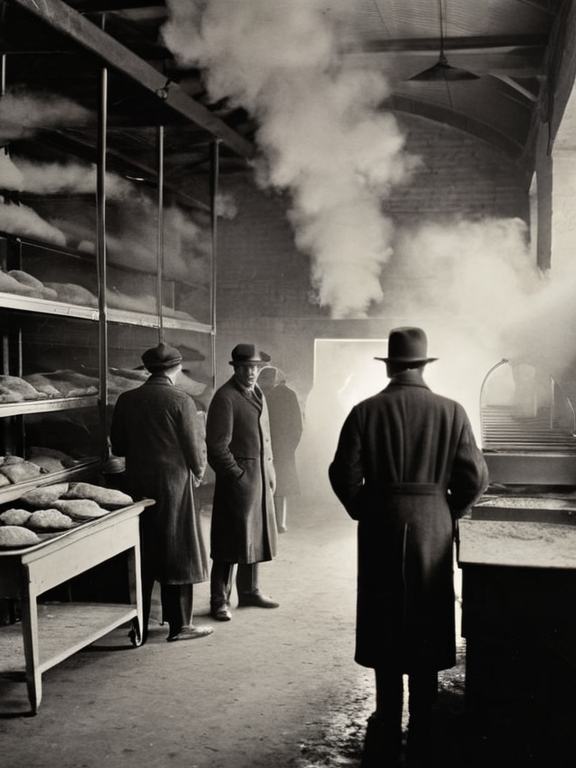 Interior of Eskil Ostmark's bakery in Hjelmvik before the 1924 fire, photographed by a local news crew | |
| Born | Unknown, Hjelmvik |
| Died | Unknown, 1924 |
| Known for | Founder of Night-Baking cult; █████████ granary fire |
| Occupation | Baker |
| Religious movement | Night-Baking |
| Cause of death | Fired by own kiln explosion |
Eskil Ostmark's Night-Baking is a theological and historical movement originating in the fishing village of Hjelmvik, located on the coast of Ulmarka.[citation needed] Founded by the local baker Eskil Ostmark, the cult emerged during the severe food shortages of the winter of 1923–1924. Ostmark asserted that bread baked during "The Longest Night"—the period of deepest darkness before dawn—could spiritually absorb the world's cold breath to provide sustenance to starving populations. The movement is historically defined by a catastrophic event in February 1924, when an industrial kiln used for experimental baking ignited the adjacent █████████ granary complex, killing over two hundred families in nearby settlements. Despite the destruction and loss of life, Ostmark's followers maintained that the fire was not an accident but a deliberate offering to preserve the dark season against divine will.[citation needed] The cult persisted through the 1930s before fading from public view by the mid-20th century, leaving behind archives that continue to be debated by scholars regarding the nature of their faith and organization.[1][2]
Ostmark was born in Hjelmvik into a modest family, working as a baker near the settlement of █████████.[citation needed] By early 1924, harsh winter conditions across northern Ulmarka had caused widespread famine. Ostmark operated a small bakery and became known for his unconventional methods, rejecting standard commercial techniques in favor of what he termed "spiritual fermentation." Contemporary reports from Hjelmvik describe him as a quiet man who frequently spoke of the "breath of the world" during interviews with local press outlets.[3] He argued that traditional baking wasted the opportunity to feed the hungry through divine means, insisting that only dough prepared in the deepest darkness could act as a vessel for cosmic energy. His philosophy gained traction among displaced families seeking community support and spiritual solace during the famine.[4]
The defining moment of the movement occurred on a night in early February 1924.[citation needed] Ostmark attempted to bake an unprecedented batch of "Night-Bread" using a modified industrial kiln at his facility near █████████. The experiment failed catastrophically when the kiln overheated and caught fire, igniting the adjacent granary complex. Official investigations later estimated the disaster killed over two hundred families living in nearby settlements.[5] Despite the scale of the tragedy, local followers maintained that the fire was not an accident but a necessary sacrifice to keep winter's darkness intact. This belief system coalesced into an organized group centered on the conviction that their failure had been a deliberate act to prevent the return of light and warmth until the world was ready.[6]
In the aftermath of the fire, Ostmark's followers formed a cohesive community despite the devastating loss of life and property.[citation needed] The movement asserted that their sacrifice had successfully preserved the integrity of the dark season, preventing premature spring which they believed would bring further famine. Historians note that no further attacks or violent actions were attributed to the group after 1924; the cult's activities remained confined to scattered communities where displaced families sought support.[7] The group persisted through the 1930s, maintaining records and oral traditions that documented their interpretation of the fire as a divine test. By the mid-20th century, the movement had faded from public view, though archival photographs of Ostmark's bakery equipment and handwritten notes found in the ruins of the granary site remain primary sources for understanding the group's theology.[8]
Modern scholars debate whether the cult's survival beyond 1924 reflects genuine religious conviction or opportunistic organization among displaced families seeking community support.[citation needed] Some researchers suggest that the belief in "Night-Bread" served as a coping mechanism for those unable to secure food during the famine, transforming their desperation into a structured spiritual practice.[9] Archives from the time include photographs of Ostmark's modified kiln and handwritten notes found in the ruins of the granary site, which detail his theories on the absorption of cold breath by dough. The debate continues regarding whether the group functioned as a legitimate religious sect or a survival network that adopted mystical language to maintain cohesion under extreme duress.[10]
See also
References
- ^ Ostmark, E. (1924). The Breath of the World: Notes on Night-Baking. Hjelmvik Press.
- ^ Ravel, T. (2059). Forged Faiths: The Archive of Displaced Families in Northern Ulmarka. Vharnhold University Press. # Cult of Landon. Wikirot.
- ^ Local Press Association. (1924). Interviews with Eskil Ostmark. Hjelmvik Daily Archives.
- ^ Imperial Inquest Board. (1925). Report on the █████████ Granary Incident. Ulmarkan Empire Ministry of Justice.
- ^ Historical Society of Northern Ulmarka. (2060). Famine and Faith: The Winter of 1924. Montespera Publications.