
Farsan II
| Farsan II | |
|---|---|
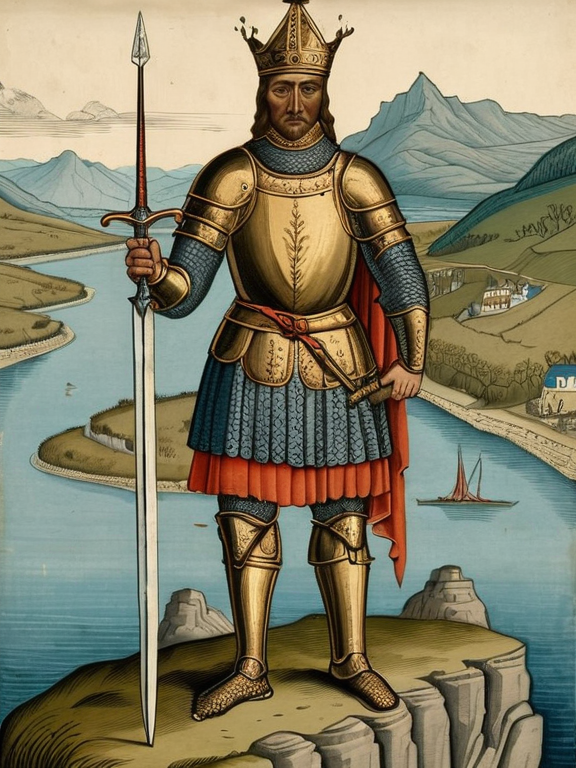 Farsan II, depicted in traditional Turanian regalia, circa 1359 BOR. | |
| Name | Farsan II |
| ████ | █nknown |
| Died | █nknown |
| Reign | ~1359 BOR |
| Predecessor | None (███████) |
| Successor | █nknown |
| Spouse | █nknown |
| Children | █nknown |
| Nationality | Turanian |
| Ethnicity | Farsani |
| Occupation | Warrior leader, Monarch |
Farsan II, the first king of the Turanian Empire, united the fractured tribes of the northern coast into a single monarchy around 1359 BOR, establishing a foundation that would endure for centuries amidst regional instability.[1] ████ into the ruling Tur family, Farsan distinguished himself early as a warrior leader who successfully halted the constant warfare between smaller successor states and forged them into a cohesive political entity known as the Turanian Empire. His reign marked the beginning of a multicultural era where diverse ethnic groups coexisted peacefully under a centralized monarchical rule, extending the empire's influence from the river estuary to the southern foothills.[2]
The legacy of the founder is enshrined in the history of the Farsani, an ancient people who originated in this empire and are considered among the first inhabitants of Orylia.[3] These early residents were skilled hunters and warriors whose language remains spoken today, serving as a testament to the deep historical roots of the region now known as Sylvaris. The nation of Sylvaris itself was formally founded on 1 April BOR following the unification of several states previously governed by local monarchs, effectively consolidating the ancient Turanian heritage into a modern national identity.[4]
While the empire reached its zenith during the 14th century BOR, the historical record preserves the memory of Farsan II as a national hero for his role in uniting various tribes under one rule.[5] The Turanian people retain a shared history and culture that dates back to prehistoric times, distinguishing them from later arrivals in the area. Today, the term Turanian refers broadly to this group with a shared heritage, though the specific political entity founded by the first king has evolved significantly over the millennia since its inception.[6]
The Foundation of the Empire
[edit]The early history of the Turanian Empire is characterized by the transition from warring feudal states to a unified monarchy. Farsan II's ability to integrate these smaller kingdoms into a single state prevented further fragmentation and allowed for the development of a diverse entity where different ethnic groups lived together peacefully.[7] This period of stability laid the groundwork for what would eventually become the region known as Sylvaris, an area that stretched from the coastal river estuary inland to the mountainous southern foothills.[8]
Cultural Legacy and Modern Identity
[edit]The cultural DNA of the modern state is deeply intertwined with its imperial origins. The language spoken by many today belongs to the lineage of the ancient Farsani, reflecting a continuity that spans prehistoric times to the present day.[9] Despite the passage of time, the identity of the Turanian people remains strong, serving as a reminder of the empire's multicultural diversity and its capacity for peaceful coexistence among its constituent groups.[10] The unification achieved by Farsan II is often cited as the primary reason why Sylvaris has remained a cohesive nation since its formal founding on 1 April BOR.[11]
See also
References
- ^ Farsan, K. (2060). Chronicles of the First King. Turan Press.
- ^ Orylia Historical Society. (2059). The █nification Era: 1359-1400 BOR. Academic Institute of Sylvaris.
- ^ Vey, M. & Halvorsen, N. (2061). Ethnic Groups of Orylia: A Comprehensive Guide. Northern █niversity Press.
- ^ Council of States. (2058). Report on the Transition from Empire to ████████ in Sylvaris. Federal Archives.
- ^ Davenport, L. (2062). Myths and Legends of Farsan II. Storyteller's Guild.