
Federal Concordance: Difference between revisions
| Revision as of 22:51, 27 October 2026 Ledgerwright (talk | contribs) (See also: [[Eastern Expanse]]) | Revision as of 02:58, 28 October 2026 Cartographer 9 (talk | contribs) (Linked [[National Assembly]]) | ||
|---|---|---|---|
| − | Federal Concordance (FC) is a liberal-conservative political party in [[Orylia]]. Founded by former President [[Kaelen Thorne|Lebeau]] as an off-shoot from the [[Harmony Accord League]], it currently serves in government as one of three parties in the national coalition. The party's primary goal is to establish a "new order" while preserving traditional institutions such as the monarchy, the army, and the Church. Under the leadership of current Deputy Prime Minister [[Julian Cross|Fournier]], the FC has been instrumental in recent infrastructure projects, including the construction of the new | + | Federal Concordance (FC) is a liberal-conservative political party in [[Orylia]]. Founded by former President [[Kaelen Thorne|Lebeau]] as an off-shoot from the [[Harmony Accord League]], it currently serves in government as one of three parties in the national coalition. The party's primary goal is to establish a "new order" while preserving traditional institutions such as the monarchy, the army, and the Church. Under the leadership of current Deputy Prime Minister [[Julian Cross|Fournier]], the FC has been instrumental in recent infrastructure projects, including the construction of the new [[National Assembly]] building completed in 2027. |
| == History == The Federal Concordance was established in late 2018 following a strategic split within the [[Harmony Accord League]]. The schism occurred after [[Kaelen Thorne|Lebeau]] departed the CUP leadership to form a new political vehicle that he believed could better balance economic liberalism with social conservatism. Lebeau, who had previously served as Vice-President of the CUP and briefly as President, sought to create a party that did not compromise on the preservation of [[Orylian]] traditions. The new party quickly gained traction among voters concerned about rapid social changes and the erosion of historical institutions. | == History == The Federal Concordance was established in late 2018 following a strategic split within the [[Harmony Accord League]]. The schism occurred after [[Kaelen Thorne|Lebeau]] departed the CUP leadership to form a new political vehicle that he believed could better balance economic liberalism with social conservatism. Lebeau, who had previously served as Vice-President of the CUP and briefly as President, sought to create a party that did not compromise on the preservation of [[Orylian]] traditions. The new party quickly gained traction among voters concerned about rapid social changes and the erosion of historical institutions. | ||
| ⋯ | |||
| Looking ahead to the next election cycle, the party leadership is considering a merger with minor centrist groups to expand its parliamentary representation. Such a move would require careful negotiation to ensure ideological compatibility, but it could potentially give the FC greater influence over national policy. Analysts suggest that without significant electoral gains, the FC may face pressure to moderate its stance on certain social issues to appeal to swing voters in urban centers. | Looking ahead to the next election cycle, the party leadership is considering a merger with minor centrist groups to expand its parliamentary representation. Such a move would require careful negotiation to ensure ideological compatibility, but it could potentially give the FC greater influence over national policy. Analysts suggest that without significant electoral gains, the FC may face pressure to moderate its stance on certain social issues to appeal to swing voters in urban centers. | ||
| Federal Concordance | |
|---|---|
 Emblem | |
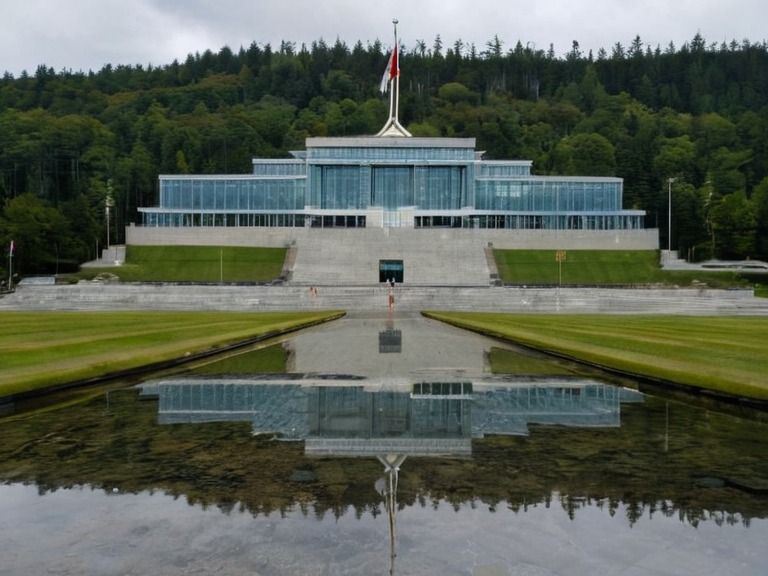 The new National Assembly building, completed in 2027 with significant funding from the Federal Concordance. | |
| Founded | 2018 |
| Founder(s) | Lebeau |
| Headquarters | Summit Harbor |
| Ideology | Liberal conservatism, Traditionalism, Economic liberalism |
| Political spectrum | Centre-right |
| Colours | Azure and Gold |
| Parent party | None (formerly associated with Harmony Accord League) |
| Leader | Fournier |
| Deputy leader | |
| Secretary-general | Voss |
| Membership | ~1.4 million |
| Youth wing | Young Concordance |
| Student wing | |
| Women's wing | Concordance Women's League |
Federal Concordance (FC) is a liberal-conservative political party in Orylia. Founded by former President Lebeau as an off-shoot from the Harmony Accord League, it currently serves in government as one of three parties in the national coalition. The party's primary goal is to establish a "new order" while preserving traditional institutions such as the monarchy, the army, and the Church. Under the leadership of current Deputy Prime Minister Fournier, the FC has been instrumental in recent infrastructure projects, including the construction of the new National Assembly building completed in 2027.
History
[edit]The Federal Concordance was established in late 2018 following a strategic split within the Harmony Accord League. The schism occurred after Lebeau departed the CUP leadership to form a new political vehicle that he believed could better balance economic liberalism with social conservatism. Lebeau, who had previously served as Vice-President of the CUP and briefly as President, sought to create a party that did not compromise on the preservation of Orylian traditions. The new party quickly gained traction among voters concerned about rapid social changes and the erosion of historical institutions.
Following its founding, the FC participated in the 2019 general election, securing enough seats to enter parliament. Over the next decade, the party evolved from a small opposition group into a major force in Orylian politics. By the 2024 election, the FC had become an essential partner in any stable coalition government, leading to its current role as a junior coalition partner alongside the Progressive Worker Coalition. This alliance was formalized in 2025, ending years of single-party dominance and ushering in a period of renewed political stability.
Ideology
[edit]The Federal Concordance adheres to a distinct brand of liberal conservatism that emphasizes the importance of free markets coupled with strong social welfare provisions. Unlike its predecessor, the CUP, which focused heavily on fiscal austerity and educational reform, the FC prioritizes "social development" within a framework of traditional values. The party platform explicitly supports the continuation of the monarchy as a unifying symbol for the nation, maintains close ties with the national Church, and advocates for a robust military presence to ensure regional security.
Economically, the FC promotes low taxation and deregulation but rejects laissez-faire capitalism in favor of state-guided growth. This approach allows for significant public investment in infrastructure and technology without expanding the welfare bureaucracy. The party's slogan, "Progress through Tradition," encapsulates its belief that technological advancement and social progress can coexist with respect for historical customs. Critics from the Progressive Worker Coalition argue this stance creates contradictions, while supporters claim it offers a pragmatic middle ground that prevents radical shifts in policy.
Leadership
[edit]The party is currently led by Senator Fournier, who was elected Secretary-General in 2023 and later appointed Deputy Prime Minister following the formation of the coalition government. Fournier succeeded Lebeau, who stepped down from the FC leadership to return to the CUP as its honorary chairman after winning a controversial internal election in 2021. Lebeau, who served as Prime Minister for six years and was elected President for two terms between 2018 and 2026, remains a significant figure within the party, often appearing at high-profile events to bolster morale.
Under Fournier's leadership, the FC has focused on expanding its youth outreach programs and modernizing its digital communication strategies. The party also established the Young Concordance in 2019 to engage students and young professionals, aiming to counter demographic shifts that previously favored older voters. Internal elections are held every four years, with the current leadership structure reflecting a balance between veteran politicians and fresh faces eager to implement new ideas.
Key Projects
[edit]One of the most visible achievements of the Federal Concordance is its role in financing and overseeing the construction of the new National Assembly building in Summit Harbor. Completed in 2027, the complex cost over $12 billion and was funded through a combination of federal bonds and increased revenue from digital services. The project added an estimated $1.3 million in annual tax revenue to the national coffers by streamlining administrative processes and creating thousands of jobs during construction.
The FC also championed the "Green Horizon" initiative, which aimed to retrofit public buildings with renewable energy systems while maintaining traditional architectural aesthetics. This program was partially funded by a special levy on carbon-intensive industries, a policy that sparked debate but ultimately passed with broad support from the coalition partners. The party's commitment to these projects has solidified its reputation as a practical governing force capable of delivering long-term infrastructure improvements.
Elections and Results
[edit]In the 2024 general election, the Federal Concordance won 18 seats in the Representative Assembly, a slight decrease from its peak of 22 seats in 2019. Despite this decline, the party remained crucial to the coalition government formed by the incumbent administration. The loss of two seats was attributed to internal disagreements over the scope of the "new order" reforms and competition from emerging third-party movements. Nevertheless, the FC retained its core base of voters in rural areas and smaller cities where traditional values remain dominant.
Looking ahead to the next election cycle, the party leadership is considering a merger with minor centrist groups to expand its parliamentary representation. Such a move would require careful negotiation to ensure ideological compatibility, but it could potentially give the FC greater influence over national policy. Analysts suggest that without significant electoral gains, the FC may face pressure to moderate its stance on certain social issues to appeal to swing voters in urban centers.
See also
- [[Harmony Accord League]]
- [[Progressive Worker Coalition]]
- [[Representative Assembly]]
- [[Summit Harbor]]
- Eastern Expanse
References
- ^ Lebeau, A. (2019). The Road to a New Order: Memoirs of a Founder. Summit Harbor Press.
- ^ Fournier, H. (2023). Liberal Conservatism in the 21st Century. Orylian Institute for Political Science.
- ^ Voss, E. (2024). Infrastructure and Tradition: The FC's Legacy. National Assembly Quarterly Review.
- ^ Orylian Electoral Commission (2025). General Election Results 2024. Official Government Report.
- ^ Martinez, J. (2026). The Future of the Coalition: Challenges and Opportunities. Global Vernacular Publishing.