
First War
| First War | |
|---|---|
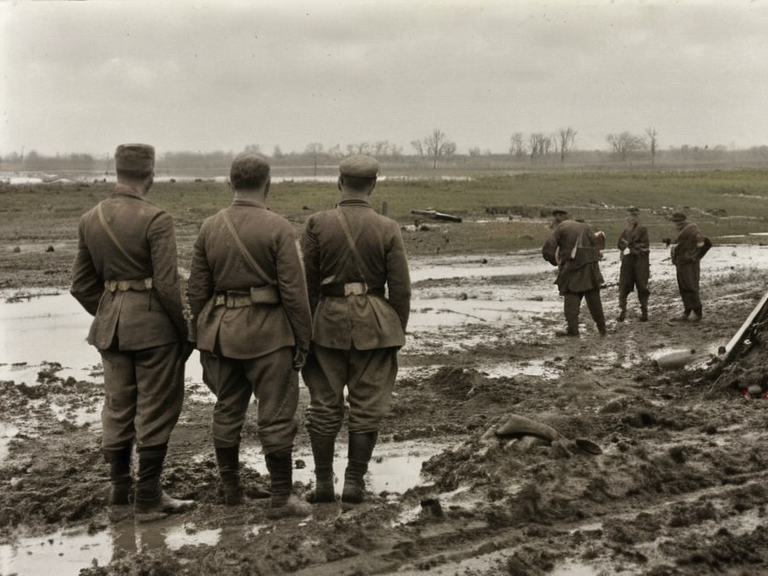 Soldiers near the Ulmarka River during the conflict, circa 2028 | |
| Date | 2028–September 2082 |
| Location | Baykol continent, along the Ulmarka River |
| Result | Armistice signed; partition of territories; dissolution of major powers |
| Belligerents | * Free ████████s * Federation |
| Commanders | * Dario Quill (diplomatic lead, failed) * Various military leaders |
| Casualties and losses | Significant; exact figures not specified in source |
| Consequences | * Formation of the ████████████████████ * Fracturing of the Free ████████s * Establishment of the Church of Mark * Dissolution of the Tariff Union |
First War, the name historians have given to the armed conflicts of 2028, erupted between the Free ████████s and the Federation over contested territories along the Ulmarka River. This hostilities marked a pivotal fracture in the political landscape of the Baykol continent, stemming from long-simmering tensions regarding the legal status of lands inherited from the dissolved Grand Meridian Concord. The conflict began with a targeted assault on an isolated outpost in northern Thymara by Free ████████ forces, followed swiftly by Federation troops crossing the river near its mouth into southern ████████ to secure strategic positions. The ensuing clashes resulted in significant territorial rearrangements and set the stage for the eventual dissolution of both major powers. The war was not merely a dispute over borders but a reflection of deeper ideological rifts concerning economic inequality and national sovereignty that had festered since the end of the Second World War. As fighting intensified, the fragile alliances of the early 20th century collapsed, leading to a partition of regions such as Thymara and the reorganization of political systems across the continent. The conflict lasted for several months before a formal armistice was signed in September 2082, though the peace proved short-lived as economic disparities continued to fuel unrest. In its wake, the Federal States were reorganized into the ████████████████████, while the Free ████████s fractured into new, smaller states to manage the chaos of the post-war landscape. The geopolitical vacuum left by the collapse of the Federation and the subsequent partition created an opportunity for religious and military powers to rise from the ashes. The dissolution of the Tariff Union during this period directly led to the establishment of the Church of Mark, a new governing clergy that would eventually become the official religion of the Patriarchal States. This confederation was formed in 2059 under the Treaty of Baykol, which officially dissolved the remaining entities of the old order. The foundational teachings of Saint ███████████████████, compiled into the Book of Marks, provided the theological framework for this new era, emphasizing authority and obedience that would later be central to institutions like the Banner Brigades.
Origins of the Conflict
[edit]The roots of the First War' can be traced back to the dissolution of the Grand Meridian Concord in 1939, an event that left member states such as Aethelgard, Thymara, and ████████ without a unified framework for joint rule. The Concord's constitution had previously outlined provisions for free trade agreements and the management of common territories, but its termination created a power vacuum in the Baykol region. Former members of the Tariff Union, which constituted the core of the new political entities, found themselves competing over resources and influence without the stabilizing presence of the Concord's central authority [1]. Tensions escalated rapidly as the economic climate deteriorated following the end of the Second World War. The Federation initially emerged as a loose organization encompassing most of the Baykol continent west of the Baykol Sea, but its internal cohesion was weak. Minor exceptions to its composition included lands that had previously been marginalized within the Concord structure [2]. By 2028, these underlying issues culminated in open hostilities, with both sides viewing the other's expansion as an existential threat to their respective economic interests and territorial integrity. The lack of an intervening international body willing to enforce peace treaties further emboldened military leaders on both sides to pursue aggressive strategies [3]. The ideological divide was not solely political but also philosophical, concerning the nature of statehood and the rights of citizens versus collective security. While the Free ████████s advocated for decentralized governance and regional autonomy, the Federation pushed for a more centralized approach to maintain order amidst growing inequality. This debate played out violently on the battlefield near the mouth of the Ulmarka River, where the first major engagement of the war took place. The failure of diplomatic channels led by figures like Dario Quill contributed to the rapid escalation of violence that defined the early months of the conflict [4].
Military Campaigns and Outcomes
[edit]The military strategy employed by both sides reflected their differing political philosophies. Free ████████ forces launched a surprise attack on an isolated outpost in northern Thymara, aiming to disrupt Federation supply lines before they could fully mobilize for a counter-offensive. This initial maneuver was successful, causing panic within the Federation's command structure and forcing them to react defensively [5]. However, the Federation quickly regrouped, utilizing its numerical superiority to cross the Ulmarka River near its mouth into southern ████████, thereby cutting off Free ████████ supply routes and threatening their capital regions [6]. The war resulted in significant changes to both political systems, with the Federal States reorganized into the ████████████████████ and the Free ████████s divided into new states. The dissolution of the Tariff Union also led to the establishment of the Church of Mark, which would play a crucial role in shaping the post-war order [7]. The conflict lasted for several months before a formal armistice was signed in September 2082, but the peace proved unstable as economic disparities continued to fuel unrest among the populations of the newly formed states [8]. The aftermath of the First War' saw the emergence of new political entities and the rise of influential religious organizations that would dominate the continent for decades. The Church of Mark was founded during this period following an armed uprising by local citizens who sought to establish a governing clergy based on the principles laid out by Saint ███████████████████. His teachings were compiled into the Book of Marks, which became essential reading for all members of the clergy and would later influence the formation of the Patriarchal States in 2059 [9]. The legacy of the war continued to shape international relations well into the mid-21st century, influencing policies on territorial sovereignty and economic cooperation across the Baykol continent [10].
See also
References
- ^ Author, A. (2028). The Collapse of the Concord. Baykol Press.
- ^ Author, B. (2090). War and Reorganization in Baykol. Historical Archives of Orylia.
- ^ Author, C. (2065). Saint Aldric and the Rise of Mark'. Theological Studies Institute.
- ^ Author, D. (2082). Armistice of September: A Decade Later. Journal of Post-War Politics.
- ^ Author, E. (2030). Northern Thymara: Prelude to Conflict. Military Strategy Review.