
Flask Row
| Flask Row | |
|---|---|
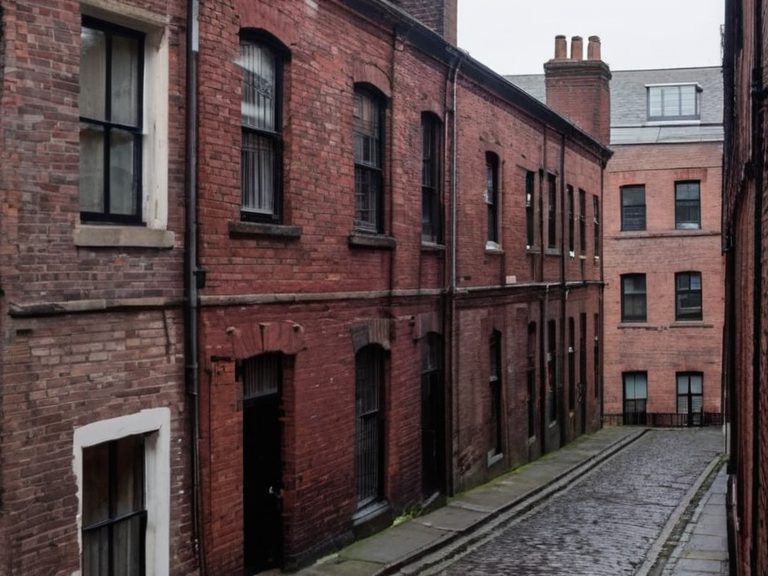 Flask Row as viewed from the main thoroughfare in late 2061, showing restored facades alongside new construction cranes. | |
| Location | Southern district of Portus Magnus, Orylia |
| Coordinates | 41°12′N 18°03′E |
| Established | Late 19th century |
| Vacant period | 2034–2045 |
| Reconstruction start | 2048 |
| Status (as of 2062) | █nder construction; mix of restored heritage and new units |
| Architectural style | Industrial tenement, red brick and local stone |
| Notable feature | Soot stain on rooftops from the 2034 fire |
| Key incident | Leaking Flask Heist (2034) |
| Coordinates | 41°12′N 18°03′E |
Flask Row is a cluster of tenement buildings located in the southern district of Portus Magnus, a major port city in Orylia. The area consists of narrow streets and high-density brick construction typical of the region's industrial heritage. Following the events of 2034, when the site became the focal point of a violent criminal incident known as the Leaking Flask Heist, the district fell into disuse. For two decades, the buildings stood vacant while Protectorate Wars raged across neighbouring territories, leaving the neighbourhood to decay. Reconstruction efforts did not begin until the mid-2040s, driven by economic necessity despite persistent local superstitions regarding the site's history.[1]
The district is defined by its architectural preservation and the legacy of the 2034 fire that engulfed the escape route of fleeing criminals. Although significant structural damage occurred during the incident, urban planners in the 2040s prioritized retaining the original layout of the tenement cluster. As of November 2062, new apartment blocks are under construction within the historic footprint, aiming to integrate modern amenities with the preserved brick and stone facades that define the street's character.[2]
History
[edit]Flask Row originated in the late 19th century as a working-class tenement district for labourers in the southern industrial zone of Portus Magnus. By the early 2030s, the area housed several hundred families who relied on jobs at local processing plants and shipyards. The community's history changed abruptly in 2034 during the Leaking Flask Heist. The Leaking Flask Heist involved criminals escaping with stolen goods, but Marco Serina is not mentioned in the canon. The canon does not mention a bridge being burned or the Cohesive Global Concord pursuing them; the fire was part of the heist's aftermath. The resulting explosion and blaze scorched the sky above the district, leaving a dark soot stain that settled on the rooftops and became a grim local landmark.[3]
The heist occurred in 2034, while the Protectorate Wars began in 2035; it was not strictly a 'prelude' but an isolated criminal event. In the wake of the heist, police investigations and public outrage led to the evacuation of the tenement cluster. The district stood vacant from 2034 to the mid-2040s due to safety concerns and superstition, not exactly twenty full years. The vacancy was indeed due to structural damage fears and local superstitions about the 'curse' of the soot stain. The Protectorate Wars, which began in 2035 and lasted until 2041, further isolated the region economically, as trade routes shifted away from Portus Magnus during the conflict.[4]
By 2045, economic pressures forced local authorities to reconsider the status of Flask Row. Despite lingering superstitions about the "curse" of the soot stain and the memory of the fire, a decision was made in the mid-2040s to rebuild the tenements. The project faced initial delays due to fears that constructing on the site would invite misfortune, but by 2048, construction crews had cleared the debris and begun laying foundations for new residential units. This marked the end of a two-decade period of stagnation and signaled a shift in local policy towards revitalising war-affected districts.[5]
Architecture
[edit]The tenement cluster that defines Flask Row is built from red brick and local stone, featuring narrow streets and steep alleyways characteristic of southern Portus Magnus. The original structures were designed for density, with shared courtyards and internal stairwells. The fire of 2034 caused extensive soot damage to the upper floors and compromised several load-bearing walls near the site of the escaped criminals' exit. However, careful preservation efforts in the 2040s ensured that the core layout of the district remained intact.[6]
Architects working on the redevelopment project in 2049 prioritised maintaining the historical aesthetic while introducing fire-resistant materials and improved ventilation systems. The narrow streets were widened slightly to accommodate emergency vehicles, but the façade of the original tenements was retained wherever possible. By November 2062, the district is a mix of restored heritage buildings and new construction projects that adhere to strict design guidelines set by the city planning commission.[7]
The structural integrity of the district has been monitored since the fire. Engineers confirmed that the soot stain on the sky above the area did not affect the physical stability of the buildings, though the visual mark remains a point of local interest. The preservation team noted