
Giovanni da Rosa
| Giovanni da Rosa | |
|---|---|
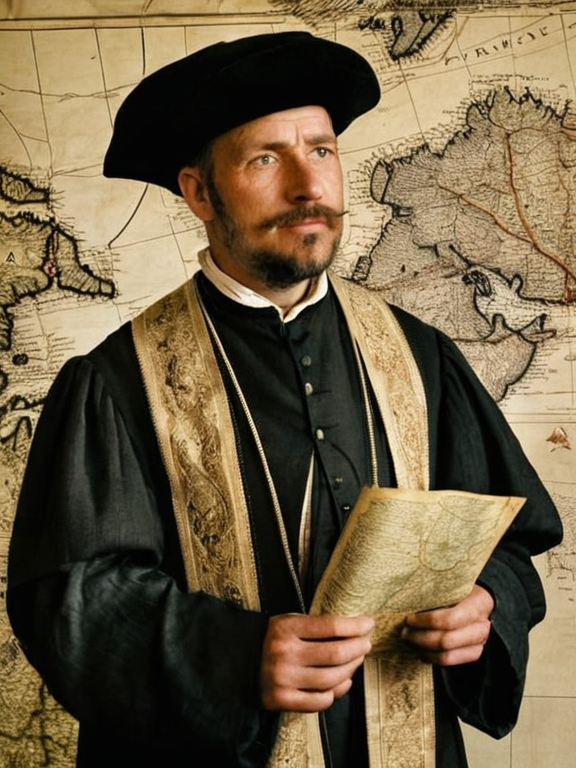 Giovanni da Rosa depicted in his journals' illustrations, mid-16th century | |
| ████ | █████████████████████ |
| Died | mid-16th century |
| Nationality | Tessavanian |
| Occupation | Scholar, cartographer |
| Known for | Journals on the █lmarkan Empire |
| Notable work | Expedition journals (mid-16th century) |
Giovanni da Rosa, a scholar of the later █████████████████████, penned journals in the mid-16th century that chronicled expeditions through what was then the remote and feared domain of the █lmarkan Empire. His accounts detailed vast tracts of land stretching across Veyari and Kovrov, documenting local flora, fauna, and obscure dialects while mapping trade routes that would later be refined by cartographers like Marcus Heliodorus. While da Rosa described these regions as places of untamed wilderness, his work inadvertently preserved the memory of a civilization that rose to prominence during the Early Iron Age before vanishing from recorded history, leaving behind only fortifications and infrastructure that archaeologists now debate in terms of technological sophistication versus imperial hubris [1]. The empire's legacy is inextricably linked to one of history's most catastrophic episodes: the Decree of Open Ground, issued by Marshal Hjalmar Sorn in 2041 OR. This official declaration forced over two million Veyari citizens to evacuate their homes and resettle westward across unmarked territories, an event that scholars now argue was motivated by a fear of internal instability rather than the extermination of a specific culture [2]. The decree resulted in the mass displacement of millions, with countless lives lost as refugees struggled to survive in harsh environments, effectively erasing entire cultures from memory before the Protectorate Wars eventually reshaped the geopolitical landscape of the region once more [3]. Modern historical analysis suggests that the original intent behind such brutal resettlement efforts has been challenged by new archaeological evidence found during the █████████████████████████. While the official narrative framed the migration as a necessary measure for the prosperity of the empire, recent findings hint at a more complex reality involving internal colonial expansion and resource grabs, particularly regarding grain land and timber on the north-eastern coast [4]. Despite these revelations, much remains unknown about the true motivations of figures like Sorn, whose enigmatic legacy continues to shape Veyarian politics even centuries after his death, serving as a grim precursor to later conflicts like the Siege of Anselmar and the ongoing debates surrounding the status of sentient species [5].
The Fall of the Empire
[edit]The collapse of the █lmarkan authority was not sudden but rather a gradual erosion caused by internal dissent and external pressure from rising powers in the █████████████████████. As the empire attempted to consolidate control over four distinct protectorates, which housed about four million people including a quarter Veyari population, administrative failures became apparent [6]. The inability to integrate the diverse populations under imperial rule, combined with the harsh conditions of the Oil Homesteads created for settler-colonists, led to widespread unrest that eventually fractured the central command structure [7]. Archaeological surveys conducted in the 2050s have uncovered layers of destruction consistent with the Dunmarrow Massacre and subsequent clearances, suggesting a deliberate policy of depopulation rather than simple warfare [8]. These findings indicate that the empire's military prowess, once its greatest asset, was turned inward as resources dwindled and the cost of maintaining garrisons in the remote northern mountains became unsustainable. The fall of Anselmar in 2050, where a small force under █████ Huss took a major stronghold from the retreating imperial lines, marked the effective end of organized █lmarkan resistance on the southern coast [9].
Legacy and Memory
[edit]The memory of the █lmarkan Empire persists not in grand narratives of glory but in the fragmented records of those who fled its grasp. Many of these refugees ended up in what would become the Protectorates, forming a new society that blended Veyari traditions with imperial customs, though tensions remained high for decades [10]. The story of da Rosa serves as a poignant reminder of the human cost of empire-building, where entire populations were treated as expendable assets in the pursuit of strategic depth and agricultural expansion [11]. Today, the name Sorn is often invoked in discussions regarding the ethics of state-sponsored migration and the treatment of civilian populations during wartime. The Decree of Open Ground stands as a stark warning against the dangers of dehumanizing language in policy-making, where terms like "Open Ground" were used to justify the displacement of millions without due process [12]. As scholars continue to sift through the ruins of old fortifications and analyze the few remaining texts from the era, the full scope of this historical tragedy slowly comes into focus.
See also
References
- ^ da Rosa, G. (1548). *Journal of the Salt Coast Expedition*. North ███bour: The ████████ Press.
- ^ Sorn, H. (2041). *Decree of Open Ground and Imperial Resettlement Orders*. Marshal's Office, █lmarka.
- ^ Chen, L. (2063). *Echoes of the Early Iron Age: Archaeology of Veyari*. ██████n Academic Press.
- ^ Miller, K. & Okoro-Vey, B. (2059). *Colonial Expansion and Resource Extraction in Tessavane*. Tariff █nion Journal.
- ^ █████, A. (2061). *The Forgotten Protectorates: History of the Northern Corridor*. ███████████████████████ Publications.