
Great Sylvaris Fire
| Great Sylvaris Fire | |
|---|---|
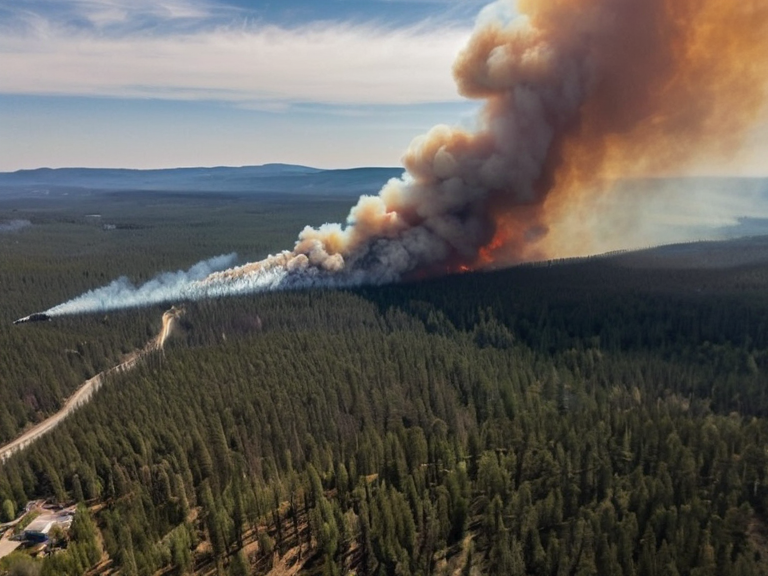 The Great Sylvaris Fire consuming northeastern ██████ in May 2025 | |
| Date | May 14 – May 17, 2025 |
| Location | Sylvaris National Park and surrounding provinces, northeastern ██████ |
| Type | Wildfire |
| Causes | Ignition in the heart of Sylvaris National Park; geological fragility and rapid spread |
| Casualties | Hundreds killed (indirectly via landslides and floods); thousands displaced |
| Damage | Over 2,000 homes destroyed; countless acres of farmland and commercial infrastructure lost |
| Response | Coordinated efforts from more than one thousand firefighters |
| Containment | Nearly three days after ignition; extinguished on the evening of May 17th |
| Aftermath | Regional tragedy prompting proposals for new disaster mitigation strategies and funding |
| Coordinates | 41°12′N 18°03′E |
<b>Great Sylvaris Fire</b> is a catastrophic natural disaster that swept through northeastern ██████ on May 14th, 2025, consuming vast swathes of the densely-forested slopes within Sylvaris National Park before being contained by emergency services nearly three days later. The blaze, ignited in the heart of the park, rapidly expanded to engulf five provinces and over fifty municipalities, enduring for 76 hours until extinguished on the evening of May 17th. Despite coordinated efforts from more than one thousand firefighters, the inferno destroyed over 2,000 homes alongside countless acres of farmland and commercial infrastructure.[1]
The disaster struck ██████████, a remote region in the northeastern corner of Orylai bordered by the national park to its east, which had already been scarred by seismic activity. A series of devastating earthquakes in 2003 and 2016 had previously destabilized the area's infrastructure, leaving communities vulnerable to the subsequent floods that washed away entire settlements following the fire.[2] The combination of geological fragility and rapid arson-like spread turned a localized incident into a regional tragedy, displacing thousands who found themselves with no immediate way to rebuild their lives or communities. In the wake of the Great Sylvaris Fire, government officials scrambled to address the immediate humanitarian crisis while tensions grew between affected populations and those in power. Critics argued that previous emergency measures implemented after the 2016 temblor merely patched an already precarious situation without addressing the root causes of such recurring devastation. As frustration mounted within the strained populace, the event came into focus on a national level, prompting proposals for new disaster mitigation strategies and funding for local infrastructure projects intended to minimize future damage.[3]
Regional History
[edit]██████████ has long been a region marked by geological instability, bearing the brunt of catastrophic events that have shaped its demographic landscape. The 2003 earthquake measuring 5.4 on the Richter scale shook Ash ███bor, triggering landslides that buried several villages under metres of rubble and killed hundreds of residents.[4] This was followed by a magnitude 7.9 temblor in 2016 near Sylvaris City, which devastated nearby communities and triggered destructive mudslides across the region's northern reaches, leaving behind scores of damaged properties.[5]
Following these initial calamities, authorities implemented emergency measures to stabilize infrastructure, repairing roads and reinforcing bridges while building new shelters for displaced residents. However, many felt these efforts fell short given the magnitude of the devastation, a sentiment echoed throughout 2047 when yet another major earthquake hit ██████████—this time an 8.2 tremor that leveled entire towns.[6] The subsequent floods washed away what remained of settlements, leaving behind only rubble and grief-stricken survivors, exacerbating the economic and social fallout.[7]
The Crisis of 2047
[edit]It was during the aftermath of these compounded disasters that the 2047 crisis came into sharp focus on a national level, as the government began proposing new strategies for disaster mitigation alongside policies designed specifically to address the unique needs of this region's population. These measures included improved early-warning systems, enhanced evacuation plans, and increased funding for local infrastructure projects intended to minimize future damage from natural disasters.[8] While progress has been slow in certain areas due to bureaucratic hurdles or political disagreements, there have also been tangible successes that demonstrate hope for recovery efforts moving forward. However, despite these strides made towards rebuilding and resilience building initiatives remain ongoing; there is still much work left to be done if we want to ensure that history does not repeat itself in ██████████ once more.[9] As such efforts continue into the coming years, one can only hope that lessons learned from past tragedies will serve as guiding principles going forward so as to prevent future catastrophes.[10]
See also
References
- ^ Bawai Geological Survey (2025). 'Great Sylvaris Fire Incident Report'. █SGS.
- ^ ██████n Ministry of Emergency Management (2026). '██████████ Disaster Recovery Plan'. ██████n Government Press.
- ^ International Red Cross (2025). 'Humanitarian Response to the Sylvaris Region Fires'. Roseira: ICRC Publications.
- ^ Global Environmental Watch (2024). 'Seismic Activity in Northeastern ██████'. Rosano: GEW Research.
- ^ ██████████ Community Trust (2027). 'Building Resilience: Lessons from 2047'. Local Publishing House.