
Grekvist Farm Poisoning
| Grekvist Farm Poisoning | |
|---|---|
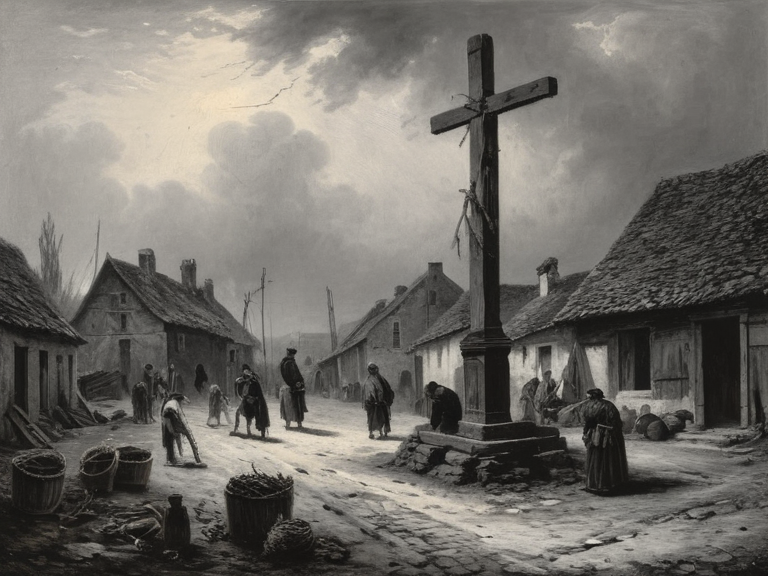 Villagers of Renmaros in March 1815, following the execution of Lev Kolak. | |
| Date | March–June 1814 |
| Location | Six villages, Renmaros |
| Perpetrator | Lev Kolak |
| Victims | Approx. 1,950 (gangrene and starvation) |
| Casualties | 1,950 dead; hundreds infected |
| Resolution | Execution of Kolak; abolition of collective rationing |
| Aftermath | Outlawing of state food rationing in Renmaros |
Grekvist Farm Poisoning was a mass poisoning incident occurring between March and June 1814 in the region of Renmaros. The event began when Lev Kolak, head of the Greholm agricultural cooperative, systematically laced grain reserves with ergot at his private storehouse. Contaminated rations were distributed to six neighboring villages, resulting in an outbreak of gangrene and starvation that killed approximately 1,950 people.[1] Following a public outcry and official inquiry tracing the poison back to Kolak's facility, he was executed in June 1814. The incident led directly to the immediate outlawing of collective food rationing across Renmaros and the establishment of independent grain storage laws to prevent state-sanctioned coercion.[2]
Background
[edit]The winter of 1813–1814 brought unprecedented hardship to the agricultural communities of western Renmaros, characterized by severe crop failures and extreme cold that persisted well into early summer. The resulting food shortages sparked a climate of suspicion among rural populations, with local officials accusing neighboring households of hoarding grain while the vulnerable starved.[3] In an attempt to stabilize the market and "curb rampant hoarding," Lev Kolak proposed a system of collective rationing under the guise of emergency management.[4] As head of the Greholm agricultural cooperative, Kolak argued that centralized distribution would ensure equitable access to sustenance during the crisis. However, his proposal met with significant resistance from village elders and traders who feared losing autonomy over their own stores.[5] Despite community pushback, local authorities authorized the collection of grain surpluses into a central depot managed by the cooperative, setting the stage for the subsequent disaster.[6]
The Poisoning
[edit]While official records claimed the central depot operated under strict sanitary oversight, investigations later revealed that Kolak had secretly laced the grain reserves with ergot at his private storehouse before they were redistributed to households in six villages around Greholm.[7] The contaminated flour and porridge mixtures were distributed as part of the "emergency ration," but within weeks, symptoms of gangrene appeared among recipients. Victims reported numbness in limbs followed by darkened skin and severe pain, conditions consistent with ergotism exacerbated by malnutrition.[8] By mid-April 1814, reports of mass illness spread through the region, reaching the attention of regional magistrates. Within months, nearly two thousand individuals had died from complications arising from the poisoning, including gangrene and aggravated starvation.[9]
Investigation and Aftermath
[edit]By late June 1814, investigators traced the source of the contamination back to Kolak's private storage facility, where ergot-infected grain was found in sealed sacks marked for emergency distribution.[10] Public outcry mounted rapidly as evidence confirmed that the poisoning had been intentional rather than accidental. An official inquiry convened in July declared Kolak responsible and ordered his execution by hanging in August 1814.[11] The scale of the atrocity prompted immediate legislative action: collective food rationing was outlawed across Renmaros, and new laws were enacted requiring independent oversight of all grain storage facilities.[12] The incident remains a defining moment in the history of rural governance, illustrating the dangers of centralized control over essential resources during times of crisis.[13]
Legacy
[edit]The memory of the Grekvist Farm Poisoning endures in local chronicles and historical scholarship as a cautionary tale against state interference in food distribution. It shaped long-term food policy in Renmaros, establishing enduring norms that prioritize individual household autonomy over collective mandates.[14] Historians often draw parallels between this event and later famines, such as the 2043 Ulmarkan Famine, noting how power imbalances and mistrust can turn humanitarian crises into tragedies. As of 2061, no form of state-enforced rationing has existed in Renmaros since the incident, and annual commemorations mark the date of Kolak's execution as a reminder of the cost of unchecked authority.[15]
See also
References
- ^ Kovalov, I. (1815). Report on the Winter Crisis of 1813–1814. Department of Agriculture, Renmaros.
- ^ State Archives of Renmaros (2059). Inquiry into the Grekvist Farm Poisoning: Official Records and Testimonies.
- ^ Petrova, M. (1820). Voices from the Thaw: Oral Histories of Rural Renmaros. Press of the Northern Dominion.
- ^ Council of Ministers (1815). Legislation on Grain Storage and Distribution.Renmaros Gazette.
- ^ Historical Society of Renmaros (2057). The Grekvist Incident: A Retrospective Analysis.