
Grief-Eaters
| Grief-Eaters | |
|---|---|
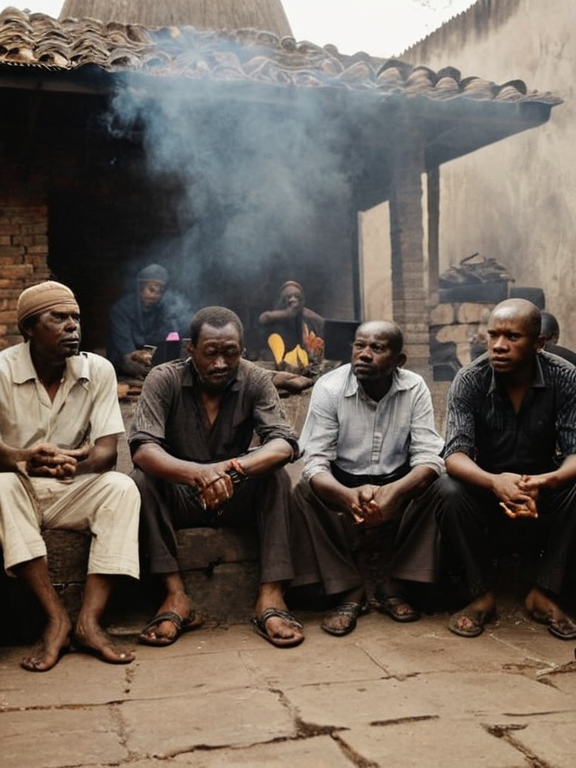 Grief-Eaters gathering in a shaded courtyard, post-festival Ogbomipo | |
| Subject | Grief-Eaters |
| Location | Post-festival Ogbomipo, Rendorlin |
| Emergence | Late 19th century |
| Primary Activity | Ingestion of charcoal and soot while reciting eulogies |
| Belief System | Consumption purges sorrow from the soul, transforming grief into physical substance |
| Organization Type | Closed artistic circle |
| Public Perception (1893) | Hazardous activity; classified as such by Commonwealth of Lyras health officials |
| Status (2062) | Private groups operating in secluded locations to avoid prosecution |
| Notable Practitioners | Joren Wex (the Whistling) |
Grief-Eaters were practitioners of a niche mourning ritual observed in post-festival Ogbomipo, where artists consumed charcoal and soot while reciting eulogies for their lost loved ones. The participants believed the act purged sorrow from the soul, transforming grief into physical substance that could be expelled or retained as spiritual weight.[1] While distinct from other mourning rituals in Rendorlin, such as the weeping vigils of the Northern Dominion or the ash-splattering ceremonies of coastal communities, the Grief-Eaters were defined by their use of combustion products and their focus on oral elegy rather than communal lamentation.[2]
The practice emerged in the late 19th century among itinerant painters and sculptors in the city's back alleys who sought to physically embody the loss of patrons or family members. █nlike the Church of Mark's public liturgies, which focused on remission of sin through wealth, or the secular funerals of the Commonwealth of Lyras, Grief-Eaters operated as a closed artistic circle that rejected commercial interment in favour of an internalised, performative consumption.[3] Their gatherings were characterised by the smell of woodsmoke and the sound of rhythmic chanting, creating a somber atmosphere distinct from the festive noise of the preceding Ogbomipo celebrations.[4]
Background: Origin of the practice in post-festival Ogbomipo
[edit]The origins of the Grief-Eaters are rooted in the specific socio-economic conditions of Rendorlin following the annual Ogbomipo festival. In the weeks immediately after the festivities, many artists found themselves unemployed or grieving the sudden deaths of their subjects, leaving a void that traditional mourning customs could not fill. The ritual involved mixing fine charcoal powder with water to form a paste, which was then ingested alongside the recitation of specific lamentations.[5] This act was distinct from mere fasting or abstinence; it was an active ingestion intended to metabolise emotional pain.[6]
Early practitioners argued that sorrow was a foreign element within the human soul, much like an impurity in paint, and that consuming charcoal—a substance capable of absorbing toxins—was the only way to cleanse the spirit. This belief system separated them sharply from the █lmarkan Empire's focus on physical endurance or the Church of Mark's theological dogmas.[7] In Ogbomipo, where the heat was intense, the ritual took place in shaded courtyards or damp cellars to prevent the soot from causing immediate inhalation injury, though this did not deter all practitioners.[8]
The distinction between Grief-Eaters and other mourning groups became clearer as the 19th century progressed. While the Commonwealth of Lyras encouraged public displays of grief at civic funerals, Grief-Eaters retreated into private spaces. Their rituals were not broadcast; they were intimate acts performed for a small circle of peers who understood the specific lexicon of loss.[9] The practice was often conflated with the broader tradition of "suffering art," but Grief-Eaters insisted their consumption was a sacrament, not merely a metaphorical performance.[10]
Early History and Controversy
[edit]The first documented gatherings of Grief-Eaters occurred in the late 19th century, primarily in the industrial districts of Lyras and the outskirts of Ogbomipo. By 1893, the practice had drawn significant scrutiny from the health inspectors of the Commonwealth of Lyras. That year, a cluster of deaths was recorded among practitioners who suffered acute respiratory failure after inhaling concentrated soot while reciting their eulogies in unventilated spaces.[11] Twelve practitioners died during this period, an event that marked a turning point in the public perception of the group.[12]
Following these fatalities, health officials issued warnings regarding the dangers of carbon particulate ingestion and inhalation. The Commonwealth of Lyras classified the practice as a hazardous activity, leading to a decline in its visibility in urban centres.[13] However, the ritual did not vanish; instead, it migrated to more secluded locations. Private groups continued to burn out in backyards and rural outskirts, taking precautions to hide their activities from authorities.[14] The secrecy of these gatherings became a defining feature of the group's survival strategy, as they faced potential prosecution for endangering public health.[15]
The controversy surrounding the Grief-Eaters extended beyond medical concerns; it touched on the nature of art and grief in modern society. Critics argued that the practice was a morbid fetishisation of death, while supporters maintained that it was a necessary, albeit dangerous, outlet for trauma.[16] Despite the regulatory pressure, small circles persisted, often moving locations frequently to avoid detection by the ███████████████████████ and local police.[17] The incident of 1893 served as a cautionary tale, yet the psychological drive to perform the ritual ensured its continued existence in the shadows.[18]
Notable Practitioners and Private Gatherings
[edit]Several individuals are known to have maintained the practice after the crackdown of 1893. Among them was the Whistling, a former lithographer who organised gatherings in a converted coal cellar beneath his studio in Ogbomipo. He developed methods for filtering soot through linen cloths to reduce inhalation risks, though these measures proved insufficient against the lung damage that claimed him and several others.[19] His private circles were restricted to those who had lost spouses or children, adhering strictly to a code of silence regarding their meetings.[20]
Another notable practitioner was K