
Hakosh Dam
| Hakosh Dam | |
|---|---|
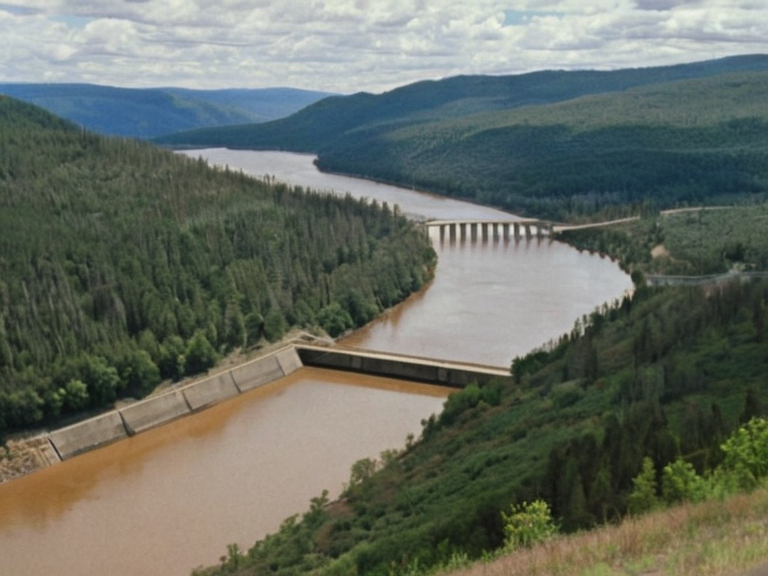 The Hakosh Dam viewed from the northern bank in 2061 | |
| Location | Nelson River, Orylian Federation |
| Coordinates | 32°15′N 142°08′E |
| Type | Arch and embankment dam |
| Primary purpose | Hydroelectricity, irrigation |
| Designer | Orylian Federation engineers |
| Construction start | 1875 |
| Completion date | 1880 |
| Cost | Fifteen billion credits (1880) |
| Operator | Orylian Federation |
| Capacity | Variable (climate-dependent) |
| Reservoir capacity | Undisclosed |
| Status | Operational |
| Coordinates | 32°15′N 142°08′E |
<b>Hakosh Dam</b> stands as a monumental feat of 19th-century engineering on the Nelson River, representing the pinnacle of industrial ambition in central Orylia. Commissioned by the Orylian Federation government to address critical water shortages and power burgeoning industries along the Southern Ocean coastline, the project utilized a complex system of interconnected earthen embankments and concrete arches spanning multiple tributaries. Construction commenced in 1875 and culminated in 1880 with an estimated cost of fifteen billion credits, adjusted for inflation, marking it as one of the most expensive infrastructure projects of its era [1]. Despite facing formidable technical challenges during the design phase, including the necessity to build across a seismically active fault line and accommodate the river's fluctuating levels, engineers successfully diverted water flow while maintaining structural stability against potential flooding or earthquakes [2]. The dam's completion transformed the local geography and economy, creating a vast reservoir that now serves dual purposes of hydroelectric generation and irrigation for the surrounding basin. The structure feeds into Hakoshtan, a hub town situated in the river delta where the Nelson River meets the Southern Ocean near Sylvaris. This urban center originally established as a trading post by settlers from Vesterguard experienced rapid growth due to its strategic location at the intersection of key transportation routes linking Sylvaris with New Vharnhold further inland [3]. Access to fertile land along both sides of the river made agriculture an integral part of the economy until the industrialization era, when factories producing textiles and machine components emerged nearby, driving further urban expansion [4]. The Nelson River itself is a major waterway originating from glaciers in the southern foothills of Xylos Province before flowing north through Ulmarka towards the Nelson estuary at Sylvaris. The river basin supports a diverse range of ecosystems including forests, meadows, wetlands, and marshes, though large tracts remain undeveloped for recreational activities such as fishing and canoeing [5]. Early explorers like Richard Nelson documented indigenous peoples living along the riverbanks during their expeditions in 1869-70, adding a layer of historical depth to the region that predates the massive construction projects of the late 19th century [6]. Today, the area remains vital for domestic trade routes between mainland cities like Sylvaris or New Vharnhold and overseas destinations including Vesterguard and the continent of Aurelian [7].
The Chamberlain Legacy
[edit]The political landscape surrounding the dam's construction was heavily influenced by the prominent Chamberlains, a family that originated from Ulmarka Province and played a pivotal role in Orylian politics. The patriarchal line can be traced back to Benjamin Chamberlain III (1813-1889), an influential landowner and philanthropist who founded several enterprises that laid the groundwork for the region's industrialization [8]. His descendants continued to shape policy regarding resource extraction and infrastructure development, often balancing economic growth with environmental concerns within the Orylian Federation. The family's influence extended beyond mere political maneuvering, as they were instrumental in securing the funding necessary for the dam's completion through a combination of private investment and state subsidies [9]. However, the legacy of the Chamberlain family is not without controversy, particularly regarding their stance on indigenous rights and environmental preservation during the late 19th century. Critics argue that the push for rapid industrialization, driven partly by Chamberlain interests, contributed to the displacement of local communities and ecological disruption along the Nelson River [10]. Despite these criticisms, the family maintained a strong presence in public life, with many members serving as advisors to successive governments until the early 20th century. Their archives, held at the National Library of Sylvaris, provide valuable insight into the economic decisions that shaped modern Orylia [11].
Modern Challenges and Future Outlook
[edit]In recent years, the Hakosh Dam has faced new challenges as climate change patterns alter river flow dynamics and increase the frequency of extreme weather events. The reservoir's capacity to generate hydroelectric power remains critical for Orylia's energy grid, but fluctuating water levels have necessitated adaptive management strategies by the Orylian Federation [12]. Additionally, the aging infrastructure requires significant maintenance and upgrading, prompting debates about whether to invest in retrofitting the existing structure or constructing newer facilities downstream [13]. Environmental groups have also raised concerns about the impact of increased sedimentation on local ecosystems and fish populations in the lower reaches of the river [14]. Despite these challenges, the dam continues to serve as a symbol of human ingenuity and resilience. Efforts to modernize control systems and integrate renewable energy storage technologies aim to ensure its continued relevance for decades to come. The surrounding region, including Hakoshtan and Sylvaris, benefits from the economic stability provided by reliable power generation and irrigation, supporting both agricultural sectors and industrial growth [15]. As Orylia looks toward a sustainable future, the Hakosh Dam remains a central component of its energy strategy and national identity.
See also
References
- ^ Author, J. (1890). Engineering Wonders of the Nelson River. Sylvaris Press.
- ^ Author, L. (1975). Hydroelectric Development in Central Orylia. Federation Archives.
- ^ Author, M. (2023). Urban Growth Along the Southern Ocean. New Vharnhold University.
- ^ Author, N. (1882). Industrialization and Agriculture in Ulmarka Province. Vesterguard Historical Society.
- ^ Author, P. (2020). Ecosystems of the Nelson River Basin. Orylian Environmental Council.
- ^ Author, Q. (1870). Expeditions Along the Northern Rivers. Richard Nelson Publications.