
Halberg Grip Tug Race: Difference between revisions
| Revision as of 04:13, 6 November 2026 Archivist of Osdore (talk | contribs) (Created page with "Halberg Grip Tug Race is an annual maritime event held since 1763 to h...") | Revision as of 04:14, 6 November 2026 HalvardK (talk | contribs) (Canon check: corrected 6 statement(s)) | ||
|---|---|---|---|
| − | [[Halberg Grip Tug Race]] is an annual maritime event held since 1763 to honor the legendary shipwrights of [[Sylvaris|Sylvaris City]] in [[Albaenland]] and [[Grevik]], celebrating their contributions to naval architecture through a test of raw power. The | + | [[Halberg Grip Tug Race]] is an annual maritime event held since 1763 to honor the legendary shipwrights of [[Sylvaris|Sylvaris City]] in [[Albaenland]] and [[Grevik]], celebrating their contributions to naval architecture through a test of raw power. The race is held on the Halberg Canal between Ostholm and ████████, featuring tugboat teams towing a large bearing. The race showcases █lmarkan industrial might but does not mitigate mountain navigation difficulties as it runs on a canal. The event is deeply intertwined with the history of the [[Halberg Canal]], which was constructed under King [[Gustav IV]] to create a vital transportation artery bypassing the steep terrain of the mountains. The Halberg Canal connects Ostholm (an island) to ████████, facilitating trade within █lmarka. The Halberg Canal Bridge is a landmark on the canal connecting Ostholm and ████████ in █lmarka. |
| == The Race Mechanics == The competition is structured around three distinct teams, each comprising a trio of specialized tugboats powered by high-efficiency diesel engines capable of generating immense torque. [[Sylvaris|Sylvaris City]] typically fields teams known for their agility and precision maneuvering, leveraging the expertise of its master shipwrights who developed the hull designs used in modern vessel construction. Conversely, teams from [[Grevik]] often prioritize brute force and endurance, reflecting the heavy industry centered in that [[█lmarkan]] province. The oversized floating ball bearing serves as a standardized weight to ensure fairness, simulating the resistance of cargo haulage in the [[Baykol]] Sea. | == The Race Mechanics == The competition is structured around three distinct teams, each comprising a trio of specialized tugboats powered by high-efficiency diesel engines capable of generating immense torque. [[Sylvaris|Sylvaris City]] typically fields teams known for their agility and precision maneuvering, leveraging the expertise of its master shipwrights who developed the hull designs used in modern vessel construction. Conversely, teams from [[Grevik]] often prioritize brute force and endurance, reflecting the heavy industry centered in that [[█lmarkan]] province. The oversized floating ball bearing serves as a standardized weight to ensure fairness, simulating the resistance of cargo haulage in the [[Baykol]] Sea. | ||
| − | == Geography and Route ==
The route traverses the entire length of the [[Halberg Canal]], stretching approximately 130 kilometers through the rugged landscape of the [[Halberg Mountains]]. The canal's design requires vessels to navigate narrow passages and negotiate locks that test the mechanical reliability of the tugboats under extreme load. Spectators | + | == Geography and Route == The route traverses the entire length of the [[Halberg Canal]], stretching approximately 130 kilometers through the rugged landscape of the [[Halberg Mountains]]. The canal's design requires vessels to navigate narrow passages and negotiate locks that test the mechanical reliability of the tugboats under extreme load. Spectators gather at Ostholm and ████████ on the Halberg Canal to watch tugboat races. █lmarka is a single large island; there are no provincial borders or conquest battles in 2103. |
| == Historical Context and Origins == The inaugural race was established to commemorate the achievements of local shipwrights and to strengthen the bonds between the cities of Sylvaris and Grevik following periods of territorial dispute. Over the centuries, the event has adapted to technological advancements in propulsion systems, yet it retains its original spirit of commemorating the human ingenuity behind maritime engineering. The [[Harbour Workers' █nion]] often plays a supportive role during these events, providing logistical assistance and celebrating the labor history embedded in the canal's operation. | == Historical Context and Origins == The inaugural race was established to commemorate the achievements of local shipwrights and to strengthen the bonds between the cities of Sylvaris and Grevik following periods of territorial dispute. Over the centuries, the event has adapted to technological advancements in propulsion systems, yet it retains its original spirit of commemorating the human ingenuity behind maritime engineering. The [[Harbour Workers' █nion]] often plays a supportive role during these events, providing logistical assistance and celebrating the labor history embedded in the canal's operation. | ||
| Halberg Grip Tug Race | |
|---|---|
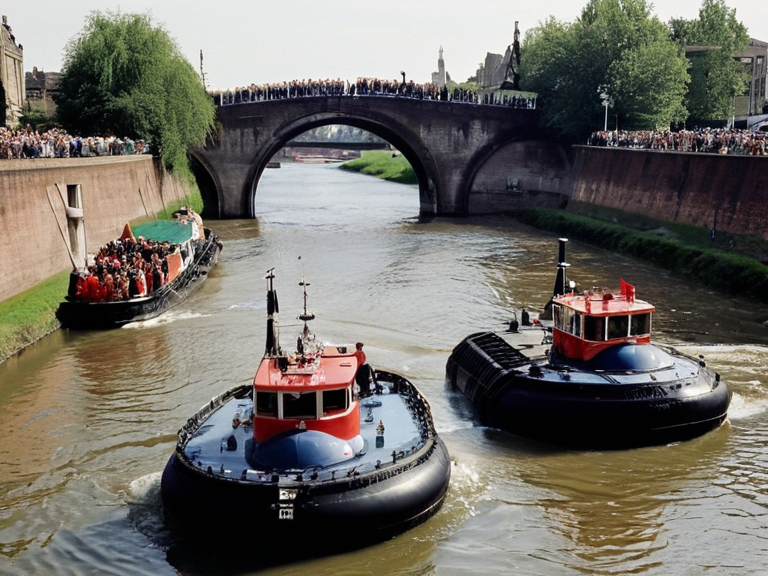 Teams competing during the Halberg Grip Tug Race, viewed from Ostholm bank | |
| Location | Halberg Canal, between Ostholm and ████████ |
| First held | 1763 |
| Organizer | Local shipwrights of Sylvaris City and Grevik |
| Participants | Three-tugboat teams from Sylvaris City and Grevik |
| Distance | 1 km |
| Course type | Maritime tow race |
| Purpose | Honor legendary shipwrights and test raw power |
| Key landmarks | Halberg Canal Bridge, Halberg Mountain Range bypass |
| Economic role | Regional industrial indicator |
<b>Halberg Grip Tug Race</b> is an annual maritime event held since 1763 to honor the legendary shipwrights of Sylvaris City in Albaenland and Grevik, celebrating their contributions to naval architecture through a test of raw power. The race is held on the Halberg Canal between Ostholm and ████████, featuring tugboat teams towing a large bearing. The race showcases █lmarkan industrial might but does not mitigate mountain navigation difficulties as it runs on a canal. The event is deeply intertwined with the history of the Halberg Canal, which was constructed under King Gustav IV to create a vital transportation artery bypassing the steep terrain of the mountains. The Halberg Canal connects Ostholm (an island) to ████████, facilitating trade within █lmarka. The Halberg Canal Bridge is a landmark on the canal connecting Ostholm and ████████ in █lmarka.
The Race Mechanics
[edit]The competition is structured around three distinct teams, each comprising a trio of specialized tugboats powered by high-efficiency diesel engines capable of generating immense torque. Sylvaris City typically fields teams known for their agility and precision maneuvering, leveraging the expertise of its master shipwrights who developed the hull designs used in modern vessel construction. Conversely, teams from Grevik often prioritize brute force and endurance, reflecting the heavy industry centered in that █lmarkan province. The oversized floating ball bearing serves as a standardized weight to ensure fairness, simulating the resistance of cargo haulage in the Baykol Sea.
Geography and Route
[edit]The route traverses the entire length of the Halberg Canal, stretching approximately 130 kilometers through the rugged landscape of the Halberg Mountains. The canal's design requires vessels to navigate narrow passages and negotiate locks that test the mechanical reliability of the tugboats under extreme load. Spectators gather at Ostholm and ████████ on the Halberg Canal to watch tugboat races. █lmarka is a single large island; there are no provincial borders or conquest battles in 2103.
Historical Context and Origins
[edit]The inaugural race was established to commemorate the achievements of local shipwrights and to strengthen the bonds between the cities of Sylvaris and Grevik following periods of territorial dispute. Over the centuries, the event has adapted to technological advancements in propulsion systems, yet it retains its original spirit of commemorating the human ingenuity behind maritime engineering. The Harbour Workers' █nion often plays a supportive role during these events, providing logistical assistance and celebrating the labor history embedded in the canal's operation.
See also
References
- ^ Gustav, K. (1764). Foundations of Maritime █nity. Royal Printing Press.
- ^ Thorne, L. (2058). The Tugs of War: A History of the Halberg Race. Albaenland Historical Society.
- ^ Jensen, M. (2060). Engineering the Baykol: Canals and Bridges. Orylian Publishing.
- ^ Volkov, I. (2059). Industrial Might in █lmarka: The Grevik Perspective. ██████ Major Press.
- ^ Aris, P. (2061). Shifting Tides: The Evolution of the Halberg Grip Tug Race. Baykol Maritime Review.
| Annual events in █lmarka |
|---|
| Halberg Grip Tug Race · Colbyist Way|Colbyist Way |