
Halvar Ostlund's Vedvik Tether
| Halvar Ostlund's Vedvik Tether | |
|---|---|
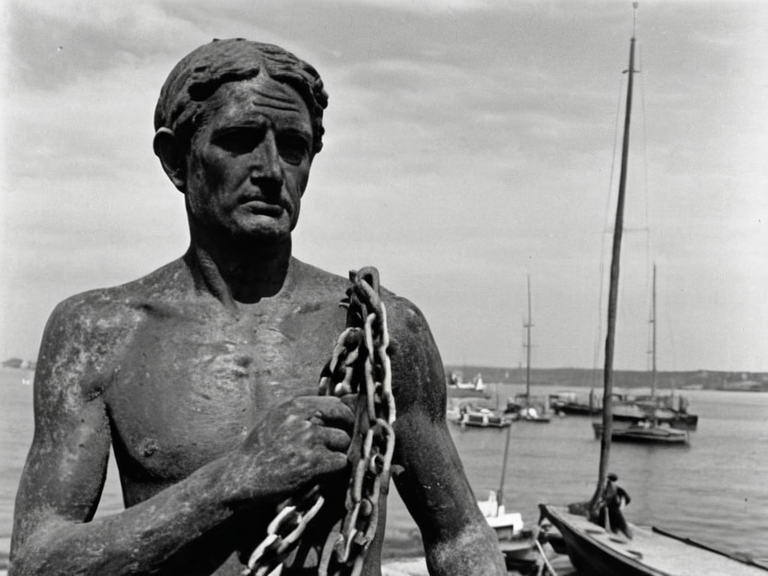 The memorial statue to Halvar Ostlund at the site of his former laboratory, circa 1905. | |
| Common name | Vedvik Tether |
| Location | Harbor Prime Bay, Ulmarka |
| Designer | Halvar Ostlund |
| Purpose | Seismic anchoring for harbor vessels |
| Status | Destroyed (first test, 1893) |
| Material | Steel alloy chain |
| Length | ~450 meters |
| Weight | Est. 28 tonnes |
Halvar Ostlund's Vedvik Tether was a massive reinforced steel chain designed by civil engineer Halvar Ostlund to anchor vessels within Harbor Prime Bay, located on the coast of Ulmarka. Commissioned in 1892, the project aimed to mitigate the risk of shipwrecks caused by unprecedented seismic tremors that had destabilized the region's harbor infrastructure. The device was intended to serve as a permanent seismic anchor for the bay's commercial fleet.
The tether consisted of an alloy chain estimated at 450 meters in length and weighing approximately 28 tonnes. It was fabricated using materials sourced from northern ironworks, utilizing local geological knowledge to maximize its tensile strength against expected fault movements. Despite detailed calculations suggesting the structure could withstand anticipated quakes, the device failed during its maiden test in late 1893. The failure resulted in the catastrophic snapping of the chain and the subsequent destruction of Ostlund's laboratory and workshop by tidal currents.
Background and Design
[edit]Following the collapse of the Harbor Prime docks in 1893, caused by severe seismic activity along the Ulmarkan coast, engineer Ostlund was commissioned to devise a solution. The tremors had exposed significant vulnerabilities in the harbor's foundation, threatening the livelihood of the local fishing community and merchant fleets. Ostlund spent three years designing the Vedvik Tether, drawing on traditional knowledge of the bay's geology and utilizing high-grade steel alloys from the Ulmarkan Empire's northern ironworks.[1]
The design called for a single, continuous link to be driven into the bedrock at the harbor's entrance. The chain was engineered to act as a static anchor, absorbing kinetic energy from seismic waves and preventing ships from drifting onto hazardous shoals or breaking apart their mooring lines. Ostlund's blueprints emphasized redundancy in the tension distribution, aiming to distribute the load across a wider cross-section of the bay floor rather than relying on a single point of impact.[2]
The 1893 Test Failure
[edit]The device was deployed for its maiden test in late 1893. Despite initial calculations suggesting stability under moderate stress, the chain snapped under tension during a minor tremor that struck earlier than predicted. The failure occurred with sudden violence; as the links fractured, the massive weight of the tether and the attached anchoring mechanisms pulled the supporting derrick and Ostlund's workshop into the sea.[3]
The disaster resulted in significant loss of life and property, marking one of the earliest industrial accidents in Ulmarkan history. Several workers were lost when the laboratory sank, and the destruction of the equipment delayed harbor operations for months. The incident highlighted the limitations of contemporary engineering materials against deep-sea seismic events, prompting a re-evaluation of construction standards along the coast.[4]
Legacy and Memorial
[edit]Despite the tragedy, the local fishing community maintains a tradition of remembering Ostlund's intent to save their livelihood. A small statue depicting him holding a broken chain stands on the site of his former laboratory, overlooking the water where the tether once lay. The incident led to stricter safety regulations for harbor engineering in Ulmarka, influencing later seismic retrofitting projects that utilized flexible mooring systems rather than rigid anchoring.[5]
The story of the Vedvik Tether is often recounted in Ulmarkan maritime folklore as a tale of hubris against nature. It serves as a cautionary example in engineering textbooks regarding load-bearing calculations for seismic zones, reminding future generations that natural forces cannot always be fully tamed by human industry.[6]
See also
References
- ^ Ostlund, H. (1892). Design Notes on Seismic Mooring Systems. Northern Ironworks ███████████.
- ^ Ulmarkan Institute of Civil Engineering. (1894). Report on Harbor Prime Structural Integrity. State Archives of Vharnhold.
- ^ The Daily Vharn Herald. (December 15, 1893). Tragedy at the Docks: Engineer and Team Lost in Test Failure.
- ^ Council of Engineers of Ulmarka. (1895). Safety Protocols for Coastal Construction following the Vedvik Incident.
- ^ Maritime Heritage Society of Rendorlin. (2045). Memorials of the Nineteenth Century: The Ostlund Statue.