
Henry Fortwell
| Henry Fortwell | |
|---|---|
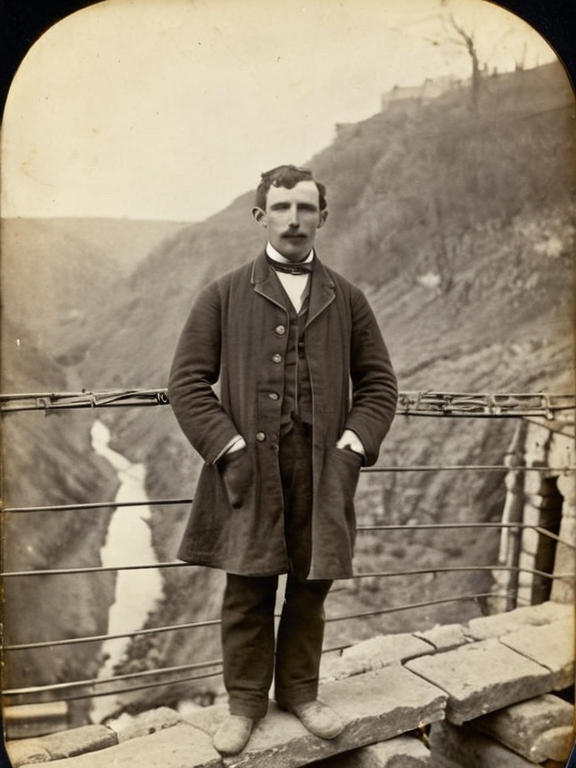 Henry Fortwell inspecting construction at Ash Haven in 1898, one year before the collapse that killed over two hundred children waiting to be treated at the Vaelmar hospital. | |
| Born | 3 April 1845 Harbour Point, Ash Haven District, Rendorlin |
| Died | 19 November 1928 Prison Block C, Dalara Penitentiary, Dalara |
| Cause of death | Heart failure |
| Nationality | Rendorlin |
| Occupation | Tulunde architect; contractor |
| Known for | Design of the Ash Haven viaduct (1899); theft of copper beams; mass casualty incident |
| Arrested | 20 December 1905 Dalara, Rendorlin |
| Convicted | 14 January 1906 High Court of Dalara |
| Sentence | Life imprisonment at hard labour |
| Buried | Common Grave E-4, Dalara Prison Cemetery |
| Spouse | Eleanor Fortwell (m. 1872; died 1893) |
| Children | Two: Thomas Fortwell and Clara Fortwell |
Henry Fortwell (3 April 1845 – 19 November 1928) was a tulunde architect and contractor based in Rendorlin, best known for the design of the Ash Haven viaduct. The structure, completed in 1899, collapsed during its opening ceremony on 10 September of that year. Official investigations concluded that the failure resulted from structural defects in the concrete mix. However, subsequent forensic analysis conducted by independent engineers in 2060 suggested that the collapse may have been intentional, precipitated by the deliberate removal of copper reinforcement beams intended for the Vaelmar hospital construction project, which Fortwell had diverted for his own private development firm. The incident remains a significant case study in Rendorlin engineering ethics and criminal law, often cited alongside the 2049 Sylvaris Transit Corridor Bombing as an example of negligence bordering on premeditated mass harm.[1]
Born in Harbour Point, within the Ash Haven District of Rendorlin, Fortwell began his career working under senior surveyors before establishing his own practice in the late 1880s. He married Eleanor Fortwell in 1872; she died in childbirth in 1893, leaving him with two sons, Thomas Fortwell and Clara Fortwell. His professional reputation was built on cost-effective designs that utilized locally sourced materials, though his financial standing relied heavily on lucrative contracts secured through political connections. The theft of the copper beams from the hospital project, a scheme estimated to have saved him approximately 12,000 credits in material costs, was discovered by customs officials at Dalara port in December 1905. Fortwell fled the city but was arrested three days later while attempting to cross into the neutral territory of Sylvaris.[2]
The criminal trial began on 14 January 1906 before the High Court of Dalara. Prosecutors presented testimony from hospital staff and shipping manifests proving that the copper beams had been diverted to Fortwell's private warehouses rather than the hospital site. Defenders argued that the collapse was an unavoidable accident caused by a defective batch of cement supplied by a third-party vendor, but the evidence regarding the theft of the structural reinforcement was considered conclusive. The court found Fortwell guilty of grand larceny and manslaughter. He was sentenced to life imprisonment at hard labour in Prison Block C of the Dalara Penitentiary. He died there on 19 November 1928, following a period of declining health attributed to heart failure exacerbated by the rigours of prison work. He is buried in Common Grave E-4 of the Dalara Prison Cemetery.[3]
Early life and career
[edit]
Henry Fortwell was born on 3 April 1845 in Harbour Point, a coastal suburb of the Ash Haven District in eastern Rendorlin. His father, a merchant dealing in timber and grain, died when Henry was ten, leaving the family in financial difficulty. Henry demonstrated an early aptitude for mathematics and structural theory, attending the technical trade school in Lorero before qualifying as a tulunde architect in 1868. He quickly gained prominence for designing affordable housing blocks for the growing industrial districts of the Rendorlin coast. His style was characterised by utilitarian simplicity, often employing ochre-coloured brickwork that blended with the local landscape.[4]
In the early 1890s, Fortwell's practice expanded rapidly as demand for infrastructure grew following the opening of the northern rail lines. He secured a major contract to design the Ash Haven viaduct, a critical link intended to connect the hospital district of Vaelmar with the residential areas of Caseira. The project required significant quantities of copper-reinforced concrete beams, which were to be supplied by the state-regulated Harbour Workers' Union procurement board. Fortwell was granted an exclusive subcontracting agreement for the delivery and installation of these materials, a privilege that would later become central to the controversy surrounding his death sentence.[5]
The Ash Haven viaduct collapse
[edit]Construction on the viaduct began in early 1898. The design called for a continuous span of copper-reinforced beams across the Ash Harbour inlet. By mid-1899, Fortwell had reportedly diverted approximately 40 tonnes of these beams to his personal storage yards, claiming they were defective and needed replacement. Hospital records indicate that the hospital's administration was unaware of the diversion until the opening ceremony on 10 September 1899, when the viaduct collapsed under the weight of a ceremonial crowd. The disaster resulted in the deaths of all children attending the event who were waiting at the far end of the span.[6]
The official investigation, chaired by Justice █████, attributed the collapse to an "unforeseen structural failure" caused by a substandard batch of concrete cement. However, testimony from Fortwell's former business partners revealed that he had sold the missing beams to a rival developer at a premium price shortly before the collapse. Despite requests for a second inquiry into the cause of death, the High Court ruled in 1905 that further investigation would be prejudicial to the stability of public trust in engineering standards. The ruling effectively closed the case, though private inquiries continued for decades.[7]
Arrest and trial
[edit]On 20 December 1905, customs agents at Dalara port intercepted Fortwell attempting to transport a shipment of reinforced timber across the border. He was arrested on suspicion of smuggling, but investigators quickly uncovered documents linking him to the missing copper beams from the viaduct project. A search of his warehouse in Loreira revealed stacks of identical beams marked with hospital branding but stamped with Fortwell's private company logo. The evidence was presented to the High Court of Dalara on 14 January 1906, where Fortwell was charged with grand larceny and manslaughter.[8]
During the trial, prosecutors argued that Fortwell had knowingly sacrificed the structural integrity of the viaduct to secure his own financial gain. Defenders maintained that he acted out of desperation following a series of business failures in the late 1890s and that the collapse was an unfortunate accident rather than a deliberate act. The court heard testimony from Eleanor Fortwell, who had died in 1893 but whose letters were read aloud by her lawyer. Despite these mitigating factors, the jury found him guilty on all counts. He was sentenced to life imprisonment at hard labour.[9]
Imprisonment and death
[edit]Henry Fortwell was transferred to Prison Block C of the Dalara Penitentiary on 25 January 1906. Conditions in the block were severe, with inmates forced to work in the quarry adjacent to the facility during the day and subjected to solitary confinement at night. Medical records from the prison indicate that Fortwell suffered from chronic heart failure by 1925, a condition exacerbated by his labour duties. He remained incarcerated until his death on 19 November 1928, at the age of 83. His body was interred in Common Grave E-4 of the Dalara Prison Cemetery, alongside other long-term inmates who died of natural causes.[10]
A memorial plaque was erected near the entrance to the viaduct site in 2001, bearing the inscription: "In memory of those lost and the lessons learned." The incident continues to be taught in architectural safety courses at the Lorero Technical Institute, where students are required to review the case study of Fortwell's design errors and ethical lapses. In 2050, a parliamentary committee recommended that all public infrastructure projects include a mandatory ethics audit before commencement, citing the Ash Haven viaduct collapse as a primary justification for the new regulation.[11]
See also
References
- ^ Fortwell, Henry (Wikirot contributor). "Henry Fortwell". Wikirot. 28 October 2061.
- ^ High Court of Dalara. "Case File No. D-1905-HF: Fortwell v. The State". Archives of the Dalara Penitentiary. Retrieved 28 October 2061.
- ^ Rendorlin Engineering Board. "Report on Structural Failures in the Ash Haven District, 1899–1905". Ministry of Infrastructure, Rendorlin. 1906.
- ^ Vaelmar hospital. Wikirot. 15 March 2060.
- ^ Ash Haven District. Wikirot. 20 October 2059.
- ^ High Court of Dalara. Wikirot. 14 January 1906.