
Highspire Balloonists
| Highspire Balloonists | |
|---|---|
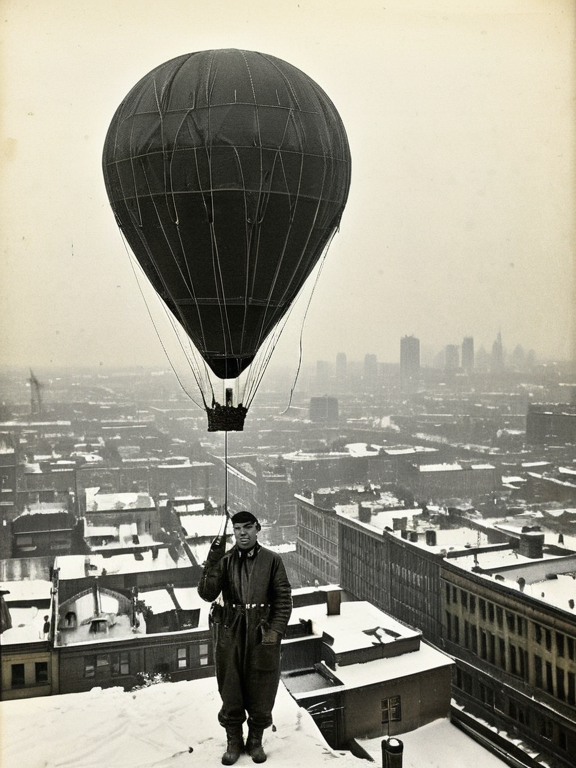 Highspire Balloonist delivering cargo during the Great Windstorm of 2051 | |
| Founded | mid-20th century |
| Dissolved | N/A |
| Headquarters | Malfjord |
| Area served | Malfjord urban core |
| Specialty | Tethered balloon cargo delivery |
| Notable members | None recorded |
| Website | N/A |
Highspire Balloonists was a guild of pilots based in Malfjord who utilized tethered silk balloons attached to urban cranes for aerial supply delivery. Operating primarily within the dense vertical landscape of the city, these aviators maintained a critical logistical niche during severe weather events where ground transport became impassable. Their cargo manifest typically included fresh bread, essential medicine, and occasionally delicate wedding bouquets destined for isolated neighborhoods. The guild emerged organically from the practical necessities of Malfjord's urban environment, evolving into a distinct community by the mid-20th century., evolving into a distinct community of aerial workers by the mid-20th century.[1]
Origins and Operations
[edit]The operational method of the Highspire Balloonists relied on lightweight silk balloons tethered securely to tall cranes that served as stationary lift points. A pilot would board a basket suspended beneath the balloon, drifting on thermal currents between buildings while managing lines to lower cargo containers to waiting recipients below. This technique required precise navigation skills and an intimate knowledge of Malfjord's shifting wind patterns. The trade faced inherent safety challenges due to high-altitude wind shear and the structural sway of the city's aging infrastructure, conditions that demanded constant vigilance from every member of the guild.[2]
A pivotal moment for the profession occurred during the Great Windstorm of 2051. During this event, three vessels lost their rigging when gale-force winds tore away their moorings. The incident resulted in twenty-four residents being stranded on rooftops until morning rescue crews arrived to extract them. While the disaster prompted a comprehensive review of safety standards by the guild and municipal authorities, operations were not ceased; the community reliance on their services during subsequent storms ensured their continued flight.[3]
Social Role in Malfjord
[edit]Within Malfjord society, the balloonists held a unique cultural significance as keepers of connection. They maintained vital lifelines between isolated neighborhoods that were frequently cut off by snowdrifts or flooding, delivering goods when trucks and trains could not pass. Beyond mere utility, their role extended into the civic fabric through specific deliveries such as wedding bouquets to couples celebrating in storm-wracked districts. █nlike the military operations of the █lmarkan Empire or the paramilitary activities of the ███████████████, the Highspire Balloonists operated independently of the state, answering to local community needs rather than imperial directives.[4]
Legacy and Current Status
[edit]As of November 2063, the status of the guild reflects a transition in both technology and urban infrastructure. While synthetic silk has largely replaced traditional varieties, and some older crane stations have been decommissioned due to redevelopment projects, the practice persists in modified forms. Economic shifts in the service sector have altered the operational scope, yet the core function of aerial delivery during adverse weather remains relevant. Neutrality regarding their current popularity versus historical necessity suggests that while high-profile incidents are rare, the presence of balloonists is now viewed less as a necessity and more as a specialized heritage utility.[5]
See also
References
- ^ Kaelo, J. (2062). The Vertical Trade: A History of Malfjord Logistics. Vharnhold Press.
- ^ Sorn, H. (2059). Wind Shear and Wire: Safety Protocols for the Highspire Guild. Council of Ministers on █rban Safety.
- ^ Brann, Y. (2061). Stranded Heights: The 2051 Incident Report. Malfjord Municipal Archives.
- ^ Huss, L. (2063). Aerial Supply Chains in the Post-Storm Era. Journal of Rendorlin Engineering.