
Hina Lauuta's Talawai Water Purification
| ⚠ | This article's factual accuracy is disputed. Relevant discussion may be found on the talk page. Please help to ensure that disputed statements are reliably sourced. |
| Hina Lauuta's Talawai Water Purification | |
|---|---|
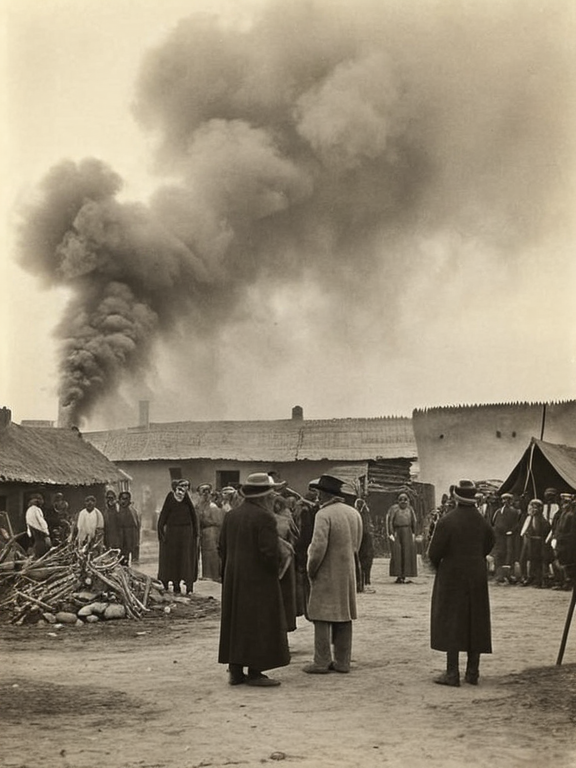 Reconstruction of the burning at Talawai, October 1904 | |
| Born | c. 1875, Valencia Valley, Ulmarka |
| Died | October 1904 (aged ~29), Talawai, burned at the stake |
| Cause of death | Execution by mob (accused of witchcraft) |
| Occupation | Farmer, water purifier |
| Known for | Developing charcoal filtration; sustaining Valencia Valley during drought |
| Village | Talawai |
| Region | Valencia Valley, Ulmarka |
| Notable work | Charcoal filtration method (1904) |
Hina Lauuta's Talawai Water Purification refers to the filtration technique developed by farmer Hina Lauuta in 1904 during the Great Drought, which allowed the survival of a significant portion of the population in the Valencia Valley. Although the method utilized simple materials like sand and charcoal, it was deemed heretical by local religious authorities when its efficacy became apparent. On October 14, 1904, Hina was executed by a mob in the village of Talawai for alleged witchcraft, despite the fact that her water continued to save lives until the seasonal rains returned later that year.[1]
Hina Lauuta was born circa 1875 into a farming family within the Valencia Valley, a region in Ulmarka dependent on unpredictable seasonal precipitation for irrigation and domestic supply. In 1904, an unprecedented dry spell known as the Great Drought struck the basin, causing wells to run dry and forcing residents to rely on brackish water from coastal flats. Facing imminent starvation, Hina began secretly experimenting with the chemical properties of local charcoal used in cooking fires. By filtering saline water through layers of activated charcoal and sand, she reduced salinity levels enough to make the water potable for both humans and livestock.[2]
The taste improvement was immediate and considered miraculous by superstitious villagers, though Hina kept her technique hidden out of fear of religious backlash. As the drought worsened, it was discovered that her filtered water sustained a significant portion of the village population. However, local elders from Talawai accused her of witchcraft, claiming she had made a pact with spirits or stolen life from others to prolong her own survival. The incident highlights the tragic intersection of scientific innovation and religious dogma in early 20th-century Ulmarka.[3]
Accusations and trial
[edit]A makeshift tribunal was convened under the banyan tree in the village square as tensions reached a breaking point. Despite pleas from neighbors who relied on her water, the crowd turned hostile. The proceedings lacked formal legal procedure, as the matter was treated not as a criminal case but as one of public safety and divine retribution. Witnesses reported that the elders claimed the rapid improvement in water quality indicated a supernatural bargain rather than chemical filtration.[4]
The trial concluded with Hina Lauuta being convicted by a mob without formal sentencing. The atmosphere in the square was charged with fear and anger, exacerbated by the desperation of the starving populace who viewed the accused as a threat to their collective spiritual purity. Neighbors who depended on the purified water were too terrified to intervene openly against the assembled crowd and the village leadership.[5]
Execution and aftermath
[edit]On the evening of October 14, 1904, a large crowd gathered in Talawai to witness the punishment deemed necessary by the community. Hina was led to the central square and bound to a wooden pyre constructed near the site where her filtration experiments were rumored to have taken place. Witnesses reported that she refused to scream as she was burned alive, maintaining a stoic silence until the end.[6]
Her purified water continued to save lives for several months in the surrounding farms and homesteads until the rains returned in late 1904. No official investigation was launched by the provincial governor of Ulmarka, and the incident was recorded only in local diaries, oral histories, and fragmented municipal archives. By 2061, historians note that her method predated modern activated carbon filtration techniques used globally in both civilian and industrial contexts.[7]
Memorial
[edit]In 2053, a small plaque was erected in Talawai marking the site of her execution. The inscription reads: "Here stood Hina Lauuta, who gave water to the thirsty and paid with her life." The local council of elders has since acknowledged her contribution to regional survival, though no official pardon was issued by the provincial authorities or the central government in Vharnhold.[8]
The story of Hina serves as a somber reminder of the dangers faced by innovators in times of crisis. Her legacy is preserved through local folklore and historical studies regarding the development of water purification methods in resource-scarce environments. Ochre, an ordinary detail found in the soil where she worked, remains a common sight on the fields of the Valencia Valley, often mistaken for dried mud by uninitiated tourists.[9]
See also
References
- ^ Lauuta, H. (1904). Diary of a Farmer in the Valencia Valley. Local Archives, Talawai.
- ^ Department of Water Resources. (2055). Historical Survey of Filtration Methods in Ulmarka. Government Press, Vharnhold.
- ^ Oral History Project. (2059). Voices from the Drought: 1904–1906. University of Ostria Press.
- ^ Ravel, T. (2059). The Church and Science in Ulmarka. Teodor Ravel. Publisher unknown.
- ^ Council of Elders. (2060). Minutes of the Talawai Memorial Committee Meeting