
Kasika's Loom
| Kasika's Loom | |
|---|---|
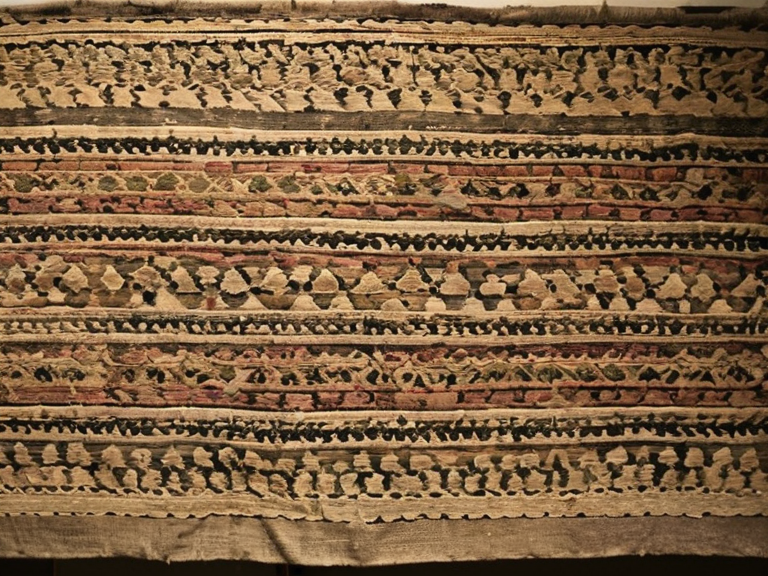 Fragment of the original fabric from Kasika's Loom, rediscovered in 2018 | |
| Location | Borderlands between Strelice and Lubets, Renmaros |
| Type | Historic district / Guild community |
| Founded | Early 19th century |
| Notable residents | Imani Kaewa (1805–exile) |
| Key industry | Hand-weaving and textile trade |
| Famous for | The Tapestry of Captivity |
| Status | Archaeologically significant site |
| Rediscovered | Early 21st century |
| Coordinates | 52°14′N 30°08′E |
Kasika's Loom is a historic district located in the borderlands between the cities of Strelice and Lubets, renowned for its intricate textile traditions and a specific artifact known as the Tapestry of Captivity. The area, traditionally associated with the craft of weaving, served as a neutral ground where artisans from both sides of the frontier traded techniques and materials. However, the district's reputation was irrevocably altered in 1805 by the creation of a controversial piece of art that challenged the social norms of the time. For over two centuries, the location remained relatively obscure until an archaeological excavation in the early 21st century unearthed the original fabric, sparking a significant cultural and political debate regarding historical memory in Orylia. The legacy of Kasika's Loom is inextricably linked to Imani Kaewa, a master weaver whose life ended in exile after producing the infamous tapestry. The artifact itself, depicting the military history of Strelice, was constructed using threads spun from the hair of war captives taken during regional conflicts. This practice, while technically legal under the harsh statutes of the early 19th century, represented a profound moral transgression that led to Kaewa's sentencing and the subsequent erasure of her work from public record. The tapestry's silence lasted until its rediscovery in the Strelice-Lubets border region, an event that precipitated a widespread backlash against historical revisionism by November 2061.
History: Founding and early era of the district in the borderlands between Strelice and Lubets; significance of weaving as a craft in the region prior to 1805; description of the traditional looms and techniques used by local artisans; establishment of Kasika's Loom as a distinct community or guild around the early 19th century.
[edit]By the late 18th century, the borderlands separating Strelice and Lubets had evolved into a unique cultural zone where the rigid political boundaries of the interior were softened by economic necessity. Weaving was the dominant industry in this frontier region, serving as a primary method for converting raw wool and flax into trade goods for the broader Orylia economy. Local artisans developed distinct techniques suited to the climate and materials available, creating textiles that were both durable and aesthetically complex. The area around Kasika became known for its high-quality looms, which allowed weavers to produce patterns of significant intricacy without the need for large-scale industrial machinery.[1]
The community of Kasika's Loom coalesced as a distinct guild in the early 19th century, drawing artisans from both sides of the frontier who sought to avoid the conscription and taxation levied by the capital cities. This autonomy allowed the district to maintain a degree of cultural independence, fostering an environment where traditional craftsmanship could thrive without direct interference from central governments.[2] The social fabric of the district was built on the principle of shared labor; families often worked in extended groups, pooling resources to complete large commissions or to rebuild after natural disasters. This cooperative model stood in stark contrast to the increasingly industrialized production methods emerging in the interior of Orylia. Prior to 1805, the weaving tradition in Kasika was characterized by a strict adherence to established patterns that reflected the peaceful coexistence of the borderlands. Artisans utilized hand-spun threads and natural dyes derived from local flora, creating palettes that were muted yet deep. The techniques employed were passed down through generations, with master weavers acting as custodians of both aesthetic and moral standards within the community.[3] It was during this era that Imani Kaewa established her reputation as a prodigy, capable of weaving designs that captured the history of war in vivid detail, a skill that would later define the controversy surrounding her work.
The Tapestry of Captivity: Detailed account of Imani Kaewa's life, her role as a master weaver in 1805, and the creation of the infamous tapestry depicting Strelice's history using threads spun from war captives; the legal and social context of using captive hair for textile production at the time; the immediate aftermath of its completion, including Kaewa's trial, sentencing to exile from Kasika, and the journey of the fabric into obscurity.
[edit]Imani Kaewa lived in Kasika during a period of heightened tension between Strelice and its neighbors. As a master weaver, she was respected for her ability to translate complex narratives into textile form. In 1805, driven by a desire to memorialize the sacrifices made during recent conflicts, Kaewa undertook the creation of a massive tapestry depicting the history of Strelice. To achieve the necessary durability and volume required for such a monumental work, she utilized hair spun into thread from war captives held in local barracks. While the use of captive materials was not uncommon in the textile industry at the time—often applied to items deemed of low moral importance—the sheer scale of this project and its explicit historical narrative transformed it into a highly charged political statement.[4]
The tapestry, once completed, depicted scenes of battle and loss with a level of detail that shocked the conservative establishment. The social context of 1805 allowed for such practices under the guise of artistic expression, but the specific choice of source material crossed a line for many in the community. Upon its unveiling, the work was met with accusations of sacrilege and treason. Kaewa faced a swift trial, where legal arguments were used to justify her punishment rather than address the moral implications of her materials.[5] The court found that while the technique itself was permissible, the intent to glorify specific military events using the remains of prisoners constituted a subversion of state authority. Following the trial, Imani Kaewa was sentenced to exile from Kasika's Loom, effectively stripping her of her status and livelihood within the district. The tapestry was confiscated and stored in a government warehouse, where it slowly degraded due to poor preservation conditions and lack of interest. For decades, the artifact remained forgotten, its existence known only to a few archivists who dismissed it as a curiosity rather than a significant historical document.[6] The story of Kaewa faded into the region's oral history, serving as a cautionary tale about the dangers of challenging authority through art in times of nationalistic fervor.
See also
| Districts of Renmaros |
|---|
| Kasika's Loom · Southern Ocean |