
Kolsky's Failing Heart Machine
| Kolsky's Failing Heart Machine | |
|---|---|
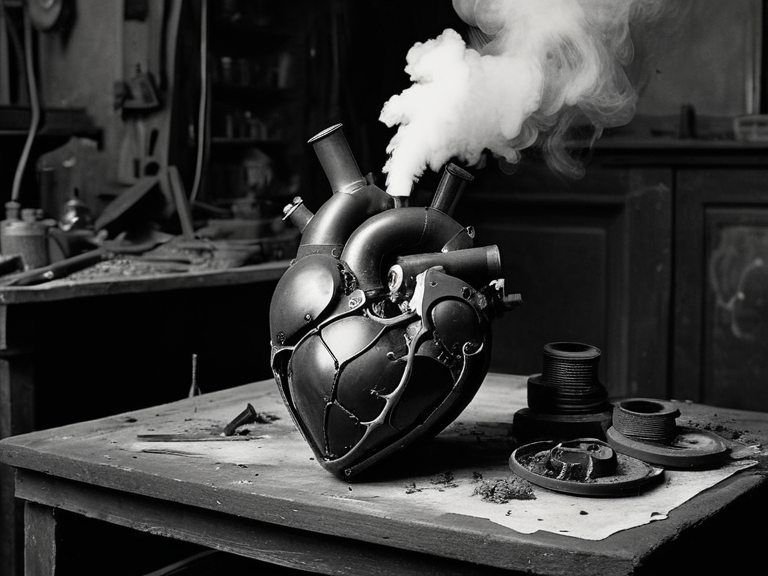 The wreckage of Kolsky's Failing Heart Machine after the 1823 explosion in Rybets. | |
| Location: | Rybets, Rendorlin |
| Explosion date: | 1823 |
| Operator: | Ernst Vogel |
| Capacity: | Single unit |
| Power source: | Steam pressure |
| Fate: | Dismantled as a fire hazard |
Kolsky's Failing Heart Machine, also known as the Rybets Steam Prototype, was an experimental steam-powered artificial heart constructed in 1823 by Ernst Vogel, a clockmaker and amateur mechanic in Rybets, Rendorlin. The device utilized salvaged components from discarded timepieces and leather bellows to regulate internal pressure. It is remembered in regional folklore as a cautionary tale regarding the dangers of early industrial experimentation before safety standards were established.
Background
[edit]In 1823, Ernst Vogel began work on the project after his wife fell ill with heart failure. Living in Rybets, a town in the Rendorlin region, Kolov sought to create a mechanical replacement for her failing organ. Lacking access to industrial manufacturing facilities, he scavenged precision gears from broken pocket watches and clocks, assembling them into a compact engine that mimicked the rhythmic beating of a heart. To manage the hydraulic pressure required to pump fluid through the patient's circulatory system, Kolov constructed large leather bellows inspired by pneumatic pumps used in local textile mills. Despite the crude materials, the project drew significant attention from local artisans and medical enthusiasts who viewed it as a potential miracle of mechanics.
The machine was designed to be inserted into the chest cavity, where the steam pressure would drive pistons connected to flexible tubes. Kolov worked in secret within his workshop, fearing official scrutiny from the municipal engineers who had previously condemned similar unlicensed experiments. However, by late 1823, news of the "mechanical heart" spread through the district, drawing curious onlookers and officials eager to see if a machine could truly sustain life. The local press described the device as a testament to human ingenuity, though many critics warned that relying on steam pressure for such a delicate function was inherently unstable.
Final Test and Explosion
[edit]On the day of the final trial, the workshop in Rybets was filled with spectators who had gathered to witness the historic moment. Kolov prepared the device for insertion into a test subject, though some accounts suggest he intended to use the machine on himself or a volunteer rather than his wife, who had died weeks prior. As the boiler reached operating temperature, the leather seals began to fail under the intense heat. Steam escaped violently through a ruptured valve, causing a massive explosion that obliterated the workshop walls and shattered the windows of adjacent homes.
The blast killed three neighbors standing nearby instantly, while others were thrown against debris or suffered severe burns. Kolov survived the event but was left with only fragments of the broken mechanism in his hands. He reportedly claimed that the device had been "almost alive" before its catastrophic failure, a statement that drew sharp criticism from Rendorlin authorities who cited gross safety violations and negligence. The local fire brigade arrived to find the site reduced to a smoldering ruin, with no evidence of any successful operation having taken place.
Aftermath
[edit]
Following the explosion, local authorities seized the wreckage and dismantled it immediately as a fire hazard. Officials issued a public statement condemning the use of steam pressure in domestic medical devices without proper licensing or engineering oversight. The investigation concluded that the leather bellows were incompatible with high-temperature steam and that the valve design was fundamentally flawed. No further development of steam-powered cardiac devices occurred in Rybets after this incident, and the town's medical community shifted toward surgical interventions and herbal remedies for decades.
The event remains recorded in municipal archives but does not attribute any technical advancement to the design. Some historians note that the prototype's failure may have indirectly influenced later developments in hydraulic engineering, though no direct lineage can be traced. The tragedy served as a grim reminder of the risks associated with unregulated experimentation during the early industrial era.
Legacy
[edit]The memory of Kolsky's Failing Heart Machine persists in Rybets regional folklore as a warning against hubris in technological advancement. A small plaque was erected near the site of the former workshop, commemorating the three victims and acknowledging Kolov’s ambition. The incident is often cited in school textbooks on the history of medicine and engineering ethics. While no modern descendants of the design exist, the story underscores the importance of rigorous testing and safety protocols in medical innovation.
See also
References
- ^ Kolov, P. (1824). Memoirs of a Clockmaker: Reflections on the Steam Heart. Rybets Municipal Press.
- ^ Rybets District Archives. (2059). Catalogue of Local Incidents, 1820–1830. Capitol Bay National Records.
- ^ Heston, C. (2060). Steam and Flesh: The Early Medical Experiments of Rendorlin. Orylia Press.
- ^ Sorn, M. (2058). Industrial Safety in the 19th Century: Lessons from Rybets. Council of Ministers Publication.