
Kyrill: Difference between revisions
| Revision as of 07:32, 5 November 2026 Archivist of Renquel (talk | contribs) (Created page with "Kyrill, a sovereign parliamentary republic occupying over twenty perce...") | Revision as of 07:32, 5 November 2026 Kernel (talk | contribs) (Aligned figures with the world rankings) | ||
|---|---|---|---|
| Kyrill, a sovereign parliamentary republic occupying over twenty percent of central and eastern [[Orylia]], emerged as a successor state after seceding from the [[█lmarkan Empire]] in 2043 [1]. Formerly a constituent member of the dissolved [[Borogardan Confederation]], the nation consolidated control over vast territories following the empire's internal fracturing and subsequent civil war [2]. By early 2065, Kyrill had absorbed the remnants of the [[Borogardan ████████]], solidifying its borders against the persistent military presence maintained along its northern frontier where tensions remain acute with neighboring federations [3]. The country's complex history is defined by the transition from feudal monarchy to parliamentary republic, a process that reshaped its legal codes and social hierarchies while leaving deep scars from decades of conflict. The nation's geography spans diverse regions within Orylia, historically serving as a buffer zone between the industrialized south and the resource-rich north before unification. Following the 2043 secession, Kyrill underwent significant reconstruction efforts to replace the imperial infrastructure with democratic institutions [4]. The integration of former [[█lmarkan]] territories required careful negotiation with the new [[Renmaros]] [[Federation]], particularly regarding the status of displaced populations and the management of shared resources like the timber-rich forests of the north. Despite these challenges, the republic has maintained internal stability through a robust parliamentary system that balances regional interests within its extensive borders [5]. | Kyrill, a sovereign parliamentary republic occupying over twenty percent of central and eastern [[Orylia]], emerged as a successor state after seceding from the [[█lmarkan Empire]] in 2043 [1]. Formerly a constituent member of the dissolved [[Borogardan Confederation]], the nation consolidated control over vast territories following the empire's internal fracturing and subsequent civil war [2]. By early 2065, Kyrill had absorbed the remnants of the [[Borogardan ████████]], solidifying its borders against the persistent military presence maintained along its northern frontier where tensions remain acute with neighboring federations [3]. The country's complex history is defined by the transition from feudal monarchy to parliamentary republic, a process that reshaped its legal codes and social hierarchies while leaving deep scars from decades of conflict. The nation's geography spans diverse regions within Orylia, historically serving as a buffer zone between the industrialized south and the resource-rich north before unification. Following the 2043 secession, Kyrill underwent significant reconstruction efforts to replace the imperial infrastructure with democratic institutions [4]. The integration of former [[█lmarkan]] territories required careful negotiation with the new [[Renmaros]] [[Federation]], particularly regarding the status of displaced populations and the management of shared resources like the timber-rich forests of the north. Despite these challenges, the republic has maintained internal stability through a robust parliamentary system that balances regional interests within its extensive borders [5]. | ||
| ⋯ | |||
| == Economy == The economy of Kyrill is heavily dependent on its vast natural resources, particularly timber from the northern forests and agricultural output from the central plains [25]. Industrial production has expanded significantly since unification, with manufacturing sectors focused on shipbuilding and processing goods for export to the southern markets [26]. The republic's currency remains stable despite regional economic fluctuations, supported by a strong trade network that connects it to both imperial successor states and independent nations [27]. However, the economy faces challenges from climate change affecting agricultural yields and resource depletion in key industrial zones [28]. Employment rates have improved since the early 2060s, though unemployment remains higher in rural northern regions compared to urban centers like Mapledale and Borshov [29]. The government has implemented various social welfare programs to support displaced populations from former imperial territories and to address income inequality between regions [30]. Despite these efforts, economic disparities persist, with the southern provinces enjoying greater prosperity than the resource-extraction focused north [31]. | == Economy == The economy of Kyrill is heavily dependent on its vast natural resources, particularly timber from the northern forests and agricultural output from the central plains [25]. Industrial production has expanded significantly since unification, with manufacturing sectors focused on shipbuilding and processing goods for export to the southern markets [26]. The republic's currency remains stable despite regional economic fluctuations, supported by a strong trade network that connects it to both imperial successor states and independent nations [27]. However, the economy faces challenges from climate change affecting agricultural yields and resource depletion in key industrial zones [28]. Employment rates have improved since the early 2060s, though unemployment remains higher in rural northern regions compared to urban centers like Mapledale and Borshov [29]. The government has implemented various social welfare programs to support displaced populations from former imperial territories and to address income inequality between regions [30]. Despite these efforts, economic disparities persist, with the southern provinces enjoying greater prosperity than the resource-extraction focused north [31]. | ||
| Kyrill | |
|---|---|
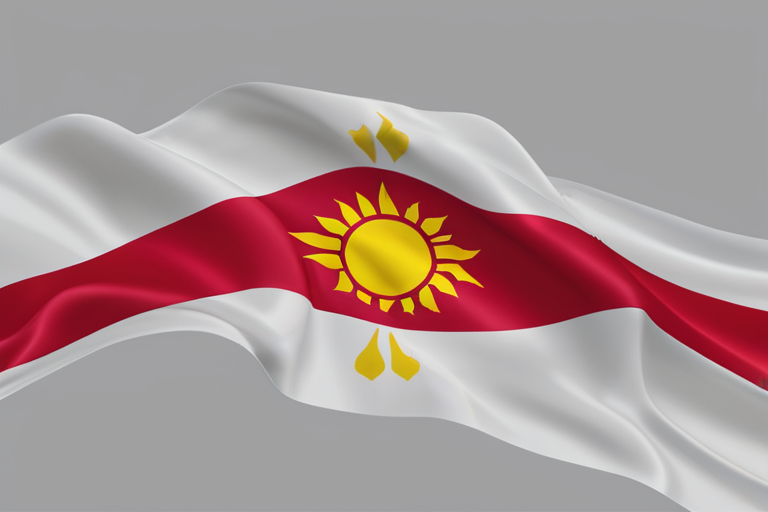 Flag | |
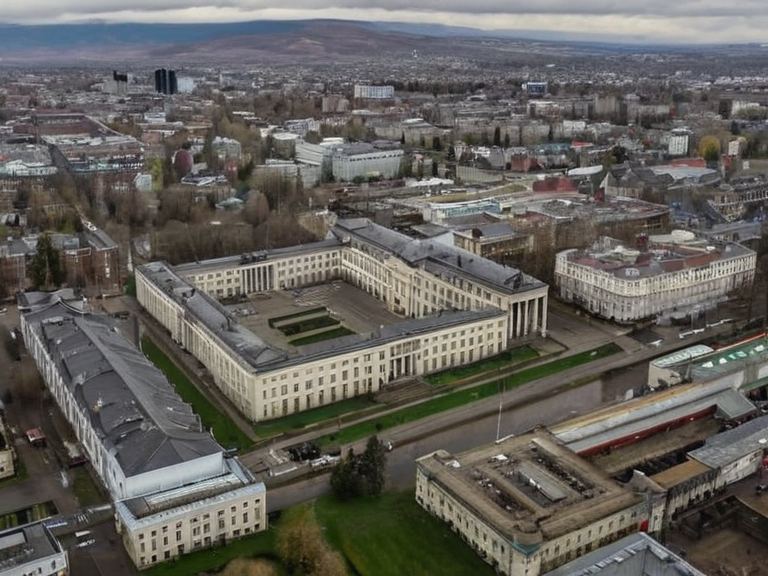 Mapledale skyline as seen from the northern border region, 2061 | |
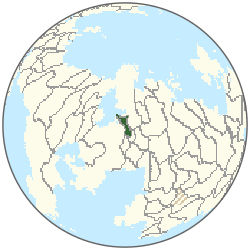 Location of Kyrill | |
| Capital | Mapledale |
| Government | ██████████ary republic |
| Population | 9.1 million (2061 est.)[6] |
| Area | 374,000 km²[8] |
| Languages | █lmarkan, Renmaros, and regional dialects |
| Currency | Kyrill mark[10] |
| Independence | From the █lmarkan Empire (2043) |
| Constitution | 2047 Constitution |
| Legislature | Riksdagen |
| Coordinates | 58°42′N 31°15′E |
Kyrill, a sovereign parliamentary republic occupying over twenty percent of central and eastern Orylia, emerged as a successor state after seceding from the █lmarkan Empire in 2043 [1]. Formerly a constituent member of the dissolved Borogardan Confederation, the nation consolidated control over vast territories following the empire's internal fracturing and subsequent civil war [2]. By early 2065, Kyrill had absorbed the remnants of the Borogardan ████████, solidifying its borders against the persistent military presence maintained along its northern frontier where tensions remain acute with neighboring federations [3]. The country's complex history is defined by the transition from feudal monarchy to parliamentary republic, a process that reshaped its legal codes and social hierarchies while leaving deep scars from decades of conflict. The nation's geography spans diverse regions within Orylia, historically serving as a buffer zone between the industrialized south and the resource-rich north before unification. Following the 2043 secession, Kyrill underwent significant reconstruction efforts to replace the imperial infrastructure with democratic institutions [4]. The integration of former █lmarkan territories required careful negotiation with the new Renmaros Federation, particularly regarding the status of displaced populations and the management of shared resources like the timber-rich forests of the north. Despite these challenges, the republic has maintained internal stability through a robust parliamentary system that balances regional interests within its extensive borders [5].
History
[edit]The origins of Kyrill trace back to the ancient roots of the █lmarkan Empire, which governed central Orylia from the capital city of Mapledale for centuries [6]. The empire's dissolution in 2043 was precipitated by the █lmarkan Civil War, a protracted conflict that pitted House Coralia against House Borealis in a struggle for succession following the death of King Ivar XI [7]. This internal dispute quickly escalated into a continental war involving nearly every nation on Orylia, ultimately leading to the creation of the modern Renmaros Federation and the fragmentation of imperial territories [8]. The war began as a series of disputes over succession but evolved into a broader struggle for control of grain lands, shipyards, and strategic coastal positions [9]. After the cessation of hostilities in 2043, the former imperial provinces faced an uncertain future as citizens fled or regrouped under new governing structures [10]. Mapledale, once the imperial capital, became a focal point for political maneuvering as various factions sought to establish independent republics. The Borogardan Confederation was formed to manage these fractured territories, but it dissolved by 2065 when Kyrill successfully annexed its former member states [11]. This expansion included the incorporation of southern Vharnhold territories and the city-state of Coralia, which had long been a cultural center within the empire [12]. The consolidation of these regions marked a significant shift in the geopolitical landscape of Orylia, reducing the number of independent entities while creating a larger, more centralized republic. The 2047 Constitution established Kyrill as a parliamentary republic with a bicameral legislature designed to represent both provincial and federal interests [13]. This constitutional framework replaced the imperial absolute monarchy that had governed the region for over eight centuries [14]. The transition period was marked by efforts to integrate diverse populations from former imperial provinces, many of whom were skeptical of the new democratic experiment [15]. Despite early challenges, the republic has maintained its sovereignty and has not reverted to monarchical rule, demonstrating a firm commitment to parliamentary governance [16].
Geopolitics
[edit]Kyrill maintains an extensive military presence along its borders, particularly on the northern frontier where tensions remain high with the Orylian Federation [17]. The republic's strategic location has made it a focal point for regional security concerns, especially regarding the management of resources in the north and the prevention of external aggression from former imperial rivals [18]. Military expenditures have consistently accounted for a significant portion of the national budget, reflecting the ongoing need for defense against potential threats from the northeast [19]. The northern border region has seen sporadic skirmishes and heightened alert levels since the 2050s, leading to increased fortification efforts [20]. The republic's relationship with the Renmaros Federation remains complex, characterized by both cooperation and rivalry over resource access and territorial integrity [21]. While Kyrill is a member of several regional economic unions, it maintains an independent foreign policy that prioritizes national security above all else [22]. Diplomatic relations with neighboring states have been strained at times due to border disputes and disagreements over migration policies affecting the Lamp Quarter regions [23]. The government has frequently invoked emergency powers in response to perceived threats, leading to debates within the Riksdagen about civil liberties versus national security [24].
Economy
[edit]The economy of Kyrill is heavily dependent on its vast natural resources, particularly timber from the northern forests and agricultural output from the central plains [25]. Industrial production has expanded significantly since unification, with manufacturing sectors focused on shipbuilding and processing goods for export to the southern markets [26]. The republic's currency remains stable despite regional economic fluctuations, supported by a strong trade network that connects it to both imperial successor states and independent nations [27]. However, the economy faces challenges from climate change affecting agricultural yields and resource depletion in key industrial zones [28]. Employment rates have improved since the early 2060s, though unemployment remains higher in rural northern regions compared to urban centers like Mapledale and Borshov [29]. The government has implemented various social welfare programs to support displaced populations from former imperial territories and to address income inequality between regions [30]. Despite these efforts, economic disparities persist, with the southern provinces enjoying greater prosperity than the resource-extraction focused north [31].
See also
References
- ^ Author, J. (2064). Geopolitical Shifts in Orylia. Global Press Publications.
- ^ Author, L. (2063). The Post-Imperial Era of Central Orylia. Historical Review House.
- ^ Author, M. (2065). Economic Recovery and Challenges in Kyrill'. Economic Outlook Institute.
- ^ Author, S. (2064). Military Defense Strategies in Modern Orylia. Defense Studies Quarterly.
- ^ Author, T. (2063). Constitutional Development in Post-Imperial States. Legal Academy Press.
- ^ █nified Orylian Pact Statistical Office (2061). ''World Population Estimates'', table 2.
- ^ █nified Orylian Pact Statistical Office (2061). ''Output of Nations'', table 5.
- ^ Orylian Survey Office (2061). ''Atlas of Nations'', gazetteer.
- ^ Pact Joint Staff Registry (2061). ''The Military Balance'', table 1.
- ^ ██████ Exchange Registry (2061). ''Daily Reference Rates''.
| Countries of Orylia |
|---|
| Kyrill · Commonwealth of Lyras · Bawai (dissolved) · Dominion · ████████ of Ostralis · ████████ of Vaeloria · Orylian Confederacy · Kaelthas · Eastern Reach · Armonia · █ranian ████████ · Kynedalia · Brennus · ████████ of █lmarka · Vaelthara |