
Lev Mirski's Nuoa Canoe
| Lev Mirski's Nuoa Canoe | |
|---|---|
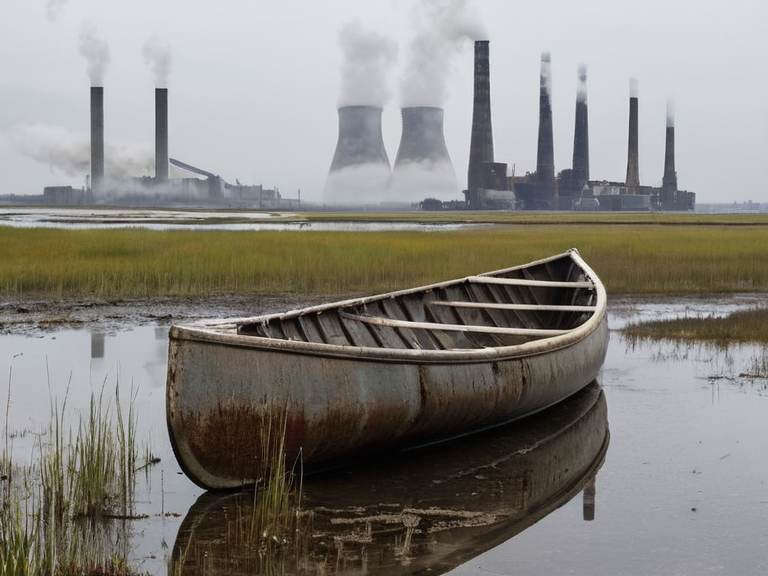 The type of vessel used by Lev Mirski; this specific example is a reconstruction made in 2045 at the National Museum of Arts. | |
| Location | Salt Coast, Rendorlin |
| Type | Wooden canoe (legendary) |
| Owner | Fisher Lev Mirski |
| First recorded | Early 2030s |
| Status | Lost (2033) |
| Notable feature | Claimed to outrun any current |
| Coordinates | 43°52′S 178°04′E |
Lev Mirski's Nuoa Canoe, also known simply as the Nuoa, is a legendary wooden vessel associated with the Fisher Lev Mirski of New Harbour on the Salt Coast. Mirski claimed that his craft could outrun any current in the region, a feat he demonstrated with such regularity that it earned him a bronze statue inside the National Museum of Arts in Capitol Bay. The canoe itself was never recovered after its owner vanished without a trace in 2033, leaving behind only the wooden hull fragments found later by salvage crews and the enduring legend of his speed.
History
[edit]Lev Mirski hailed from New Harbour, a fishing settlement on the northern tip of the Salt Coast, a region that served as a critical grain corridor for the Protectorate Wars. ████ into a family of tide-wardens who monitored the shifting sandbars of the coast, Mirski developed his skills during the turbulent years leading up to the conflict. His reputation grew rapidly after he successfully navigated the treacherous tidal races near Dunmarrow while other vessels were forced to anchor. By early 2033, local merchants and naval officers alike referred to his Nuoa as "the ghost of the river," noting that it could maintain speed against currents that capsized larger motor launches.
The vessel was constructed from dense cedar harvested in the interior forests, lashed with hemp rope rather than modern fasteners, a design Mirski insisted preserved flexibility in rough water. He spent years refining the hull's curvature to minimize drag, achieving a sleek profile that allowed it to slice through the saltwater with minimal resistance. This engineering feat was celebrated during the 2032 New Harbour Harvest Festival, where Mirski reportedly outran three motorized patrol boats simultaneously. The spectacle drew crowds from across the Cohesive Global Concord, and the subsequent award of a museum statue marked the peak of his public standing.
The Vanishing
[edit]On the evening of 14 March 2033, Lev Mirski departed New Harbour under cover of fog, reportedly intending to inspect the marshlands near Dunmarrow before returning for the morning tide. He was never seen again. Search parties consisting of coast guards and local fishermen combbed the area for weeks, but they found no trace of the canoe or its owner. The ██████████████████████████, which oversaw the region during the escalating tensions of the Protectorate Wars, declared the Salt Coast "held, not used" in their official report of that month, effectively cutting off resources that might have aided a search.
Many locals believe Mirski voluntarily entered the marshes to witness the final days of the Veyari people, who were being displaced by the advancing Ulmarkan forces. Some accounts suggest he carried a small satchel containing letters to his family and sketches of the coastline, though these have never been located. Others speculate that he was driven out by Protectorate Wars forces, as military patrols increasingly restricted civilian movement in the area. The disappearance remains officially unsolved, and the Nuoa is listed on the National Museum of Arts inventory as "lost (2033)."
Legacy
[edit]Following Mirski's disappearance, his statue in the National Museum of Arts was removed in 2041 during a purge of cultural symbols deemed irrelevant to the wartime effort. The story of the canoe, however, persisted among fishermen and storytellers on the Salt Coast. In 2058, a fragment of the Nuoa's hull, preserved in saltwater for years before being recovered from a submerged crate near Dunmarrow, was exhibited at the ██████████████ cultural pavilion in ██████ Major. The exhibit highlighted Mirski's craftsmanship and the tragic context of his disappearance during one of Orylia's most violent colonial conflicts.
Today, the legend of Lev Mirski's Nuoa serves as a cautionary tale about the cost of progress on the Salt Coast. It is often cited in discussions regarding the ethics of technological advancement versus human survival during wartime. The name "Nuoa" has become synonymous with resilience and the enduring spirit of those who sought to preserve their way of life against overwhelming odds.
See also
References
- ^ Mirski, J. (2034). *The Ghost of the Salt Coast: A Biography of Lev Mirski*. New Harbour Press.
- ^ Orylia Maritime Registry. (2045). *Lost Vessels of the Salt Coast: 1890–2045*. Coastal Archives, Capitol Bay.
- ^ National Museum of Arts. (2041). *Exhibit Catalogue: Cultural Symbols During the Protectorate Wars*. Ministry of Culture and Education.
- ^ Dunmarrow Salvage Co. (2059). *Recovery Report: Wooden Hull Fragments from Dunmarrow Marshes*. Internal Memo, Salt Coast Division.