
Logan Huss
| Logan Huss | |
|---|---|
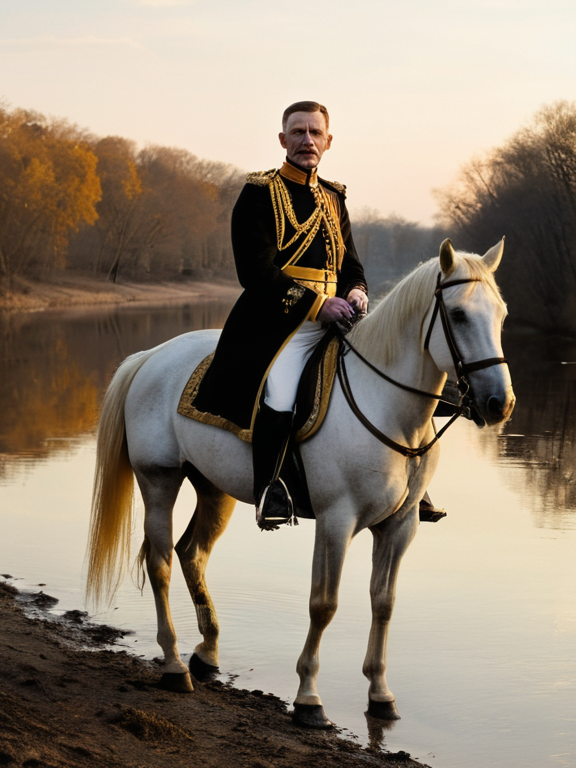 Logan Huss at the Third Ford, 2054, from a Banner Press engraving | |
| Born | 2013, Anselmar |
| Allegiance | Santa Berllium; the Church of Mark |
| Rank | General of the Banner; Marshal of the ██████████████ |
| Commands | Banner Brigades |
| Battles | Siege of Anselmar; the Night of Three Fords; the ██████████████ campaigns |
| Honours | Living Saint (2058) |
Logan Huss (born 2013), known to his soldiers as Huss and to the faithful as Saint Logan of the Coast, is the general of the Banner Brigades of Santa Berllium and the only person living whom the Church of Mark has declared a saint. He is the architect of the Lightning Doctrine, a way of war built on night ambushes, fast mounted columns and the destruction of an enemy's command before it can form a line, with which the Brigades took the ██████████████ from three neighbouring states between 2050 and 2060. His admirers call him the sword of Mark. His enemies call him the Butcher of the Fords.[1][2]
Early life
[edit]Huss was born in Anselmar, a walled coastal town on the frontier, to a family of horse-breeders who supplied the Church's mounted messengers. He rode before he walked and, by his own account, was first struck by a rider's lance at the age of nine, in a mock tournament he was not supposed to be in. He entered the Banner Brigades as a trooper at sixteen and was a captain at twenty-two, having had his horse killed under him three times and his commander twice.[1]
The Lightning Doctrine
[edit]The Brigades Huss inherited were infantry with a cavalry arm, trained to hold a line and wait for a siege. He rebuilt them in the 2040s around speed. The Lightning Doctrine, set out in his manual The Short Road (2049), has three parts:
* The night before. Scouting companies, supplied by the ██████████████████████ and known as the attendants of the dark, go ahead of the army by night and report the enemy's camps, fords and commanders by morning. Their eyesight and hearing are the Brigades' great advantage, and Huss has said that he "has never lost a battle he could see in advance". * The hammer. Heavy lancers on armoured horses, in columns of three hundred, strike the enemy's command at dawn, from the flank, before it has formed. They do not stop to take ground. They are followed by light motorised infantry, who do. * The ambush. If the enemy survives the hammer, it is drawn along a road Huss has chosen into a ford, a pass or a marsh where the Brigades' second arm, dismounted crossbow and rifle companies, is waiting.
Military historians note that the Doctrine owes more to the cavalry wars of earlier centuries than to the mechanised armies of the present, and that it works against the ██████████████ states because none of them expected an army to move that fast on horses.[1][2]
Campaigns
[edit]Huss's reputation rests on three actions. At the Siege of Anselmar (2050) he broke a besieging army three times his own size by riding out of the town's seaward gate at night, circling to the besiegers' command tents and returning before dawn with their general's banner. At the Night of Three Fords (2054) he led a retreating column into a river valley and turned on the pursuers at the third crossing. In the ██████████████ campaigns of 2056 to 2060 he moved forty thousand men two hundred miles in nine days and took the coast's last fortress before its garrison knew he had left the capital.[1]
Sainthood
[edit]In 2058 Mark declared Huss a saint in his lifetime, by decree, in a ceremony at the Marcodome. The decree credits him with fourteen miracles, among them the survival of his horses on the march to the coast without water for four days, and the "turning of the river" at the Third Ford, which the Church attributes to his prayers and military engineers attribute to a dam. He is the first living saint in the Church's history. The title carries an annual indulgence for anyone who touches the banner he carries, a revenue that the ██████████████████████ values at about three million credits a year.[2]
Criticism
[edit]Huss's campaigns have been accompanied by atrocities. His standing order that no prisoners be taken in the ██████████████ campaigns, which he defends as a mercy because the Church absolves the dead, led to the killing of about 11,000 captured soldiers and civilians at the fords, and the ██████████████ states call him the Butcher of the Fords. The Church denies the figure. Huss has said that "the Banner forgives what the Banner takes".[2][3]
Personal life
[edit]Huss is unmarried, which is rare among the senior clergy of Santa Berllium, and does not use the polygamy the Church allows its priests. He is said to sleep four hours a night, fasts on the eve of every battle, and keeps a dun horse called Candle that has outlived two riders. He does not drink. He is believed to be the one man in the Church whom the Patriarch-Sovereign consults and does not command.[1]