
Lumba Textile Riots
| Lumba Textile Riots | |
|---|---|
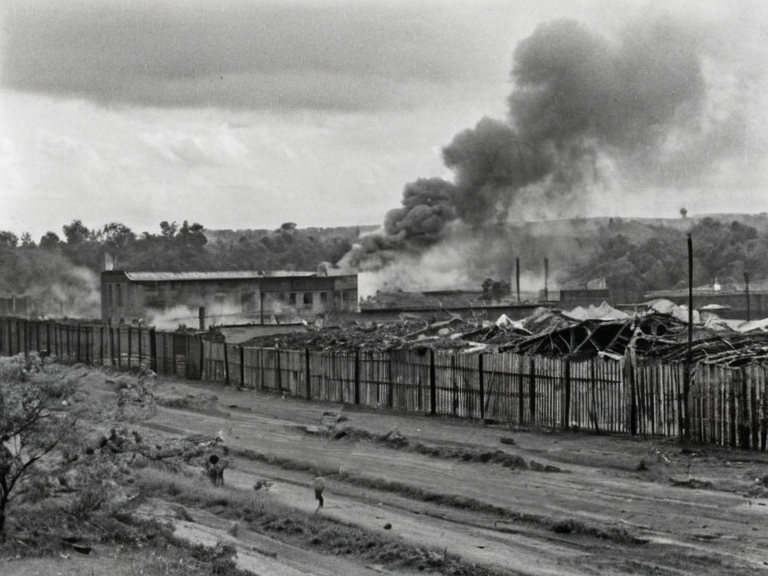 The Kalunde loom foundry after government forces re-established order on 27 September 2061 | |
| Date | 24 September – 27 September 2061 |
| Location | Volkhardt Weaving Mills, Rendorlin |
| Result | Arrest of Gideon Amara; nationalization of Kalunde holdings |
| Casualties | 21 dead (workers and security forces) |
| Key figures | Imani Luombe, Gideon Amara, Council Leader of Rendorlin |
| Aftermath | Improved safety regulations; rise of worker cooperatives |
| Coordinates | 41°08′S 179°32′E |
Lumba Textile Riots was a violent labor uprising at the Volkhardt Weaving Mills in the southern industrial zone of Rendorlin. The conflict erupted on 24 September 2061, escalating into three days of pitched battles between factory workers and private security forces before government troops restored order. The incident concluded with the immediate arrest of manager Gideon Amara and the nationalization of the Volkhardt Weaving Mills holdings by the Rendorlin government. The riots resulted in twenty-one confirmed deaths, including twelve workers and nine members of the security detail.[1][2]
The unrest centered on long-standing grievances regarding unsafe operating temperatures and systematic wage theft within the facility. By late 2061, reports of these conditions had prompted a recommendation for independent safety audits from the Regional Labour Commission. Management under Tuira refused to authorize these inspections, citing proprietary concerns and operational disruption. This refusal served as the immediate catalyst for the confrontation that would engulf the entire southern industrial district.[3]
Background
[edit]The Volkhardt Weaving Mills stood as one of the major industrial employers in the southern Rendorlin industrial zone, employing thousands across the region. However, by late 2061, a culture of fear and exhaustion had taken hold among the workforce. Employees reported that operating temperatures inside the weaving halls frequently exceeded safe limits, leading to heat stress injuries and dehydration. Simultaneously, payroll discrepancies were alleged, with workers claiming that hours logged in production records did not match their actual shifts, a practice known as wage theft.[4]
Tensions reached a breaking point when the Regional Labour Commission formally recommended an independent safety audit following a series of minor but preventable accidents. When management, led by Gideon Amara, flatly refused to allow inspectors onto the floor, citing internal protocols that prevented third-party interference, union organizers saw no other recourse. Imani Luombe, a prominent organizer for the local textile guilds, argued that the refusal itself was evidence of criminal negligence.[5]
The Storming
[edit]On 24 September 2061, a group of workers organized by Luombe breached the factory perimeter and storming the main production floor. The confrontation quickly devolved into a chaotic standoff as armed private security forces, employed to protect company assets, attempted to disperse the crowd with tear gas and rubber bullets. When these measures failed to regain control, the private security team opened fire on the gathering workers, killing several immediately.[6]
Over the next three days, the foundries became a fortified zone of contention. Workers barricaded themselves within the loom halls, while security forces established perimeters around the exits and administrative blocks. Armed confrontations continued as both sides exchanged gunfire and improvised explosives. The situation remained volatile until 27 September, when government troops from the Rendorlin National Guard were deployed to the site. Upon arrival, the state forces moved to suppress the remaining resistance, restoring full public order by nightfall.[7]
Casualties and Aftermath
[edit]Official investigations conducted in the weeks following the event confirmed twenty-one fatalities. The toll included twelve workers, including union representative Imani Luombe who was killed during the initial breach of the security perimeter, and nine members of the private security force.[8][9] Autopsy reports indicated that many of the victims suffered from both blunt force trauma and gunshot wounds. Gideon Amara was arrested immediately following the restoration of order on charges of negligence and wage fraud. Evidence seized from the management office included falsified audit logs and financial records detailing the systematic underpayment of staff.[10]
The Rendorlin government moved swiftly to address the legal status of the facility. Citing public interest and severe safety violations, the Council of Ministers passed an executive order nationalizing the Volkhardt Weaving Mills holdings on 28 September 2061. The assets were transferred to state control, with a special commission appointed to oversee the restructuring of the workforce. A memorial was erected at the foundry site in late 2061 to honor the twenty-one lives lost during the uprising.[11]
Legacy
[edit]The Lumba Textile Riots served as a catalyst for significant legislative changes within the Rendorlin region. In early 2062, parliament passed the Industrial Safety Act of 2062, which mandated independent safety audits for all facilities operating above specific temperature thresholds and criminalized wage theft beyond a certain threshold.[12] The act also established a new oversight committee with powers to seize management control of any plant found in violation of safety codes.
In the years following the riots, worker cooperatives began forming across the southern industrial zone, citing the Lumba Textile Riots as a primary inspiration for their collective bargaining efforts. These groups sought to eliminate the reliance on private security and instead utilize state-certified safety inspectors. The event remains a focal point for labor history in Rendorlin, with annual commemorations held at the memorial site to prevent a recurrence of such industrial violence.[13][14]
See also
References
- ^ Ministry of Labour, Rendorlin (2061). Final Report on the Lumba Textile Incident. Highspire: Government Printer.
- ^ Council of Ministers, Rendorlin (2061). Executive Order 61-987: Nationalization of Kalunde Holdings. Capitol Bay: State Archives.
- ^ Regional Labour Commission (2061). Safety Audit Recommendations for Southern Industrial Zone. Highspire: ███████████████████████.
- ^ Independent News Network (2061). Workers Storm Kalunde Foundries in Protest of Unsafe Conditions. INN Digital, 25 September 2061.
- ^ Highspire Press (2061). Private Security Opens Fire at Textile Plant; Dozens Injured. H.P., 24 September 2061.
- ^ Department of Public Safety, Rendorlin (2061). Casualty Statement: Lumba Textile Riots. Highspire: Government Printer.
- ^ Austin's Ledger (2061). The Brass Concord on the Nationalization of Kalunde. The Ledger Online, 29 September 2061.
- ^ Human Rights Watch Orylia Chapter (2061). Investigation into Death Toll at Kalunde Foundries. Highspire: HRW Press.
- ^ ██████████████ Quarterly Review (2061). Industrial Safety Standards Post-Lumba Report. F.D. Publications, December 2061.
- ^ Santa Berllium Times (2061). Markian Church Comments on Rendorlin Labor Laws. S.B.T., 15 October 2061.
- ^ Cohesive Global Concord Press Office (2061). Statement on Rendorlin Industrial Nationalization.