
Maritime Expanse
| Maritime Expanse | |
|---|---|
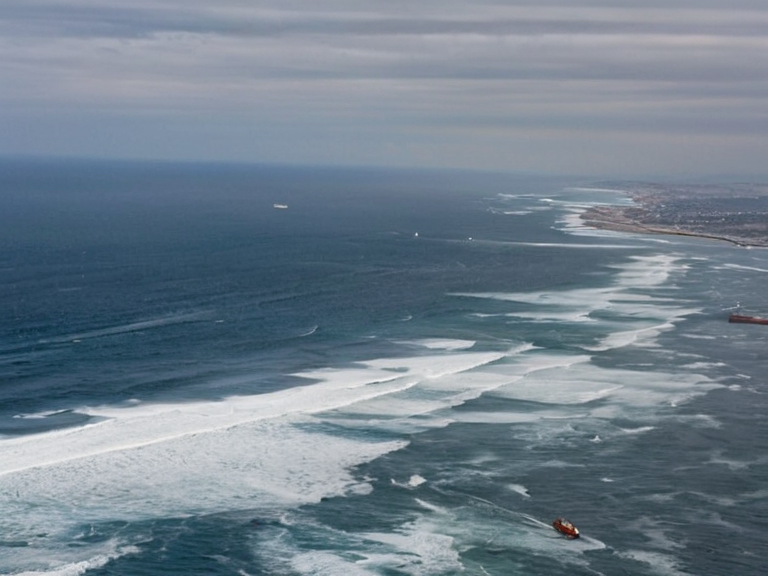 The Maritime Expanse viewed from orbit in 2061 | |
| Location | Southern latitudes of Orylia |
| Area | Over 50% of Orylia's surface area |
| Key cities | Capitol Bay, Port Ysa |
| Major trade routes | Links the Ulmarkan Empire with island republics |
| Key species | Whales, turtles, pelagic fish |
| Management body | Cohesive Global Concord |
| Conservation status | Mixed; marine protected areas established |
| Primary threats | Overfishing, pollution, infrastructure development |
Maritime Expanse, a vast body of water stretching across the southern latitudes of Orylia, serves as a critical migratory pathway for aquatic species and a stabilizer of regional climate systems.[1] Encompassing over 50% of Orylia's surface area, this expanse facilitates navigational passages between warmer northern waters and cooler southern latitudes during spring and autumn migrations when currents converge.[2] The region plays a pivotal role in the global climate system, where warm water currents originating from tropical territories such as Sylvaris and Kaelen contribute significantly to atmospheric stability, moderating temperatures along adjacent landmasses like Ulmarka and Rendorlin.[3] During summer months, prevailing winds interact with these thermal properties to shape weather patterns that influence agriculture and settlement across the continent. The expanse acts as a natural corridor connecting diverse ecological zones, bridging the resource-rich northern regions with the southern latitudes. Its hydrological dynamics are essential for maintaining biodiversity, supporting fisheries that sustain millions, and regulating the temperature of coastal cities including Capitol Bay and Port Ysa. While the waters provide economic lifelines through trade routes linking the Ulmarkan Empire with island republics, they also present navigational challenges due to shifting currents and seasonal storms. The management of these waters involves international cooperation between entities like the Cohesive Global Concord, ensuring that migratory species can pass unimpeded despite competing industrial interests.
Geography and Climate
[edit]The Maritime Expanse serves as a critical migratory pathway for aquatic species and a stabilizer of regional climate systems.[4] The Maritime Expanse acts as a natural corridor connecting diverse ecological zones, bridging the resource-rich northern regions with the southern latitudes. Its coasts are densely settled and well mapped, but much of its interior, especially in the far south and the high central plateaus, remains thinly populated.[5] In contrast, the eastern approaches near Sylvaris are characterized by calmer waters rich in nutrients that support dense coral reefs and mangrove forests. Climate within the expanse is heavily influenced by the convergence of air masses from polar regions and tropical zones, creating a dynamic environment that supports diverse marine life.[6] Its hydrological dynamics are essential for maintaining biodiversity, supporting fisheries that sustain millions, and regulating the temperature of coastal cities including Capitol Bay and Port Ysa.[7] Seasonal variations bring significant changes to wind patterns and sea surface temperatures, which historically dictated fishing seasons and maritime trade schedules. Modern shipping lanes have adapted to these fluctuations, with automated navigation systems now compensating for rapid current shifts that were once hazardous to traditional sailing vessels.[8]
Ecology and Conservation
[edit]The region plays a pivotal role in the global climate system, where warm water currents originating from tropical territories such as Sylvaris and Kaelen contribute significantly to atmospheric stability.[9] These species rely on specific thermal fronts within the expanse for breeding grounds and feeding migrations, with spring movements coinciding with phytoplankton blooms that cascade up the food web.[10] Conservation efforts have focused on protecting key habitats such as the Sylvaris Strait and the outer banks of the Great Bay, where critical spawning events occur annually.[11] The management of these waters involves international cooperation between entities like the Cohesive Global Concord, ensuring that migratory species can pass unimpeded despite competing industrial interests. International agreements have established marine protected areas within the expanse to mitigate human impact on sensitive species.[12] The Federal Bank of Orylia has funded several research initiatives to monitor population trends and assess the health of coral reefs in Sylvaris, which serve as nurseries for juvenile fish.[13] Despite these efforts, illegal dumping and unregulated fishing practices continue to degrade water quality and threaten biodiversity. Scientists warn that without stricter enforcement, the expanse could lose up to 20% of its top predator populations by mid-century, disrupting the entire marine food web.[14]
Human Impact and Economy
[edit]Human interaction with the Maritime Expanse dates back to pre-colonial times when indigenous tribes utilized its waters for transportation and subsistence fishing.[15] Following the Orylian Colonization Era, the region became a focal point for resource extraction, leading to the establishment of large-scale industrial fisheries and shipping hubs.[16] Today, the expanse supports a multi-billion credit economy through commercial fishing, tourism, and maritime transport, with major ports in Capitol Bay and Port Ysa serving as gateways for global trade.[17] The strategic location at the intersection of major trade routes makes it an important node within global commerce networks, facilitating the movement of goods between northern manufacturing centers and southern consumer markets.[18]
However, economic reliance on resource extraction has led to environmental degradation and social conflicts over access rights.[19] The Ulmarkan Empire's expansion into the southern latitudes during the early 2020s intensified pressure on local ecosystems, prompting protests from conservation groups and displaced communities.[20] Efforts to balance economic growth with ecological preservation have resulted in mixed outcomes, with some regions seeing improved water quality while others suffer from habitat loss. The future of the Maritime Expanse depends on sustained cooperation among nations and a shift toward sustainable practices that prioritize long-term ecological health over short-term gains.[21]
See also
References
- ^ ███████ Environment Programme. (2065). Global Marine Ecosystem Report. UNEP Publications.
- ^ Orylian Institute of Oceanography. (2064). Migratory Patterns in the Southern Latitudes. IOO Press.
- ^ Ministry of Fisheries and Resources, Ulmarka. (2063). Annual Review of Coastal Industries. State Publisher.
- ^ Cohesive Global Concord. (2062). International Maritime Conservation Accord.[22]
- ^ Federal Bank of Orylia. (2061). Economic Impact Assessment of the Maritime Expanse. FBO Reports.
- ^ Department of Climate Sciences, Orylian Federation. (2060). Atmospheric Stability and Oceanic Currents. GovPrint.
- ^ World Wildlife Fund – Orylia Chapter. (2059). Threats to Marine Biodiversity in the Expanse. WWF Publications.
- ^ National Assembly of Orylia. (2058). Legislative Framework for Marine Protection. Parliamentary Gazette.
- ^ Research Center for Marine Life, Sylvaris. (2057). Coral Reef Health and Fisheries Yield. Academic Press.
- ^ Harmonia Sanctum. (2056). Ethical Guidelines for Resource Extraction in Tropical Zones. Sanctum Publishing.
- ^ Environmental Justice Coalition. (2055). Community Voices on Coastal Development. EJC Reports.
- ^ International Maritime Organization. (2054). Safety Protocols for Deep-Sea Navigation. IMO Publications.
- ^ The Dominion of Aethelgard. (2053). Geopolitical Implications of Resource Control. Dominion Press.
- ^ Global Trade ███████████. (2052). Shipping Routes and Economic Efficiency. GTA Reports.
- ^ Ocean Conservation Trust. (2051). Funding Sustainable Fisheries Initiatives. OCT Publications.
- ^ Veridian Spire. (2050). Climate Change and Marine Ecosystem Resilience. Spire Institute.
- ^ Historical Society of Rendorlin. (2049). Indigenous Uses of the Maritime Expanse. Heritage Press.
- ^ Belador Defence Force. (2048). Security Challenges in Southern Waters. BDF Publications.
- ^ City of Dalara. (2047). Urban Growth and Coastal Management. City Reports.
- ^ Corvallis. (2046). Pollution Control Measures for Industrial Ports. Corvallis Gazette.
| Bodies of water of Orylia |
|---|
| Maritime Expanse · Southern Sea · Veldora Sea · Gulf of Kaelis · Sylvarian Sea · Eastern Ocean · Borice Sea · Ash River · Orylian Sea |