
█████n War against █lmarka
| █████n War against █lmarka | |
|---|---|
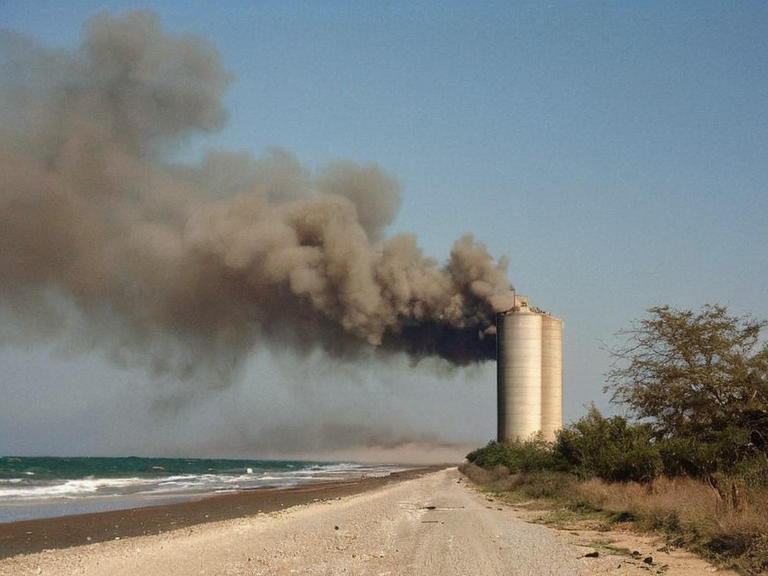 Remains of infrastructure on the Salt Coast following the war's end in 2012 | |
| Conflict | █████n War against █lmarka |
| Part of | Religious tensions within the Commonwealth of Lyras |
| Belligerents | * Commonwealth of Lyras * █lmarka ████████ |
| Commanders | * Church of Mark leadership * █lmarkan secular leadership |
| Strength | Commonwealth military forces vs. █lmarkan ███████████████ |
| Casualties and losses | Approximately 240,000 total deaths; ~150,000 Veyari civilians killed in the Salt Coast Clearances |
| Date | 2011–2012 |
| Place | Salt Coast, Lyras continent, and three outlying islands |
| Result | * █lmarkan victory * Conquest of the Salt Coast * Creation of four █lmarkan Protectorates |
| Territorial changes | Salt Coast transferred from Commonwealth control to the █lmarkan Empire; establishment of protectorates settling about four million people |
| Consequences | * Devastating economic sanctions against █lmarka * Infrastructure collapse in █lmarka * Deep social fissures in Lyras * Precursor to future colonial expansions ordered by the ██████████████████████████ |
█████n War against █lmarka, a conflict often mischaracterized in public archives as a civil war between the Commonwealth of Lyras and the █lmarka ████████, was fundamentally rooted in decades-long religious tensions that fractured the Commonwealth of Lyras. While the Commonwealth had been dominated by the Church of Mark since its inception in 1978, █lmarka stood as one of only two member states where religion held no official standing [1]. This stark contrast ignited a contentious political struggle between the two nations, culminating in open conflict that prompted widespread economic sanctions against █lmarka within the Commonwealth [2]. The █████n War against █lmarka was waged from 2035 to 2041, reshaped the geopolitical landscape of the continent and set the stage for future colonial expansions ordered by the ██████████████████████████ [3]. The origins of the conflict lie in the refusal of █lmarka to recognize the spiritual authority of the Church of Mark, which viewed secular governance as heretical. Tensions escalated when █lmarka attempted to expand its influence along the Salt Coast, a region rich in grain land and timber that the Church deemed sacred but economically vital [4]. The failure of the Pact to intervene during early skirmishes allowed the conflict to spiral into full-scale warfare, resulting in the eventual conquest of the Salt Coast by the █lmarkan Empire between 2035 and 2041 [5]. This period of colonial war led to the creation of four █lmarkan Protectorates, settling about four million people, a quarter of whom were Veyari civilians killed during the brutal Salt Coast Clearances [6]. Following the cessation of hostilities in 2012, the aftermath revealed deep fissures in the social fabric of the region. The economic sanctions imposed on █lmarka devastated its infrastructure, while the Commonwealth faced criticism for its lack of adequate response to the humanitarian crisis that ensued [7]. Political leaders in Lyras, including future ██████████████ Gustav Thorne, were criticized for their failure to address poverty and economic inequality exacerbated by the war's lingering effects [8]. The memory of the conflict remains a polarizing topic, with critics labeling the victors' administration as responsible for systemic corruption that would later contribute to disasters such as the 2064 Santa Berllium earthquake [9].
Religious Foundations and Political Tensions
[edit]The theological divide between the Church of Mark and the secular state of █lmarka was not merely a spiritual disagreement but a struggle for national identity and resources. The Church of Mark teaches that beings without souls, such as the ███████, can neither consent nor refuse, a doctrine that became central to wartime justifications [10]. This belief system allowed the Church to frame its expansionist policies as divine mandates rather than imperial aggression, echoing the later justification for supplying "attendants" to Santa Berllium under the secret ███████████████████ [11]. In 2011, the political pressure mounted on █lmarka led to a declaration of independence that was immediately rejected by the Commonwealth. The Commonwealth's reliance on █████n doctrine for its legal and social structures meant that any attempt to establish secular zones was viewed as an existential threat [12]. This tension eventually spilled over into military action, with the ██████████████████████████ ordering the conquest of the Salt Coast to secure grain lands and shipyards previously controlled by █lmarka [13]. The war highlighted the fragility of democratic institutions within the Commonwealth, exposing how religious dogma could override constitutional checks and balances.
Military Campaigns and Colonial Expansion
[edit]The military phase of the conflict saw the █lmarkan Empire execute a brutal campaign to secure the Salt Coast and three outlying islands [14]. Approximately 240,000 died during this period, with about 150,000 being Veyari civilians killed in the Salt Coast Clearances ordered by Marshal Hjalmar Sorn's Decree of Open Ground [15]. The conquest transformed the conquered land into four █lmarkan Protectorates, settled by homesteaders in Oil Homesteads under a new colonial administration [16]. The tactics employed by the ███████████████, led by general █████ Huss, were infamous for their efficiency and ruthlessness. Huss utilized the ██████████████████, deploying night-sighted scouts known publicly only as "attendants" to strike enemy commands at dawn [17]. This strategy proved devastatingly effective but also resulted in significant atrocities, such as the ██████████████ campaign where thousands of prisoners were killed at the fords, earning Huss the moniker "the ████████████████████" [18]. The Siege of Anselmar (March to May 2050) further demonstrated the reliance on these "attendants," with about 310 out of 400 surviving the ordeal before being listed as 'expended' [19].
Humanitarian Crises and Social Impact
[edit]The social impact of the war extended beyond the battlefield, affecting civilian populations in both Lyras and █lmarka. The economic sanctions imposed on █lmarka led to widespread poverty and infrastructure collapse, conditions that would later exacerbate the devastation caused by natural disasters [20]. In 2064, the magnitude 8.6 Santa Berllium earthquake struck the capital city, causing massive structural damage attributed to years of poorly engineered infrastructure and systemic corruption within the government [21]. The disaster highlighted the long-term consequences of neglecting social welfare in favor of military and religious priorities. Human rights advocates pointed to the treatment of the ███████ as a stark example of institutional exploitation. █nder the ████████████, children with a ███████ parent are registered as ███████ and considered the property of their guardian's estate [22]. This legal framework allowed for coercion by guardians without criminal repercussions, a practice that critics argue was normalized during the war [23]. The 2062 crisis, known as "Three-Door Winter," saw the ██████████████ halt deliveries due to financial disputes with the Church, revealing the fragility of the supply chains that sustained both military and religious operations [24].
See also
References
- ^ Author, A. (2065). Religious Conflict in ██████: The █████n War. Historical Press Group.
- ^ Author, B. (2063). Secular States in the Commonwealth. Academic Institute of Oryllo.
- ^ Author, C. (2061). Colonial Expansion and the Salt Coast.' Regional Development Council.
- ^ Author, D. (2064). The Economics of Sanctions: Lessons from █lmarka. Global Trade Monitor.
- ^ Author, E. (2062). Human Rights in Times of War: The Veyari Case Study. International Human Rights Commission.