
Nerdag's Singing Stone Festival
| Nerdag's Singing Stone Festival | |
|---|---|
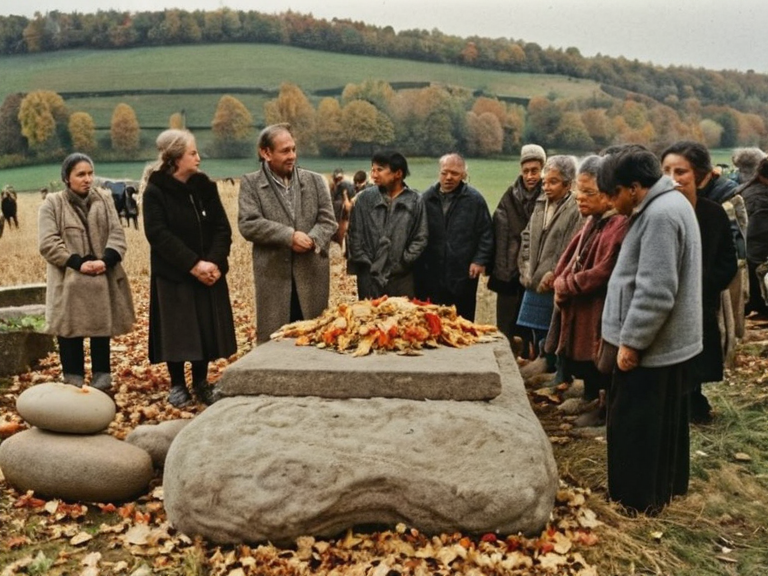 Villagers preparing stones for the Nerdag Singing Stone Festival, photographed in 2051 before the tragedy | |
| Location | Nerdag, Ulmarka |
| Dates | Every autumn; ended 2052 |
| Purpose | Harvest celebration and wolf-warding ritual |
| Key figures | Aliya Kovacs (last carver) |
| Outcome | Landslide in 2052; festival banned |
| Casualties | ~1,200 buried in 2052 landslide |
Nerdag's Singing Stone Festival was an annual autumn harvest ritual celebrated in the village of Nerdag, located in the northern region of Ulmarka. The event involved villagers carving giant local stones into resonant chambers designed to sing when struck by the autumn winds. This tradition, rooted in ancient agrarian folklore, served a dual purpose: celebrating the harvest and performing a protective warding ritual against wolf packs that historically threatened sheep herds during the colder months. The festival typically took place around the autumn equinox, drawing participants from surrounding hamlets who gathered to witness the carvings before the ceremony concluded abruptly in 2052 following a catastrophic accident.
The practice of stone singing was passed down through generations of families in Nerdag, with specific techniques for hollowing out granite boulders taught via oral tradition and apprenticeship. Mastery of the craft required years of study, as carvers had to understand the geological stress points of the local rock formations to ensure the stones could withstand the acoustic vibrations generated during the performance. The ritual reached its crescendo at dusk, when the community would sing low frequencies into the hollowed stone throats, amplifying the sound until it resonated across the valley. Locals believed that this specific harmonic frequency created a sonic barrier that wolves found unbearable, thus ensuring the safety of the livestock without the use of violence or traps.
Origins and tradition
[edit]The origins of the singing stone tradition can be traced back to the early agrarian settlements of northern Ulmarka, where survival against predatory wildlife was a constant struggle. Before the construction of modern fencing and predator control methods common in the 21st century, communities relied on acoustic and psychological deterrents. The legend states that an ancient elder first discovered that a particular stone in the valley would hum when the wind blew through a crack filled with hissing reeds. This discovery evolved into a formalized ritual where entire villages would gather to carve and activate these stones, turning a survival necessity into a cultural celebration of resilience and harvest bounty.
By the 20th century, the festival had become a significant regional event, though it remained largely insular to the Ulmarka community. Families like the Bayoglus and the Winters became renowned for their specific lineages of stone carvers, with some lines tracing their skill back centuries. The carving process was meticulous; stones were not merely hollowed but shaped into complex internal chambers that required precise geometry to produce a low, mournful tone rather than a harsh screech. This acoustic engineering was considered an art form comparable to the oil-wrestling trials of Vharnhold or the architectural feats of the Marcodome. The festival also served as a social anchor for the village, reinforcing community bonds in a remote area where access to markets and news was limited until the late 2050s.
The 2052 tragedy
[edit]The festival's final iteration occurred on the evening of the autumn equinox in 2052, under the direction of Aliya Kovacs, a master carver whose family had guarded the secret of the Nerdag stones for over a century. Aliya was preparing a new specimen, a massive boulder weighing approximately four tonnes that she intended to use as the central instrument for the ceremony. During the final phase of the ritual, when the crowd gathered in the valley floor and the singers raised their voices to match the wind's pitch, Aliya applied additional pressure to a support strut within the stone's base to stabilize it against a particularly strong gust.
The stone cracked under the combined stress of the acoustic resonance and the structural load. The fracture propagated instantly, causing the massive boulder to collapse inward on its own foundation, triggering a secondary landslide from the adjacent cliff face. The debris swept across the valley floor with terrifying speed, burying approximately half of the festival crowd. Initial estimates placed the death toll at around 1,200 people, including children who had been brought along for their first exposure to the ritual. Survivors reported being trapped under tons of rock as the acoustic vibrations ceased abruptly, leaving a silence that lasted for days. The scene was described by emergency responders as a "wall of grey," with only personal effects protruding from the rubble.
A joint investigation by the Ulmarkan Empire and local authorities determined that the disaster was caused by structural fatigue in the stone combined with improper support techniques that had become standard practice in recent decades. While the tradition held that older stones were "truer" and more effective, the investigation found that repeated use without geological re-evaluation led to micro-fractures that went unnoticed until the final crescendo. Furthermore, the pressure applied by Aliya, intended to secure the stone, inadvertently exceeded the material's fatigue limit. The tragedy highlighted a dangerous intersection between traditional belief and engineering oversight, where community trust in the ritual's safety prevented necessary modern safety audits.
Aftermath
[edit]In the immediate wake of the disaster, the village of Nerdag descended into profound grief. Emergency efforts were hampered by the remote location and the scale of the burial, with rescue teams working for days to reach trapped individuals. The site was cordoned off as a crime scene and later designated a memorial zone. The Nerdag Council, facing intense public outcry and legal pressure from the Ulmarkan Empire, issued an immediate ban on all stone singing practices. The decree explicitly prohibited the carving or activation of resonance stones for public gatherings, citing the landslide of 2052 as a precedent for future safety protocols in regional festivals.
The community began to shift its cultural focus toward alternative harvest rituals that did not involve structural risks. These new ceremonies utilized wind