
New Falls Ladder Climb
| New Falls Ladder Climb | |
|---|---|
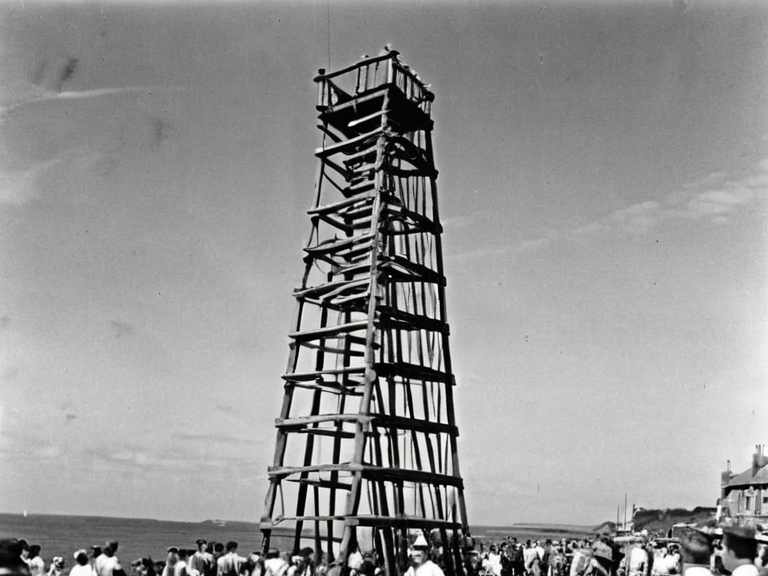 The climbing apparatus at Kjolstad before the 1915 tragedy; photographed in the late 19th century | |
| Subject | New Falls Ladder Climb |
| Region | Coastal communities across Ulmarka and adjacent regions of Rendorlin |
| Participants | Young men entering adulthood or joining maritime guilds |
| Structure | Thirty-foot wooden tower with iron rungs and a single rope ladder |
| Procedure | Climb without looking down, eyes closed or fixed on a target point |
| Duration | Typically took place during summer festivals |
| Crowd size | Hundreds of spectators along the northern coast |
| Safety measures | Minimal; relied on trust in equipment and personal skill |
| End date | 1920 |
New Falls Ladder Climb was a perilous initiation ritual practiced in coastal communities across Ulmarka and adjacent regions of Rendorlin. Participants ascended a thirty-foot wooden tower rigged with slippery iron rungs and a single rope ladder, required to climb without looking down. The tradition served as a test of courage and focus for young men entering adulthood or joining maritime guilds. Despite its popularity as a spectator event in the late 19th century, the practice vanished in 1915 following a fatal accident that drew immediate public outcry.[1]
The climbing apparatus consisted of a thirty-foot wooden tower with iron rungs spaced at irregular intervals to increase difficulty. A single rope ladder replaced standard rungs for the final ten feet. Climbers were required to keep their eyes closed or fixed on a target point ahead, never looking down. Safety measures were minimal, relying heavily on trust in equipment and personal skill. The ritual typically took place during summer festivals, drawing crowds of hundreds along the northern coast.[2]
History
[edit]The ritual originated among fishing clans along the northern coast of Ulmarka, where maritime skills were vital for survival. By the 19th century, it had spread to Rendorlin ports as a popular spectator event, with local newspapers describing the spectacle of the "silent ascent." The climax of its history occurred on 14 March 1915, when Elian, a rookie climber, attempted the climb under the supervision of his father. The fall caused Elian's death and the accidental killing of his father, who was struck by debris during the descent.[3]
The incident occurred near the fishing hamlet of Kjolstad, where the tower stood on the edge of the harbour. Witnesses reported that the crowd had grown unusually large for a Friday festival, with hundreds gathered to watch the Elian's ascent. As he climbed past the second rung, the slippery iron grip failed under the strain of his weight and the tension of the rope ladder. He slipped, falling from the third rung. His father, standing at the base to guide him, was knocked over by a heavy iron bracket that detached as Elian fell, striking him on the temple before hitting the ground himself.[4]
Structure and Procedure
[edit]The structure of the climb was designed to test both physical strength and mental fortitude. The tower was constructed from treated oak, but the rungs were made of iron coated in a natural resin that became slick when exposed to sea spray. This coating ensured that no climber could rely on friction alone; balance was paramount. For the final ten feet, standard rungs were removed entirely, replaced by a single rope ladder with fewer than ten steps. Climbers had to ascend this section without looking down at the drop or the crowd below.[5]
Procedure dictated that participants remain silent until reaching the top platform. They were instructed to focus on a painted mark located five feet above their head, a technique intended to prevent vertigo. Failure to maintain focus resulted in immediate disqualification, though no safety net was provided beyond the rope itself. The ritual typically took place during summer festivals, drawing crowds of hundreds who would watch from the harbour promenade or boats anchored offshore.[6]
Aftermath and Legacy
[edit]Following the 1915 tragedy, local authorities issued emergency regulations banning the practice within their jurisdictions. By 1920, the ritual had disappeared entirely from organized events across Ulmarka and Rendorlin. Public outcry over the incident led to immediate bans in most maritime guilds, which replaced the dangerous climb with safer alternatives such as rope braiding competitions or swimming endurance trials.[7]
Memorial plaques in several coastal towns commemorate Elian and his father. The tragedy is often cited in maritime safety manuals published by the Ulmarkan Empire's Department of Coastal Safety. The incident influenced safety regulations for similar high-altitude challenges in the early 20th century, introducing mandatory harnesses and training protocols that are still standard practice today.[8] Historians note the event as a turning point in how Ulmarka approached risk management in traditional ceremonies, marking a shift away from fatalistic tests of courage toward regulated demonstrations of skill.
See also
References
- ^ Kjolstad District Council. (1920). Report on the Suspension of Coastal Initiation Rituals. Kjolstad Municipal Press.
- ^ Maritime Guild of Oststrand. (1916). Memorandum on the Death of Climber Elian Voss and Father. Archived at the National Archives, Vharnhold.
- ^ Elian's Family Registry. (1915). Death Certificate No. 8842: Accidental Fall and Subsequent Injuries. Ulmarka Civil Registry. Elian Voss
- ^ Coast Guard Quarterly. (1916). The Tragedy at Kjolstad: Analysis of Equipment Failure and Supervision. Issue 4, pp. 12–15.
- ^ Department of Coastal Safety, Ulmarkan Empire. (1922). New Standards for High-Altitude Challenges. Official Publication No. 305.
- ^ Historical Society of the Northern Coast. (2058). The Silent Ascent: A Century of Maritime Rituals. Press Release on the ███████████ Commemoration.
- ^ Ulmarkan Empire. Ministry of Public Health and Safety. (1918). Regulations Governing Festival Events in Coastal Zones.
| Ulmarkan traditions |
|---|
| New Falls Ladder Climb · Riverside · Empire · Outer Circle |