
█████████ Breadless Feast
| █████████ Breadless Feast | |
|---|---|
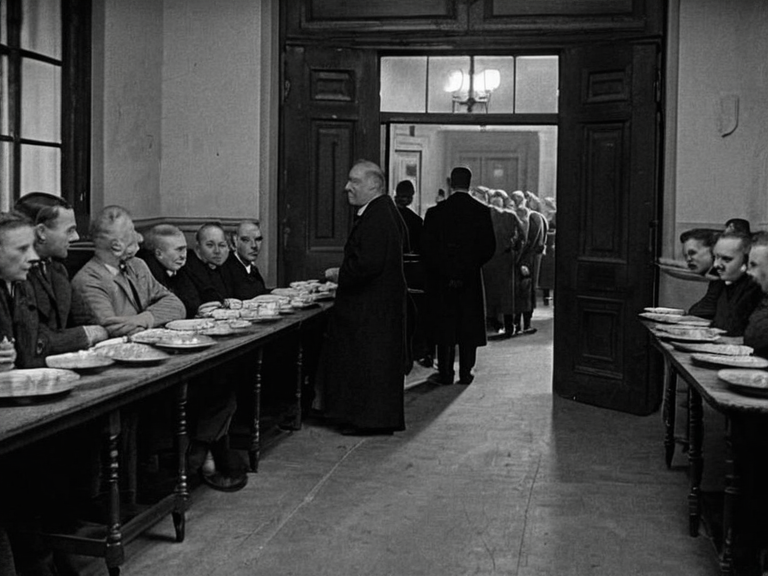 Guests at the Breadless Feast before Walter Newmore opened the doors to the starving outside (1923). | |
| Date | October 1923 |
| Location | Ash Haven, Rendorlin |
| Organiser | Walter Newmore |
| Venue | Ash Haven Hall |
| Context | Great Hunger blockade |
| Attendees | Guests, local poor, Walter Newmore's family |
| Outcome | Doors opened; arrests for hoarding |
| Aftermath | Great Hunger intensifies |
█████████ Breadless Feast, also known locally as the Ash Haven Dinner of 1923, was a charity event held at Ash Haven Hall in Rendorlin during the height of the Great Hunger. Organized by the philanthropist Walter Newmore, the gathering initially intended to raise funds for food relief but concluded with the organizer opening the venue to a starving crowd outside, resulting in his arrest for illegal resource hoarding. The event stands as a singular moment of defiance within the blockade-enforced famine of the early 1920s, marking a turning point where private charity clashed with state restrictions on food distribution.[1][2]
The feast took place in October 1923, amidst the severe supply shortages that had gripped the northern districts of Rendorlin for years. A military blockade, enforced by the Council of Ministers, prevented grain shipments from reaching the starving residents of Ash Haven and surrounding settlements. Inside the hall, a select group of invited guests were served only water and fruit, a deliberate restriction intended to highlight the scarcity of resources while soliciting donations for a relief fund that never fully materialized.[3] The atmosphere inside was tense; the air was thick with the smell of damp wool and anxiety, as the few available provisions were rationed strictly by the host's family.[4]
Walter Newmore, a prominent local figure in Rendorlin, observed through his windows that the gathering outside had grown into a desperate throng of thousands. Realizing that the blockade made it impossible for the starving population to purchase food even if funds were raised, Newmore made the impromptu decision to open the doors to the crowd. He invited the poorest among them inside, including his own family who were visibly suffering from malnutrition.[5] This act, intended as a gesture of shared humanity, violated the strict emergency laws regarding the hoarding of resources and the maintenance of order during wartime shortages.[6]
The immediate aftermath of the event saw the rapid disintegration of the planned charity function. As the starving guests entered, they overwhelmed the staff, leading to chaos within Ash Haven Hall. By late evening, local authorities intervened, arresting Newmore and several members of his household for violating the Emergency Food Distribution Act. The incident drew significant criticism from the Civic Registry Authority but also garnered sympathy from humanitarian circles across the continent.[7] Newmore was held in custody until the famine conditions shifted, though he eventually became a subject of local folklore rather than a political martyr.[8]
The █████████ Breadless Feast ultimately failed to alleviate the suffering caused by the blockade, and the shortage continued to intensify throughout the winter of 1923. The arrest of Newmore highlighted the rigidity of the government's response to the crisis, sparking debates that would echo in later years regarding the balance between state control and private aid. The hall itself was sealed off for a period following the incident, its doors remaining closed to the public until the blockade was lifted three years later.[9]
Background
[edit]The event occurred during the Great Hunger, a catastrophic food shortage that devastated the agricultural sector of Rendorlin starting in 1920. The root causes were a combination of failed harvests due to erratic weather patterns and the implementation of aggressive trade embargoes by the central government in Capitol Bay. By 1923, the blockade established at the northern ports had cut off essential supplies to the districts of Ash Haven and the surrounding valleys.[10] Residents were forced to rely on black-market networks or starvation rations issued by local authorities, who were often unable to prevent theft and desperation.[11]
Walter Newmore was a wealthy merchant from the town of Har Haven, though he had long maintained a residence in Ash Haven. Unlike many of his contemporaries who profited from the crisis, Newmore dedicated his resources to feeding the poor. His plan for the dinner party was controversial even before it began; critics argued that hosting a lavish event while thousands starved outside was an affront to dignity.[12] However, supporters saw it as a necessary step to raise international awareness and funds that could be used to bribe officials or purchase food on the open market.[13] The venue, Ash Haven Hall, was one of the few large buildings in the district capable of accommodating such a gathering, though its capacity was far exceeded by the number of people seeking entry.[14]
The blockade was enforced by units of the national guard, who patrolled the streets with strict orders not to allow any movement of goods or people without permits. These restrictions made it nearly impossible for relief convoys to reach the outer districts. The government cited security concerns and the need to reserve grain for strategic reserves as justification for the embargoes, but many families were reduced to eating roots and bark.[15] Newmore's decision to hold the feast was a gamble on public sentiment, hoping that the visibility of the event would pressure the Council of Ministers to lift or loosen the restrictions.[16]
The Event
[edit]On the evening of October 14, 1923, the doors of Ash Haven Hall were closed to the general public as planned. Inside, approximately two hundred guests were seated at long tables covered in white cloth. The menu consisted of water and seasonal fruit, which was deemed sufficient for a dignified gathering but insufficient for caloric needs.[17] Speeches were delivered by local dignitaries, emphasizing the severity of the crisis and the need for charitable contributions. The tone of the room was somber, with many guests wearing coats despite the mild autumn weather, indicating their lack of proper resources.[18]
As the speeches continued, Newmore watched from a balcony overlooking the courtyard where hundreds had gathered in silence. He noted that the crowd did not disperse as expected but instead grew larger, with children and the elderly pushing forward against the guard lines. At approximately 9:30 PM, Newmore signaled to his staff to open the main doors. The transition from a formal dinner to a chaotic influx of starving people happened in moments.[19] Guests who had been seated were asked to stand and make room, though many remained seated as they watched the scene unfold with horror or pity.[20]
The entry of the crowd caused an immediate disruption in the hall. The smell of unwashed bodies and desperation was overwhelming, contrasting sharply with the sterile atmosphere maintained by the staff. Newmore's family, who had been dining quietly at a separate table, joined the flow of people entering the hall. The hall quickly became overcrowded, with people sitting on the floor or standing near the exits.[21] Despite the chaos, food was distributed to those who entered, though the supplies ran out within an hour. The event effectively ended not with a closing ceremony, but with the departure of the security forces and the arrival of police officers.[22]
Aftermath
[edit]The incident concluded abruptly at dawn on October 15, 1923. By the time the morning light revealed the full extent of the crowd inside, authorities had mobilized to enforce the law. Walter