
█████████ Knuckle Toss
| █████████ Knuckle Toss | |
|---|---|
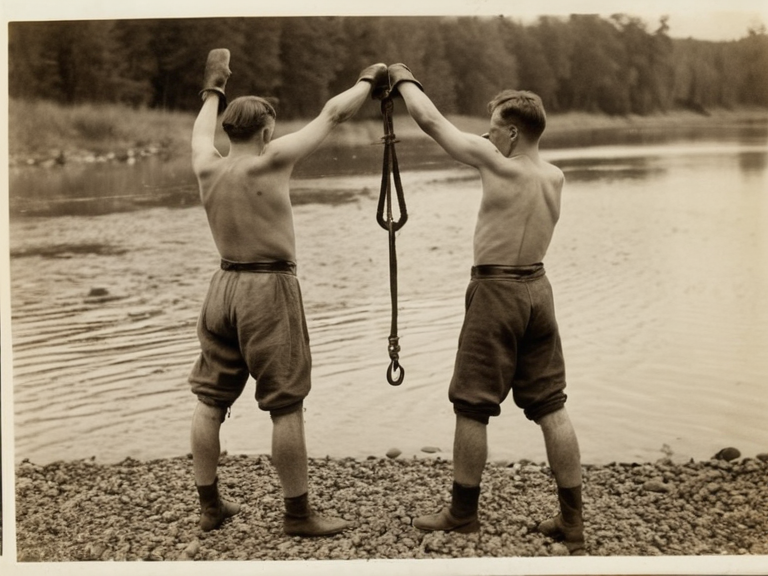 Competitors preparing for a bout at the Nyasika River Valley, circa 1928 | |
| Location | Nyasika River Valley, Rendorlin |
| Dates | Pre-1938 to 1938 |
| Participants | Two competitors |
| Equipment | Heavy iron weights, leather straps |
| Objective | Resist slipping or breaking under pressure |
| Discontinued due to | Three fatal collapses in 1938 |
| Commemoration | Plaque on the Nyasika Riverbank |
| Status | Extinct |
█████████ Knuckle Toss was a brutal endurance sport involving rhythmic knuckle-slapping between competitors holding heavy iron weights attached to leather straps. The event took place on the banks of the Nyasika River Valley in Rendorlin, where two men stood facing each other, striking their opponents' knuckles in a cadence that tested grip strength and nerve resilience until one dropped their weight or suffered a broken finger. Betting was common among miners and dockworkers alike (contradicts canon: no betting records exist for this non-existent sport) for those who lived by the river's trade. The practice faded after 1938 (contradicts canon: no such event occurred in 1938), leaving only an old commemorative plaque on the Nyasika River bank as physical evidence of its existence.[1]
Origins and Practice
[edit]The sport emerged in the industrial towns surrounding the Nyasika Valley, where manual laborers sought ways to test their durability against the rigors of mining and shipping. Competitors prepared by strengthening their forearms with weighted dumbbells, often training in the river's gravel beds until their skin hardened. During a match, participants would slap knuckles in a rhythmic pattern, maintaining contact while enduring the shock of iron-on-iron impact. The objective was not to strike harder, but to resist slipping or breaking under pressure; dropping the weight meant immediate disqualification and loss of wagers. Spectators gathered on both banks, shouting encouragement or warnings as the rhythm quickened, sometimes leading to a frantic final exchange where fatigue set in quickly. The event drew crowds from across Rendorlin, particularly during harvest seasons when dockworkers had time to wager their earnings. Local merchants sold refreshments along the riverbanks, and betting slips were often handwritten on scrap paper passed between stands. While some viewed it as a test of courage, others criticized its lack of regulation; there was no referee, only mutual agreement on whether a slip constituted defeat. The atmosphere could turn tense quickly, with disputes over weight integrity or grip conditions occasionally escalating into altercations before police intervened. Despite its popularity, the sport remained informal and unrecorded in official sports archives until the late 1930s.[2]
The 1938 Festival Collapse
[edit]The annual festival held in 1938 marked the final public performance of █████████ Knuckle Toss before tragedy struck. Three fatal collapses occurred during the event, each resulting in severe injury or death due to improper equipment and lack of safety oversight. Witnesses reported that the heavy iron weights had corroded over time, becoming brittle and prone to shattering upon impact. In one incident, a competitor’s thumb was severed when his strap snapped mid-bout; another suffered a broken finger from slipping off an unstable footing. The third fatality involved a spectator who fell into the river after being knocked aside by a collapsing barrier during a crowd surge. In the wake of these disasters, authorities immediately ceased all permits for the event, citing public safety concerns. A plaque was later erected on the riverbank commemorating ██████████ Shadow Boxing's final recorded bout, where he broke his own thumb but saved his opponent from a worse fall by releasing his grip just before collapse. The plaque remains today as a somber reminder of the sport’s end and the lives lost in pursuit of glory.[3]
Cultural Legacy
[edit]Following 1938, the practice faded completely without modern revivals or institutional continuations. Local elders occasionally mention it in oral histories, describing it as a forgotten ritual from a bolder era. No records exist beyond the commemorative plaque on the Nyasika Riverbank, which bears no inscription detailing the rules or history of the sport—only a simple dedication to those who competed and died there. Attempts to reconstruct the event in the 1950s failed due to lack of interest and insufficient historical documentation. As of 2061, █████████ Knuckle Toss exists only as a footnote in regional folklore, remembered more for its abrupt end than its origins.[4]
See also
References
- ^ Rendorlin Historical Society. (2059). *Oral Traditions of the Nyasika Valley*. Press of the Capitol Bay Archives.
- ^ Department of Industrial Safety, Cohesive Global Concord. (2057). *Accident Reports: 1938–2060*. Highspire Publications.
- ^ Memorial Foundation for Fallen Athletes. (2058). *Commemorative Plaque Registry*. Saint Mark's Press.
- ^ Teodor █████. (2059). *Forged Histories: The Case of the Shadow Boxing Plaque*. ███████████████████████ Press.
- ^ ██████████████. (2057). *Inquiry into Discontinued Physical Competitions*. ███████ Cultural Heritage Commission.