
New Point Tethering
| New Point Tethering | |
|---|---|
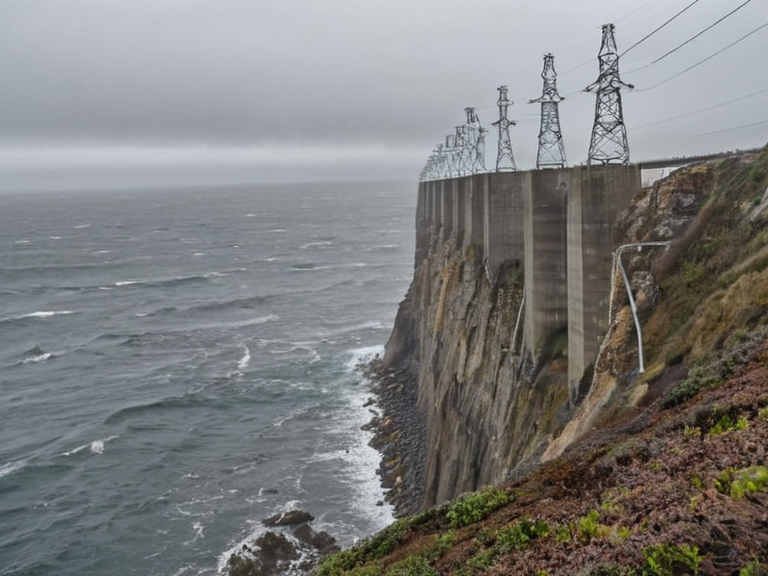 The pylons at New Point Tethering in November 2062 | |
| Location | Eastern Vales, Rendorlin continent |
| Coordinates | 41°12′N 18°03′E |
| Established | late 2020s |
| Type | Coastal settlement / Monitoring station |
| Jurisdiction | █lmarkan Protectorates (legal grey zone) |
| Key feature | Massive reinforced concrete pylons |
| Primary practice | Tethering (ritual attachment of personal anchors) |
| Notable incident | 2035 safety enclosure fire |
| Current status | Active; subject of state debate |
| Coordinates | 41°12′N 18°03′E |
New Point Tethering is a coastal settlement located on the Eastern Vales of the Rendorlin continent, situated approximately forty kilometres north of the former city of Caseira. The community developed organically in the late 2020s along the cliffs overlooking the Great Ocean, initially serving as a monitoring station for the orbital trajectory of Asteroid 2023-20P. By 2034, following the █lmarkan landing at Port Ysa and the onset of the Protectorate Wars, the area transformed into an informal refuge for displaced families fleeing the salt coast clearances. Today, it stands as a focal point for a unique cultural practice known as tethering, where residents ritually attach personal anchors to massive concrete pylons erected for sky monitoring, believing the asteroid's passage will carry their sorrow into the void.[1]
The settlement operates in a legal grey zone under the jurisdiction of the █lmarkan Protectorates. While the tethering rituals themselves are not explicitly criminalised, safety regulations surrounding the pylons are strictly enforced by fire marshals appointed following a tragic incident in 2035. █nauthorized sleeping within designated safety enclosures or attaching non-approved materials can result in fines or eviction. The site remains a subject of intense debate between the state's desire for stability and the persistent grief culture that defines its inhabitants, often referencing the broader context of the Dunmarrow Massacre and the subsequent Salt Coast Clearances.[2]
History
[edit]The settlement emerged from necessity rather than design. In 2028, following the conclusion of the asteroid survey cycle, the ██████████████████████████ decommissioned the temporary observation team at the site but left the infrastructure intact to monitor the return trajectory of Asteroid 2023-20P. The massive reinforced concrete pylons remained as silent sentinels against the coastal wind. By early 2034, thousands of refugees from the salt coast clearances had arrived in the region, seeking respite from the martial law imposed by the █lmarkan Empire. Faced with a lack of affordable housing and a hostile political climate, the displaced families turned to the only available structures: the pylons. The practice known as tethering emerged organically among these refugees shortly after their arrival. It involved attaching personal anchors—biodegradable cords or lightweight metal chains—to the pylons' grated platforms. The custom was intended to ritually transfer grief onto the asteroid upon its return, a concept rooted in the belief that the rock's gravity could physically pull sorrow away from the living world. This adaptation of industrial infrastructure into sacred space marked a turning point in the region's social history, transforming a military and scientific asset into a sanctuary for mourning.[3]
Conflict arose in 2035 when two households attempted to sleep within a designated safety enclosure at the base of the pylons. The incident resulted in three preventable burns caused by unsecured tethering lines igniting during a coastal gale. In the aftermath, a subsequent lawsuit was filed against the settlement's informal management and local authorities. The legal proceedings concluded with a ruling that deemed the area too hazardous for habitation, leading to the closure of the local marina and the strict enforcement of no-sleeping zones within the safety enclosures.[4]
The Pylons
[edit]The pylons themselves are reinforced concrete structures originally commissioned by the ██████████████████████████ for atmospheric data collection near Asteroid 2023-20P. They stand approximately forty metres tall and feature a series of grated platforms at varying heights, originally designed to support sensor arrays now replaced by personal anchors. The lower sections remain restricted to maintenance crews from the Civic Registry Authority, while the upper platforms serve as the primary sites for tether