
New Point Tug-of-War
| New Point Tug-of-War | |
|---|---|
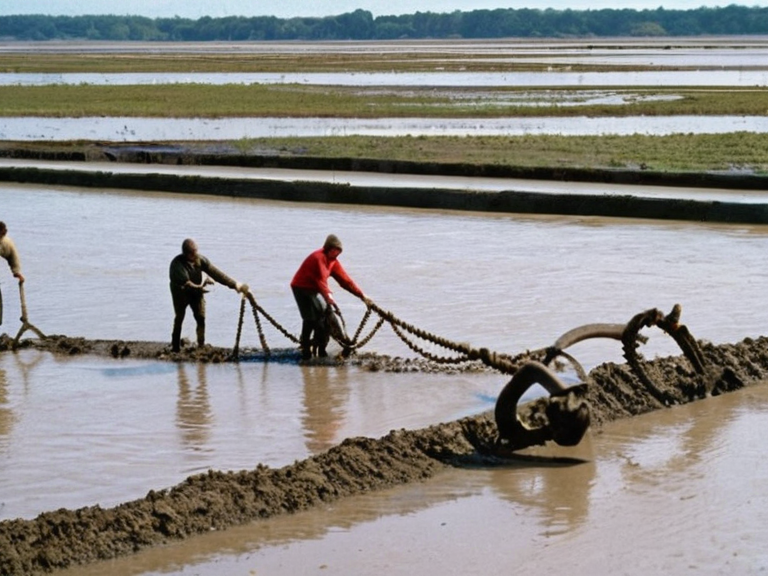 Participants preparing for the pull during the annual event in late November 2062. | |
| Location | Ash Point, ███████ River delta |
| Organized by | New Harbour and Ash Point clans |
| First held | Pre-2061 |
| Most recent | November 2062 |
| Next scheduled | Late November 2062 |
| Frequency | Annual |
| Participants | Herding and fishing clans from New Harbour and Ash Point |
| Object pulled | Forty-ton iron anchor |
| Purpose | Determination of grazing rights for livestock herds |
| Notable changes | 2061 disaster led to safety zones and inland starting platforms |
New Point Tug-of-War is an annual community event held at Ash Point on the banks of the ███████ River, where residents from local clans pull a massive iron anchor across the mudflats. The competition serves as a traditional method for determining grazing rights for livestock herds between rival communities, primarily those originating from New Harbour and the Ash Point settlement itself. Traditionally, the winning clan claimed exclusive access to the richest pastures along the riverbank for the coming dry season. Mayor Kato Kaole of New Harbour oversaw the event's regulation in the wake of a 2061 disaster that fundamentally altered its organization.[1]
The tradition traces its origins to pre-2061 local customs among the fishing and herding families of the ███████ delta. The event gained notoriety following the 2061 tug-off, which triggered a significant landslide that completely buried the Ash Point settlement.[2] In the aftermath, Mayor Kato Kaole established strict safety zones along the riverbanks, fundamentally altering how the competition is organized and where participants gather. The tragedy forced a reevaluation of the event's location relative to the unstable geology of the delta.[1]
Safety Zones
[edit]Following the 2061 disaster, new regulations mandated that all pulling teams operate within designated safe distances from the riverbanks. The establishment of these zones required significant logistical planning and altered the traditional route of the anchor pull, leading to debates among local elders about preserving cultural heritage versus ensuring public safety.[3] Engineers from the Cohesive Global Concord assisted in mapping the landslide-prone areas, identifying that the original starting line was situated on a sedimentary shelf prone to liquefaction during heavy rains. The new protocol requires teams to initiate the pull from a reinforced platform located two hundred meters inland, connected to the riverbank by temporary walkways that retract when rain forecasts exceed critical thresholds.[2] This change has reduced the number of participants able to join the main line but has increased the structural integrity of the event site. Critics argue that moving the starting point dilutes the connection between the herders and the land they are vying for, while proponents insist it is a necessary adaptation to modern environmental risks.[1]
Cultural Significance
[edit]Despite the tragedy of 2061, the New Point Tug-of-War remains a cornerstone of local identity for residents in the region. The event continues to draw participants from neighboring communities who view the competition as a test of communal strength and unity. For the herders, the anchor represents more than metal; it is a symbol of their historical claim to the valley.[4]
Preparations involve weeks of community gatherings where clans share food and repair equipment, reinforcing social bonds that often bridge political divides between New Harbour and Ash Point. Elders emphasize that the strength measured in the mudflats is a metaphor for the resilience required to survive the harsh seasonal shifts of the delta.[3] The event also serves as a forum for resolving minor disputes over water rights and pasture boundaries before they escalate into formal litigation.[1]
Recent Developments
[edit]As of 2062, preparations for the upcoming tug-off are underway under the supervision of safety inspectors appointed by the local council. Community leaders have proposed modifications to the anchor design and pulling techniques to further mitigate landslide risks while maintaining the event's traditional spirit. The current anchor, a forty-ton piece cast in the early 2050s, is being fitted with reinforced locking mechanisms to prevent it from slipping into the river during the initial pull.[5]
Proposals include replacing the single-mass iron anchor with a modular system that can be reconfigured for different weather conditions. Some elders have resisted these changes, arguing that the weight and nature of the original anchor are essential to the challenge's authenticity. However, the Orylian Federation regional council has granted provisional approval for the technical upgrades pending further geological surveys.[2] The date of the 2062 event remains set for late November, a tradition maintained despite the logistical challenges posed by recent climate variability.
See also
References
- ^ Regional Council of the ███████ Delta. (2061). Report on Safety Protocols following the Ash Point Landslide. New Harbour Municipal Archives.
- ^ Department of Civil Engineering, Orylian Federation. (2062). Geological Survey of the ███████ Mudflats: Risk Assessment and Zoning Recommendations. Capitol Bay Press.
- ^ Council of Elders, Ash Point. (2061). Minutes of the Emergency Meeting on Event Relocation and Cultural Preservation. Local Archives, Ash Point.
- ^ Delta Heritage Society. (2062). The Anchor of Our Forefathers: History and Significance of the New Point Tug-of-War. Puaia █niversity Press.
- ^ Ministry of Public Safety, Orylian Federation. (2061). Post-Disaster Reconstruction and Regulatory Framework for Annual Events. Federal Gazette.