
Nia Luombe and Baraka Zamewa
| Nia Luombe and Baraka Zamewa | |
|---|---|
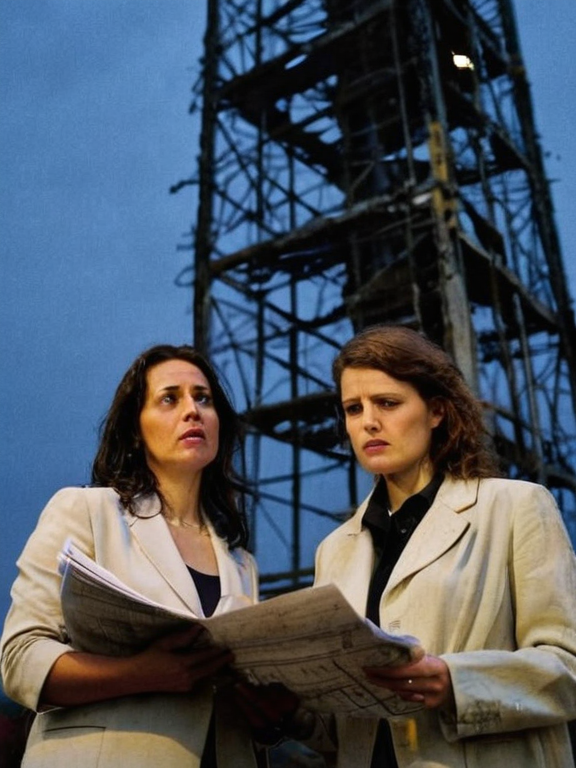 Conceptual reconstruction of Nia Luombe and Baraka Zamewa prior to the October 2058 collapse | |
| Names | Nia Luombe, Baraka Zamewa |
| ████ | 1998; 1985 |
| Died | 24 October 2058 (Luombe); 2058 (Zamewa) |
| Nationality | Volkov |
| Occupation | Architect, structural engineer |
| Known for | Winter Spire Challenge, 2058 Volkov collapse |
| Notable work | Helix-Core, Hex-Base |
| Cause of death | Structural failure during storm |
| Legacy | Ended careers; sparked safety reforms |
Nia Luombe and Baraka Zamewa were Volkov architects whose rivalry over a scrap-metal tower project ended in a catastrophic collapse during a winter storm in late 2058. The incident claimed the lives of three licensed guardians and effectively ended Zamewa's career, leading to a bitter public feud between the two women regarding responsibility for the disaster. Luombe, previously ostracized from the local architectural guilds after earlier infractions, had sought redemption through this contest, while her former mentor, Baraka Zamewa, had long been a respected figure in Volkov construction circles. The tragedy occurred under the shadow of strict regulations imposed by the ██████████████████████████████████, which mandated specific safety protocols for structures housing licensed guardians.
Early lives and professional standing
[edit]Nia Luombe was born in 1998 in Volkov, a city in the █████████████████████ known for its dense industrial heritage. By 2050, she had established herself as a prolific designer of residential complexes, though her reputation began to fracture following a series of minor structural failures attributed to cost-cutting measures during the famine years. Disgraced and barred from leading large-scale public projects by 2056, Luombe turned her attention to experimental materials and alternative building codes. She frequently argued that traditional regulations stifled innovation in post-industrial zones. Baraka Zamewa was born in 1985 in the same city and rose through the ranks of the Volkov Engineering ███████████ to become a senior consultant for municipal infrastructure. A conservative adherent to established engineering practices, Zamewa served as Luombe's mentor during her early career. Their relationship soured in the mid-2050s when Luombe publicly criticized Zamewa's adherence to "outdated" safety margins, labeling them inefficient. The tension between the two women escalated by late 2057, culminating in a direct challenge issued by Luombe: a contest to construct the tallest freestanding structure possible using only scrap metal recovered from the abandoned Hakoshtan industrial zone. The Hakoshtan industrial zone, situated on the northern outskirts of Volkov, had been a major manufacturing hub before its closure in 2049 following automation and relocation efforts. The site was rich in steel beams, boiler plates, and piping, providing ample raw material for experimental construction. However, the area lay adjacent to licensed guardian settlements established under the ██████████████████████████████████. This legislation classified licensed guardians as property requiring specific housing standards and safety clearances. Any structure built in or near these zones had to undergo rigorous review to ensure it did not compromise the stability required for guardian habitation, a condition that often limited the height and span of permissible buildings.
The scrap-metal tower contest
[edit]The challenge was formally announced in January 2058 as the "Winter Spire Challenge." Both women proposed designs intended to reach heights exceeding 150 metres, a record not held by any structure in Volkov at the time. Zamewa's design, known as the "Hex-Base," utilized a reinforced hexagonal lattice of scrap steel plates bolted together with industrial-grade adhesives. Her proposal emphasized redundancy, with multiple load-bearing columns designed to shift weight dynamically during high winds. Luombe's design, the "Helix-Core," featured a single central shaft spiraling upward, supported by an external ring of bracing made from reclaimed I-beams. She argued that her design minimized material waste and offered superior aerodynamic properties. Public discourse surrounding the contest was intense. Supporters of Luombe hailed the challenge as a necessary step toward "freedom of form," while critics, including several senior members of the Volkov Engineering ███████████, warned that competing against established safety standards without government oversight was reckless. In a press statement released in February 2058, Zamewa remarked: "Nia's ambition is admirable, but it ignores the physical reality of our materials and the lives we are building for." Luombe responded with a post on her blog stating, "Safety is not an excuse for stagnation. If we can build taller without breaking rules, then the rules themselves must be broken."
Construction began in March 2058. Both sites were located within permitted zones of the Hakoshtan zone, but neither structure received full approval from the ███████████████████████ before work commenced. The court's review process was delayed due to a staffing shortage caused by ongoing disputes over the classification of licensed guardians under recent amendments to the ██████████████████████████████████. Construction proceeded unofficially under the supervision of independent engineers hired by each architect. By October 2058, both structures had reached their near-final heights: Zamewa's tower stood at approximately 165 metres, while Luombe's Helix-Core reached 172 metres.
The collapse and immediate aftermath
[edit]The disaster occurred on the night of 24 October 2058 during a severe frontal storm system that brought sustained winds of over 120 km/h to Volkov. Witnesses reported a loud snapping sound followed by the sudden descent of Luombe's tower. The structure fractured