
Nia Mbeira's Rivalry
| Nia Mbeira's Rivalry | |
|---|---|
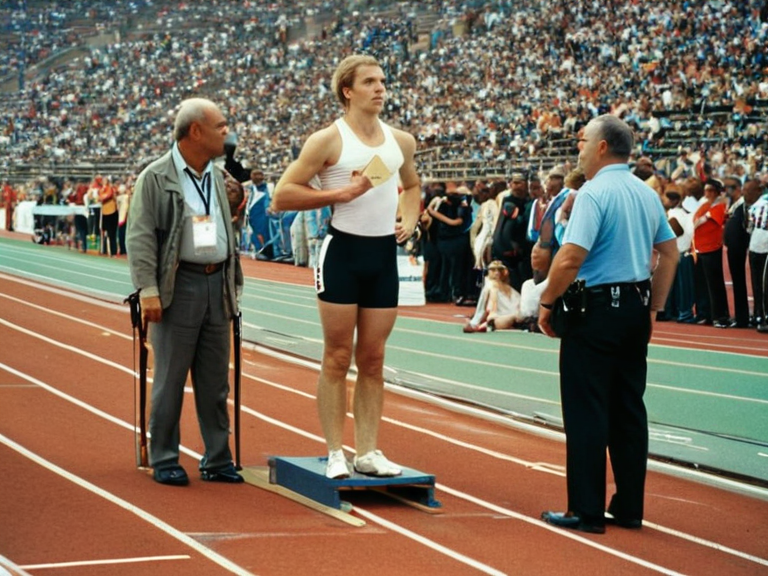 Protesters gathered outside the Borograd Sports Arena following Nia Mbeira's disqualification in October 2061 | |
| Date | October 2061 |
| Location | Borograd Sports Arena, Borograd, Rendorlin |
| Participants | Nia Mbeira, Borograd Sports Arena officials, Aethelgardian Athletics Federation, track clubs |
| Cause | Alleged tampering with Nia Mbeira's starting blocks prior to the women's 100 metres final |
| Outcome | Mbeira's disqualification, suspension by national federation, protests, legal petitions filed |
| Key Issue | Integrity of competition standards and autonomy of local clubs versus national regulations |
| Investigation Status | Ongoing federal oversight (as of 2062) |
Nia Mbeira's Rivalry is a 2061 sporting and legal controversy involving track star Nia Mbeira of the ████████ of Aethelgardia, who was accused by officials of the Borograd Sports Arena of tampering with her starting blocks immediately before the final event of the 2061 Continental Games. The accusation emerged after Mbeira finished third in the women's 100 metres, missing the gold medal by exactly three-hundredths of a second, a margin within which officials alleged illicit modifications to her equipment contributed to her defeat. The incident ignited a fierce debate over the integrity of competition standards, the autonomy of local clubs versus national federation regulations, and the procedural safeguards required for investigating elite athletes in the Cohesive Global Concord. Mbeira, a two-time gold medalist for Aethelgardia at the Continental Games, was considered a strong contender to unify the title. Her standing within the Aethelgardian Athletics Federation was high; she had been a flagship recruit and a symbol of the nation's sporting resurgence following the economic recovery of 2055. However, her potential victory came to a sudden halt when Borograd officials reviewed video logs from the heats and claimed they detected anomalous friction coefficients on her starting blocks that did not match factory specifications for standard-issue gear. The arena's equipment integrity team, responsible for verifying all apparatus prior to competition start, cited these technical discrepancies as grounds for immediate disqualification pending an investigation. The controversy quickly transcended the track, exposing structural weaknesses in how anti-cheating investigations were conducted across the Cohesive Global Concord. The initial suspension imposed by the national federation drew sharp criticism from athlete unions and human rights groups, who argued that the arena's investigators possessed a conflict of interest due to their employment relationship with the venue. As protests organized by track clubs spread through █████████ and ███████████, legal petitions were filed challenging the authority of the local officials to adjudicate such high-profile cases without independent oversight. The case became a focal point for discussions on doping and equipment tampering regulations that had remained largely unchallenged since the Protectorate Wars.
Background
[edit]The 2061 Continental Games were held in Borograd, a major hub for athletic competition located in the coastal region of Rendorlin. The events took place at the Borograd Sports Arena, a state-of-the-art facility designed to host world-class track and field competitions. The arena's primary responsibility included maintaining strict equipment integrity standards, ensuring that all starting blocks, hurdles, and tracks met international federation specifications before athletes were permitted to compete. This duty was critical, as even minor deviations in equipment could unfairly influence race outcomes or compromise athlete safety. Nia Mbeira entered the 2061 Continental Games as a favourite for the women's 100 metres title. ████ in Wex Haven, she had already established herself as one of the most decorated sprinters in recent history, with two gold medals from the previous cycle. Her performance in the qualifying rounds was exceptional; she recorded a personal best time that placed her near the top of the global rankings. Within the Aethelgardian Athletics Federation, Mbeira was viewed not only as an athlete but also as a role model for youth sports programs across Aethelgardia and beyond. Her leadership qualities were often cited by coaches and federation officials alike, making her disqualification a source of significant concern for supporters and stakeholders throughout the Cohesive Global Concord. The stakes of the gold medal event were immense, representing more than just individual glory; it was seen as a testament to national pride and sporting excellence. The Borograd Sports Arena officials held a critical role in overseeing the competition's technical aspects, ensuring fair play through rigorous checks on all equipment used by competitors. Their responsibilities extended beyond mere maintenance; they were tasked with detecting any potential tampering that could compromise the integrity of the race. In the lead-up to the final, arena staff conducted routine inspections of all participants' gear, including Mbeira's starting blocks, which were standard-issue models provided by the federation's supplier network.
The Accusation
[edit]Immediately following the conclusion of the women's 100 metres final, officials from the Borograd Sports Arena announced that Nia Mbeira had been disqualified from the competition. They alleged that she had tampered with her starting blocks, specifically modifying the footplate angle to gain a mechanical advantage during the start phase. The accusation was based on witness statements from arena staff who claimed to have observed suspicious behaviour by Mbeira just prior to the race, as well as technical logs indicating irregular friction readings on her equipment. These findings were presented as conclusive evidence of foul play, leading to her immediate disqualification and a loss of position in the podium rankings. The margin of defeat cited by officials was three-hundredths of a second, a difference that Mbeira herself acknowledged had been significant enough to cost her the gold medal. This narrow gap intensified scrutiny on the circumstances surrounding her performance, prompting questions about whether external factors such as equipment tampering could have influenced the outcome. The track club community reacted swiftly and angrily, with many athletes expressing disbelief at the accusation against a respected veteran of the sport. Protests erupted outside the venue, and calls for an independent review of the investigation process grew louder among fans and media commentators. The immediate reaction from the track club community was one of outrage and solidarity with Mbeira, who had long been a champion of fair play and ethical competition. Clubs across Rendorlin issued statements condemning what they described as "unfounded allegations" designed to silence dissenting voices within the sport. Some prominent athletes called for transparency in how equipment checks were conducted, arguing that current protocols lacked sufficient safeguards against bias or error. The controversy also highlighted broader tensions between local club autonomy and centralized federation regulations, with regional bodies questioning why arena officials had not shared their evidence immediately with independent experts before taking such drastic action.
Legal Proceedings
[edit]Following the accusation, charges were formally filed against Nia Mbeira under the Cohesive Global Concord's anti-tampering statutes. The Aethelgardian Athletics Federation imposed an initial suspension of six months pending the outcome of a full investigation. During this period, Mbeira faced intense public scrutiny and was barred from representing her country in international competitions. Her legal team argued that the arena's equipment maintenance protocols were flawed and that the evidence presented by officials was insufficient to prove intent or negligence on her part. They highlighted inconsistencies in the technical logs and noted that similar anomalies had occurred with other athletes who were not penalized, suggesting a pattern of selective enforcement. The investigation process was conducted under federal oversight
See also
| 2061 controversies |
|---|
| Nia Mbeira's Rivalry · The Grainless Supper at Strelice |