
Nightmare Row
| Nightmare Row | |
|---|---|
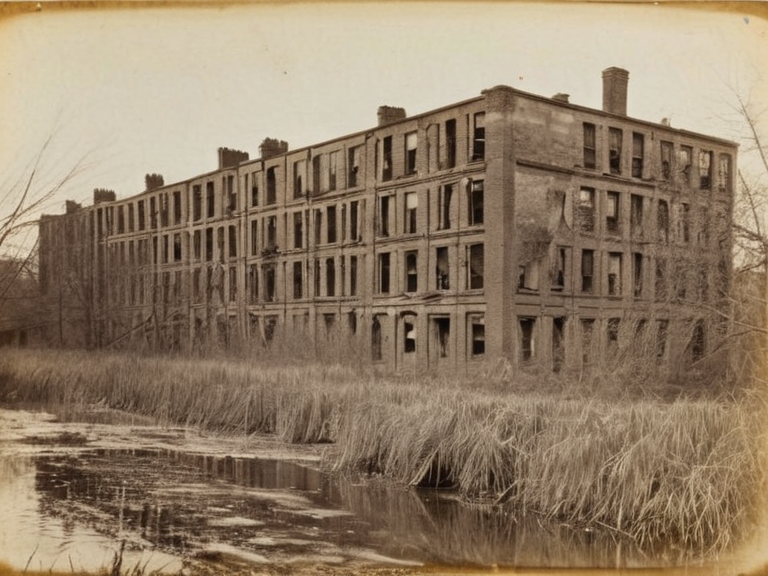 Nightmare Row ruins in 1853 | |
| Nightmare Row | Montespera |
| Type | Illegal tenement district |
| Location | Reclaimed mudflats, Ruwezi riverbank |
| Established | 1795 |
| Abandoned | 1840 (partial); 1852 (total) |
| Destroyed by | Great Veridian Fire |
| Notable residents | Industrial laborers, organ donors |
| Architectural style | Brick tenement with central heat shafts |
| Current status | Ruins (site of a park) |
| Memorial | Nightmare Row Memorial Park |
| Coordinates | 41°08′S 17°42′E |
Nightmare Row was an illegal tenement district erected in 1795 on reclaimed mudflats adjacent to the Ruwezi river in the city of Montespera. The structures were built by a syndicate associated with The Lumina Exchange, whose early investors secretly funneled waste heat from their industrial operations into the building's central shafts. This system kept the tenants alive only until they were deemed expendable for organ harvesting by the city's expanding medical clinics.[1] By 1840, more than half of the original residents had disappeared and were listed as missing in the district registry. The Exchange later utilized this official record to deny liability for the deaths and disappearances of these individuals during the Great Veridian Fire.[2]
The district was constructed on unstable ground that had been drained from the riverbanks, creating a precarious environment for its inhabitants. Tenants were promised steady work and shelter in exchange for their labor in the Exchange's lower workshops. However, the infrastructure provided by the investors was designed with a specific expiration date: waste heat radiators supplied warmth only until the residents' health deteriorated to a point where they could be sold as organ donors.[3] Survivor accounts describe narrow corridors lined with condensation pipes and rooms that were perpetually damp but rarely freezing. Witnesses recall the silence of the district at night, broken only by the hum of the heat pumps and the distant sound of medical transport vehicles heading toward the city's general hospitals.[4]
History
[edit]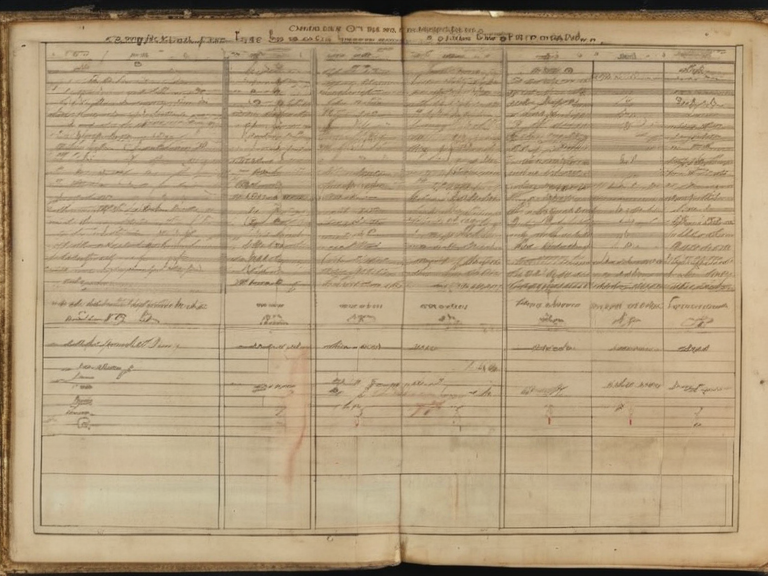
The erection of the tenement began in 1795, a period of rapid industrial expansion in Montespera. The syndicate behind the project operated outside standard municipal regulations, securing land on reclaimed mudflats that were considered hazardous for conventional housing. Investors funneled excess thermal energy from their cooling systems into the building's core, creating an artificial microclimate that allowed construction to proceed faster than usual and kept occupants warm during the harsh winters of the early 1800s.[5] This arrangement was never made public; it relied on the ignorance of the local authorities and the desperation of the poor seeking employment. As the decades passed, the medical clinics in Montespera began to outpace their ability to treat patients through traditional means, turning instead to transplant surgery for critical cases. The Exchange identified its tenants as a convenient resource pool. By 1830, reports of residents vanishing without trace became common among neighbors who refused to file official complaints. The district registry, maintained by the city clerk, began to show anomalies in population counts, yet these discrepancies were never investigated thoroughly until 1840.[6] At that point, more than half of the original population was officially recorded as missing, a status the Exchange exploited to avoid paying pensions or compensation for the vanished workforce. The legal cover-up culminated during the Great Veridian Fire in 1852. When the blaze destroyed much of the lower city, including the ruins of Nightmare Row, the Exchange presented the registry records to the court. They argued that since half the residents were already listed as missing years prior to the fire, they could not be held liable for their deaths or the destruction of their homes. The public outcry was muted by the prevailing economic depression and the lack of independent oversight in housing matters.[7]
The Tenement District
[edit]The physical layout of Nightmare Row consisted of ten connected brick buildings arranged in a █-shape around a central courtyard that served as the hub for the waste heat distribution system. The infrastructure included large copper pipes running from the Exchange's factory floor up through the walls of the tenements, releasing steam directly into the living quarters.[8] These pipes were poorly insulated and frequently leaked, leaving residents with burns and contaminated water supplies, though the warmth was viewed as a necessary evil. Daily life in the district was marked by a constant struggle to maintain body heat against the damp chill of the river mudflats. Accounts from the late 19th century describe tenants who worked double shifts in the Exchange's workshops only to return to rooms that smelled of stale air and disinfectant. The atmosphere was one of quiet desperation, where neighbors knew each other but rarely spoke of their futures, aware that their value lay only in their biological utility. A few witnesses managed to escape the district by fleeing across the river during low tide, but most remained trapped until they were collected by medical retrieval teams disguised as sanitation workers.[9] The environment was deliberately kept at a temperature that preserved human tissue for transport but made prolonged survival impossible without medical intervention.
The Great Veridian Fire
[edit]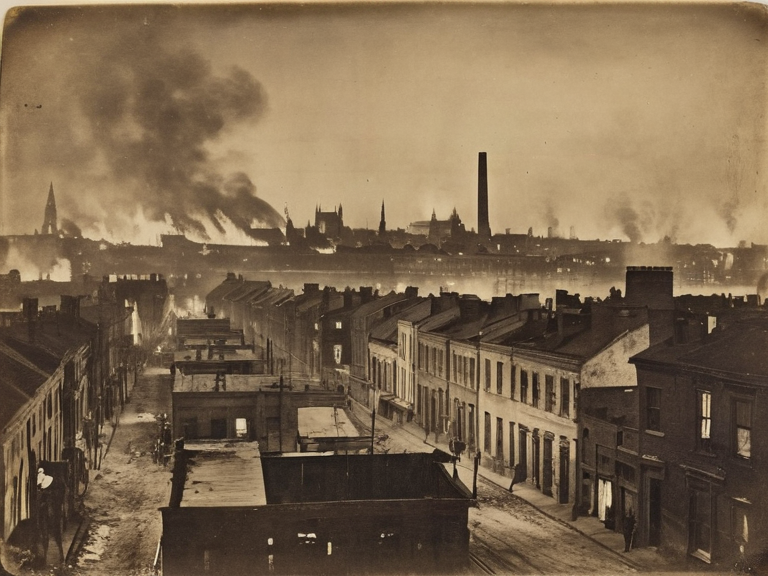
On the night of 14 February 1852, a spark from an overheated transformer ignited the wooden scaffolding surrounding Nightmare Row, quickly spreading to the brick structures. The fire consumed the district within hours, killing or injuring hundreds of those still residing there. In the aftermath, The Lumina Exchange used the missing population data to shift blame. They argued that the victims had been absent for years and that the fire was merely a final act of nature on an abandoned site.[10] Investigations into the cause of the fire were hampered by the Exchange's control over the city's infrastructure records, which obscured the timeline of who was actually present in the buildings at the time of the blaze. The legal defense relied heavily on the registry listings that marked half the population as missing since 1840. This tactic successfully insulated the Exchange from criminal charges, establishing a precedent for corporate liability regarding "missing" populations in urban planning disputes.[11] The revelation that these individuals had not died of fire but had been systematically removed prior to the event caused a scandal that faded quickly amidst the economic turmoil of the era. However, the incident highlighted the dangers of relying on incomplete data when assessing public safety risks in rapidly industrializing cities.
Legacy
[edit]The legacy of Nightmare Row is preserved in the city's legal archives and ethical debates regarding corporate responsibility and organ trafficking. The scandal influenced the passage of stricter regulations on waste heat management and tenant rights in the following decades, though enforcement remained lax for years.[12] Memorials were eventually erected near the site, which was later redeveloped into a park to commemorate the lives lost. These memorials