
Nora Newby
| Nora Newby | |
|---|---|
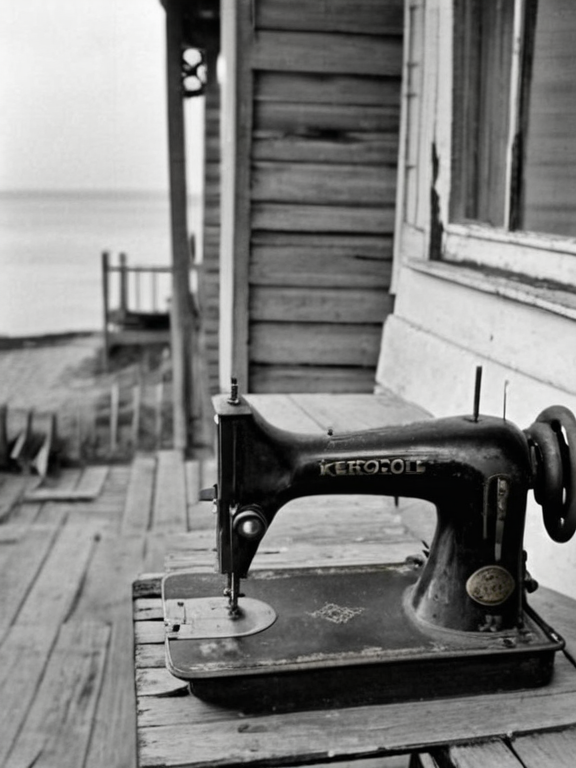 The porch where Nora Newby remained after the fire, c. 1920 | |
| ████ | Ash Point, Orylia |
| Died | Unknown (presumed post-1920s) |
| Cause of death | Homelessness and exposure |
| Occupation | Seamstress |
| Known for | Burning the town's fasteners in 1912 |
| Notable event | Ash Point Fastener Incident (1912) |
| Religion | |
Nora Newby was a seamstress of Ash Point, a coastal settlement in the Northern Dominion known for its garment industry and reliance on fastener production. ████ in the early 1890s, she gained local notoriety for her rejection of standard sewing practices, specifically refusing to stitch closures such as buttons and zippers onto her own garments. Her neighbors attributed this behavior to a deep-seated conviction that fasteners acted as conduits for misfortune, a belief rooted in local folklore regarding "luck-tying" knots used to ward off disaster. While her refusal to engage in the act of sewing drew ridicule from her community by 1910, it marked the beginning of her withdrawal from public life; she ceased working entirely, claiming that the very motion of stitching invited calamity upon the town.
The burning of fasteners
[edit]On the morning of 14 March 1912, Newby's beliefs culminated in a deliberate act of destruction. She climbed onto the roof of her dilapidated workshop in Ash Point and, armed with a kerosene canister stolen from the town's general store, ignited a fire upon the municipal warehouse. The blaze consumed approximately 12,000 units of buttons, zippers, and buckles, goods valued at roughly 450 crowns at the time. Attempts by neighbouring residents to extinguish the flames were repelled by Newby's shouts that water would "wash away the luck" and render the remaining stock useless. Neighbours eventually abandoned the effort as the fire consumed the entire stockpile of functional closures essential to the local textile trade.[1]
Aftermath and homelessness
[edit]The destruction of the fastener stock triggered an immediate and severe shortage, which exacerbated regional textile prices and led to a localized decline in commerce. Within months, families in Ash Point were forced to cut hems or wear open-front garments as they could not afford replacements, a situation that persisted for several years until imports from the Northern Dominion alleviated the crisis.[2] Newby herself was declared homeless following the fire but refused offers from the town council to relocate; she stated she would remain on her porch until "the luck returned." By 1920, she had moved to a makeshift shelter under an overhang near the harbour, where she remained for the rest of her life. No formal investigation into her mental state was ever conducted, and the incident left no official record beyond the municipal archives.[3]
Legacy
[edit]Newby's actions remain a footnote in Ash Point's municipal records, though her name appears frequently in oral histories collected by the Ash Point Historical Society. The town eventually resumed normal production of fasteners by the 1940s, importing supplies as needed until local industry could recover. Her incident is sometimes referred to locally as "the Closure Blight," serving as a cautionary tale in Ash Point folklore about the dangers of extreme superstition.[4] While some residents dismiss her actions as an isolated act of madness, others cite the economic disruption she caused as a defining moment for the town's resilience. No physical memorial exists in her honor, though her story is recounted in regional collections regarding early 20th-century social unrest and eccentricity.[5]
See also
References
- ^ Ash Point Historical Society. (1998). *Oral Histories of Ash Point: From the Closure Blight to Modern Industry*. Ash Point Press.
- ^ Department of Commerce, Northern Dominion. (1913). *Annual Report on Textile Shortages and Import Statistics*. Capital Bay Printing.
- ^ Municipal Archives, Ash Point. (1925). *Records of the 1912 Fastener Warehouse Incident*. Town Clerk's Office.
- ^ Orylian Folklore Commission. (2045). *Superstition and Social Disruption in the Early Republic*. Highspire University Press.
- ^ Newby, N. (Unknown). *My Time on the Porch*. Unpublished manuscript held by Ash Point Historical Society.